

How SaaS Founders Can Rank for Competitor Keywords
How SaaS Founders Can Rank for Competitor Keywords. A practical, evidence-led guide for SaaS founders creating ethical, useful competitor-search content.
Founders often treat launch platforms, directories, competitor pages, and search visibility as separate tactics.
They are more useful when they operate as one discovery system.
This guide is written for SaaS founders creating ethical, useful competitor-search content searching for how to rank for competitor keywords.
Key takeaway: Build pages around real switching decisions, first-hand evidence, pricing tradeoffs, migration effort, and a clear ideal-customer fit—not keyword repetition.
The recommendations below avoid guaranteed ranking claims, artificial link building, fake reviews, copied comparison content, and other shortcuts that create weak buyer experiences. The goal is to help real buyers understand the market and discover the product when it is genuinely relevant.
Competitor keywords are buyer questions
A competitor keyword is not merely a brand name to insert into a page.
It represents a decision:
- Should I stay with the current product?
- Is there a cheaper option?
- Is there an open-source option?
- Which tool fits my team?
- What will migration involve?
- What features will I lose?
- Which product is easier?
- Which product is safer?
- Which product is better for my industry?
The page should answer the decision.
Build a competitor-intent map
For each known product, map:
Alternatives
- Product alternatives
- Free alternatives
- Open-source alternatives
- Cheaper alternatives
- Alternatives for a specific industry
- Alternatives for small teams
Comparisons
- Your product vs competitor
- Competitor vs another competitor
- Feature-specific comparison
- Pricing comparison
- Security comparison
- Migration comparison
Switching
- How to migrate
- Import and export
- Contract timing
- Data portability
- Setup effort
- Training
- Integration replacement
Choose one primary intent per page
Do not create five pages with nearly identical content for minor wording variations.
For example:
- “Photoshop vs Lightroom”
- “Lightroom vs Photoshop”
- “Photoshop Lightroom vs Photoshop”
may belong to one strong canonical comparison page when the underlying decision is the same.
Create separate pages only when the buyer question materially changes.
Evidence required
Google’s helpful-content guidance asks whether content provides original information, substantial analysis, first-hand expertise, and value beyond obvious summaries.
A strong competitor page can include:
- Direct product testing
- Screenshots
- Current pricing
- Official documentation
- Export and migration testing
- Feature limitations
- Ideal customer
- Reasons not to switch
- Setup time
- Support experience
- Real use cases
- Update date
Comparison-page structure
- Direct answer
- Best for each buyer
- Core difference
- Feature matrix
- Pricing
- Limitations
- Migration
- Security and privacy
- Integrations
- Use cases
- Alternatives
- FAQs
- Sources
- CTA
On-page optimization
Use the query naturally in:
- Title
- Main heading
- Introduction
- Comparison table
- Relevant subheadings
- Image alt text
- Internal links
- Metadata
Do not repeat the brand unnaturally.
Google recommends descriptive, concise titles and warns against keyword stuffing.
Internal-link cluster
Link the competitor page to:
- Category page
- Product page
- Pricing
- Migration guide
- Use-case page
- Related comparisons
- Alternative roundup
- Help documentation
Google says every page a site cares about should have a link from another page.
Build trust
Include a section called:
When the competitor is the better choice
This improves buyer trust and helps the product avoid weak, one-sided claims.
Measure qualified outcomes
Track:
- Search impressions
- Clicks
- Comparison-page engagement
- CTA clicks
- Product visits
- Signups
- Activated users
- Migration-guide views
- Sales conversations
- Competitor selected during signup
The goal is not to “steal” a brand keyword. It is to help the buyer make a better decision.
Editorial and operational checklist
Before publishing this page:
- Verify every changing claim
- Use the official product name
- Check all prices and plan names
- Link to primary sources
- Remove duplicate sections
- Confirm the title matches the intent
- Test every internal and external link
- Review mobile formatting
- Add original examples
- Disclose direct experience
- Separate facts from recommendations
- Include who should not use the recommended product
- Confirm the CTA is relevant
- Add the page to the sitemap
- Link to the page from at least one relevant existing page
- Record the review date internally
- Schedule the next accuracy review
For saas founders creating ethical, useful competitor-search content, the best content is not the page that repeats the keyword most often. It is the page that reduces uncertainty and helps the buyer complete the decision.
A 90-day competitor-keyword program
Days 1–15: Research
List:
- Direct competitors
- Category leaders
- Adjacent tools
- Free tools
- Open-source tools
- Legacy tools
- Current customer replacements
- Competitors named during sales calls
Review search queries and customer language.
Days 16–30: Prioritize
Score each page by:
- Buyer intent
- Product fit
- Evidence available
- Search opportunity
- Migration ability
- Commercial value
- Maintenance cost
Choose three pages.
Days 31–60: Produce evidence
Test products.
Collect:
- Pricing
- Screenshots
- Feature availability
- Export options
- Limitations
- Setup effort
- Security
- Support
- Integrations
- Buyer profiles
Days 61–75: Publish
Publish one strong page per distinct intent.
Add internal links from related product and category pages.
Days 76–90: Improve
Review search impressions, engagement, CTA clicks, and buyer questions.
Add missing evidence and clarify recommendations.
Competitor-page brief
Include:
- Primary keyword
- Buyer question
- Search intent
- Direct answer
- Products compared
- Testing method
- Sources
- Main difference
- Pricing
- Feature matrix
- Ideal customer
- Limitations
- Migration
- FAQs
- Internal links
- CTA
- Review owner
- Next review date
Ethical competitor content
Do not:
- Use competitor logos deceptively
- Claim affiliation
- Invent negative reviews
- Misstate pricing
- Hide important limitations
- Copy competitor documentation
- Create fake comparison websites
- Use another brand in a misleading domain
- Promise ranking
The strongest page can recommend the competitor for some buyers.
Trust converts better than hostility.
Page-quality review
Before publication, ask an unaffiliated reviewer:
- Is the recommendation clear?
- Are the comparison criteria fair?
- Is any claim unsupported?
- Does the page explain when the competitor is better?
- Are prices current?
- Is the migration section practical?
- Are screenshots original?
- Does the CTA match the recommendation?
- Does the page add value beyond the competitor’s own site?
- Would the reviewer bookmark or share it?
Google’s people-first guidance suggests asking whether the page provides substantial value and a satisfying experience.
Avoid brand-confusion tactics
Use competitor names only to identify and compare products.
Do not design the page to look like the competitor’s official site.
Do not imply certification, partnership, or endorsement without evidence.
Clear independent positioning protects both buyer trust and brand safety.
Competitor-keyword publishing cadence
Do not publish ten pages in one week and leave them untouched.
A sustainable cadence can be:
- Month 1: one flagship comparison
- Month 2: one alternatives page
- Month 3: one migration guide
- Month 4: one pricing comparison
- Month 5: refresh the first page
- Month 6: publish the next competitor cluster
This gives the team time to test products, collect evidence, build internal links, and review performance.
Quality improves when each page teaches the team something about the market.
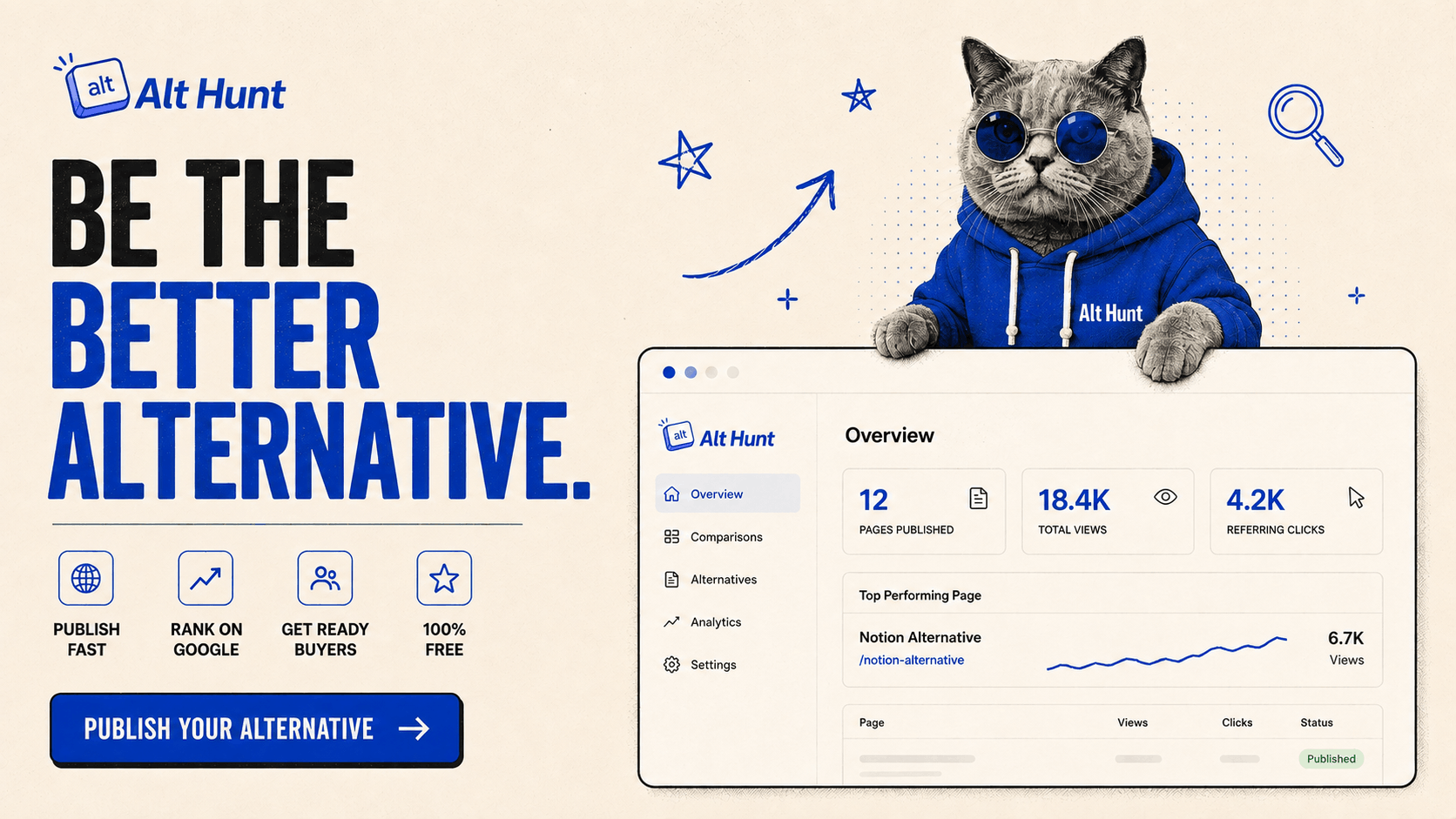
Alt Hunt helps SaaS makers publish alternative pages, comparison matrices, pricing tradeoffs, migration guides, and objection-handling content for buyers already evaluating software.
Alt Hunt is not a generic backlink service.
It is not a promise that publishing one page will create rankings.
Its role is to give founders a structured place to explain:
- Which known product they replace
- Who should switch
- Who should not switch
- Pricing differences
- Feature tradeoffs
- Migration effort
- Best use cases
- Limitations
- Sources and evidence
- Frequently asked questions
Core publishing is free.
Publish an alternative page on Alt Hunt
Frequently asked questions
Does publishing a page guarantee Google rankings?
No. Technical eligibility and good content do not guarantee crawling, indexing, ranking, traffic, or inclusion in AI-powered search experiences.
Should a founder publish hundreds of thin pages?
No. Publish pages only when the intent is distinct and the content provides original evidence, useful analysis, or a clear buyer decision.
No. Alt Hunt is an evergreen competitor-search discovery layer. Launch communities are better for live attention, feedback, and discussion.
How often should comparison pages be updated?
Review them after major product or competitor changes and run a broader accuracy review at least quarterly.
Should competitor claims link to sources?
Yes. Link to official pricing, documentation, changelogs, and direct evidence when the claim can change or materially affects the recommendation.
What is the most important measurement?
Measure qualified discovery: activated users, demos, retained customers, relevant referrals, and buyer questions—not only page views or backlinks.
- Do SaaS Directory Backlinks Still Work in 2026?
- Startup Directory Submission Strategy: Where to List First
- How Many Directories Should You Submit Your SaaS To?
- Alternative Pages SEO: How to Rank for ‘Alternative to X’ Keywords
- How to Get Your SaaS Discovered by Google and AI Search
- Top 10 Product Hunt Alternatives to Launch Your SaaS in 2026
Official sources and further reading
- https://developers.google.com/search/docs/fundamentals/creating-helpful-content
- https://developers.google.com/search/docs/appearance/reviews-system
- https://developers.google.com/search/docs/crawling-indexing/links-crawlable
- https://developers.google.com/search/docs/appearance/title-link
- https://developers.google.com/search/docs/essentials
- https://althunt.io
Search guidance, launch-platform features, submission rules, pricing, and indexing behavior can change. Verify official sources before publishing or acting on the advice.
About the Author

Building Inspo AI | AI-Powered Design Research & Builder Platform | Design Engineer.