
How to Get Your SaaS Discovered by Google and AI Search
How to Get Your SaaS Discovered by Google and AI Search. A practical, evidence-led guide for SaaS founders building discoverability across Google and AI-assis
Founders often treat launch platforms, directories, competitor pages, and search visibility as separate tactics.
They are more useful when they operate as one discovery system.
This guide is written for SaaS founders building discoverability across Google and AI-assisted search searching for how to get recommended by chatgpt.
Key takeaway: Focus on crawlable, indexed, unique, evidence-rich pages and a clear technical structure; there is no guaranteed AI recommendation hack.
The recommendations below avoid guaranteed ranking claims, artificial link building, fake reviews, copied comparison content, and other shortcuts that create weak buyer experiences. The goal is to help real buyers understand the market and discover the product when it is genuinely relevant.
Begin with the honest limitation
No founder can force Google, ChatGPT, or another AI system to recommend a SaaS product.
There is no guaranteed prompt, schema type, backlink package, llms.txt file, or content format that guarantees inclusion.
Google’s official guidance for AI Overviews and AI Mode says the same foundational SEO practices remain relevant. Pages must be indexed and eligible for Google Search with a snippet. There are no additional technical requirements for those AI features.
Build a crawlable website
Public pages
Important product information should not be hidden entirely behind login.
Crawlable links
Use normal HTML links with descriptive anchor text.
Robots and access
Do not accidentally block important pages in robots.txt, CDN rules, or authentication.
Canonicals
Use clear canonical URLs and reduce duplicates.
Sitemap
Submit a sitemap for important pages and updates.
Textual content
Important facts should be available as text, not only images, video, or client-side interactions.
Publish non-commodity evidence
Google’s current generative-AI optimization guide emphasizes unique, valuable, non-commodity content.
For a SaaS company, this can include:
- Original benchmark
- First-hand product comparison
- Migration test
- Pricing calculator
- Template
- Dataset
- Customer workflow
- Technical architecture
- Security explanation
- Industry-specific guide
- Honest product limitation
- Changelog
- Public documentation
- API examples
A generic article that repeats common advice gives systems little reason to select it.
Build entity consistency
Use one consistent product identity:
- Name
- Website
- Logo
- Category
- Founder or company
- Pricing
- Description
- Social profiles
- Support details
- Documentation
- Product status
Maintain this information across the website, directories, launch pages, and comparison pages.
Create pages for real buyer questions
Publish:
- Alternatives
- Head-to-head comparisons
- Pricing explanations
- Migration guides
- Industry workflows
- Security
- Integrations
- Templates
- How-to guides
- Limitations
- Troubleshooting
Do not create a separate page for every tiny wording variation.
Use sources and visible evidence
Cite official pricing, documentation, research, and direct product testing.
Explain:
- Who created the content
- How the comparison was produced
- Why the page exists
- What was tested
- What remains uncertain
Google’s people-first guidance specifically encourages clarity around who, how, and why.
Structured data
Structured data can help systems understand page meaning and can support eligibility for rich results.
It must match the visible page.
There is no special schema type required for Google’s AI features.
Use appropriate structured data only when the page qualifies.
Images and video
Add original:
- Product screenshots
- Workflow videos
- Architecture diagrams
- Migration screenshots
- Comparison visuals
- Calculator results
- Template previews
Use descriptive filenames and alt text.
Internal linking
Connect:
- Homepage
- Product pages
- Category pages
- Alternative pages
- Comparison pages
- Migration guides
- Documentation
- Pricing
- Case studies
Avoid orphan pages.
Third-party evidence
Useful third-party surfaces can include:
- Product Hunt
- BetaList
- Uneed
- SaaS directories
- Integration marketplaces
- Open-source repositories
- Community discussions
- Customer reviews
- Alt Hunt comparisons
Do not seek fake mentions or manufactured reviews.
What about llms.txt?
A website may maintain llms.txt for systems that choose to use it.
Google’s current generative-AI optimization guide says llms.txt neither helps nor harms visibility or rankings in Google Search because Google ignores it.
Do not treat it as a replacement for crawlable pages, internal links, sitemaps, and useful content.
Measurement
Track:
- Search Console impressions
- Search clicks
- Branded queries
- Non-branded category queries
- Competitor queries
- Comparison-page visits
- Referral sources
- Activated users
- AI-search referrals where identifiable
- Citations or mentions discovered manually
- Conversion by landing page
A 90-day plan
Days 1–30
Fix crawlability, sitemap, canonicals, titles, metadata, internal links, product pages, and documentation.
Days 31–60
Publish three strong competitor pages, one migration guide, one original tool or template, and one customer workflow.
Days 61–90
Refresh directory profiles, publish an original benchmark or dataset, improve visuals, add FAQs, and review performance.
The durable strategy is simple:
Create evidence people value. Make it crawlable. Keep it accurate. Connect it clearly.
Editorial and operational checklist
Before publishing this page:
- Verify every changing claim
- Use the official product name
- Check all prices and plan names
- Link to primary sources
- Remove duplicate sections
- Confirm the title matches the intent
- Test every internal and external link
- Review mobile formatting
- Add original examples
- Disclose direct experience
- Separate facts from recommendations
- Include who should not use the recommended product
- Confirm the CTA is relevant
- Add the page to the sitemap
- Link to the page from at least one relevant existing page
- Record the review date internally
- Schedule the next accuracy review
For saas founders building discoverability across google and ai-assisted search, the best content is not the page that repeats the keyword most often. It is the page that reduces uncertainty and helps the buyer complete the decision.
AI-discovery website audit
Score the website from zero to two for each item:
Comparison Matrix
2026 Verified| Area | 0 | 1 | 2 |
|---|---|---|---|
| Crawlability | Blocked or hidden | Partial | Important pages accessible |
| Indexing | Unknown | Some pages | Search Console monitored |
| Product clarity | Vague | Understandable | Specific buyer and outcome |
| Evidence | Claims only | Some proof | Original, sourced proof |
| Comparisons | None | Thin | Detailed and maintained |
| Documentation | Missing | Basic | Complete and public |
| Entity consistency | Conflicting | Mostly consistent | Consistent across surfaces |
| Internal links | Orphan pages | Partial | Clear content graph |
| Structured data | Incorrect | Limited | Appropriate and matching |
| Page experience | Poor | Acceptable | Fast and usable |
| Original media | None | Stock | Product-specific visuals |
| Update process | None | Informal | Assigned and scheduled |
Content portfolio for AI discovery
Publish a balanced portfolio:
- Homepage
- Product pages
- Pricing
- Documentation
- Security
- Integrations
- Case studies
- Benchmarks
- Templates
- Alternatives
- Comparisons
- Migration guides
- Glossary
- Changelog
- Founder or company information
This gives search and AI systems several forms of evidence.
Avoid AI-search myths
Do not rely on:
- Keyword stuffing
- Hidden text
- Thousands of near-duplicate pages
- Fake third-party mentions
- Fake reviews
- Schema that does not match the page
- Unverified “AI ranking scores”
- Paying for guaranteed citations
- Rewriting every sentence as a question
- Creating pages only for machines
Google’s current guidance says there is no need to rewrite content specifically for generative AI search or create unnecessary pages for every query variation.
Useful content remains the foundation.
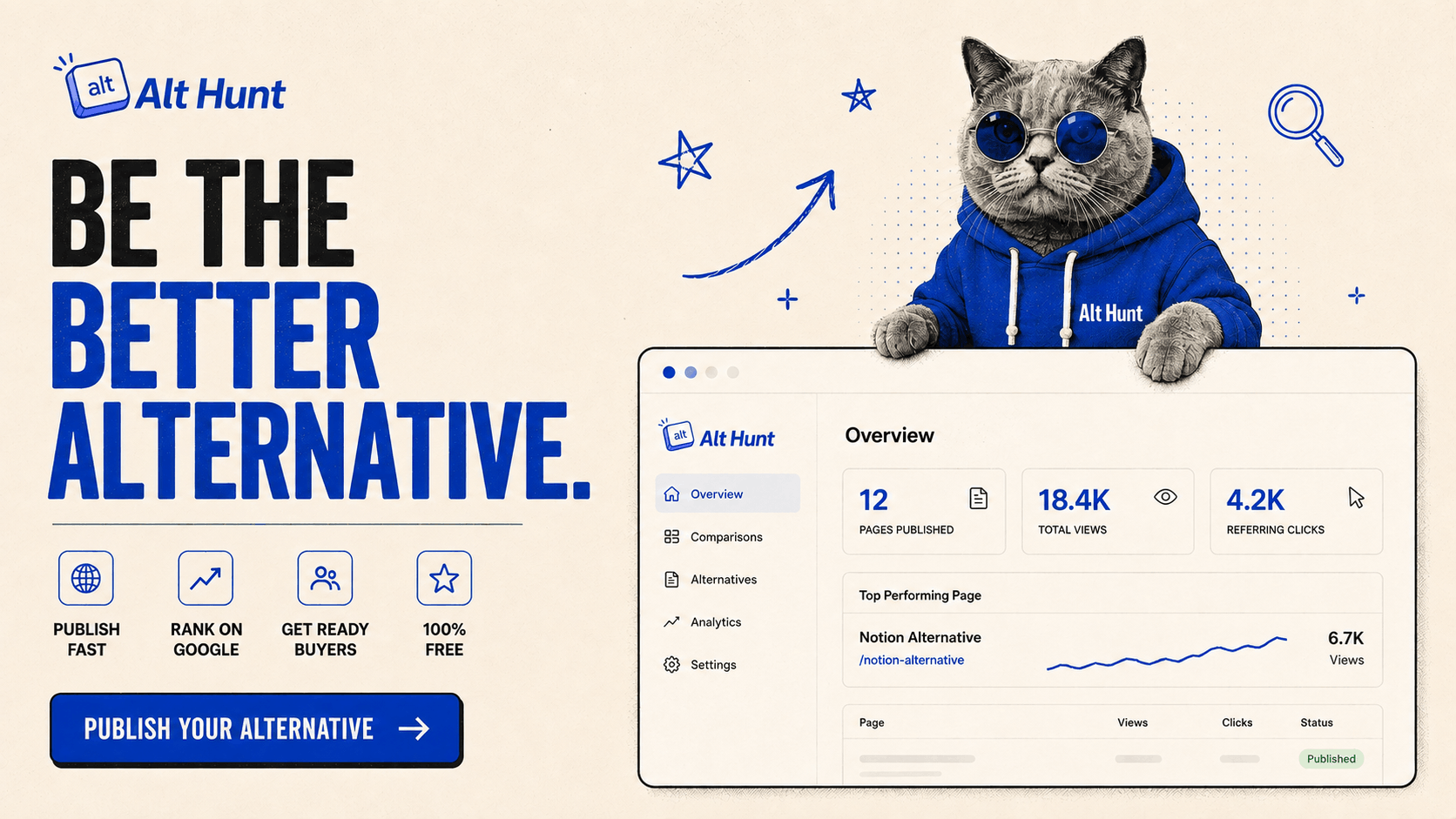
Alt Hunt helps SaaS makers publish alternative pages, comparison matrices, pricing tradeoffs, migration guides, and objection-handling content for buyers already evaluating software.
Alt Hunt is not a generic backlink service.
It is not a promise that publishing one page will create rankings.
Its role is to give founders a structured place to explain:
- Which known product they replace
- Who should switch
- Who should not switch
- Pricing differences
- Feature tradeoffs
- Migration effort
- Best use cases
- Limitations
- Sources and evidence
- Frequently asked questions
Core publishing is free.
Publish an alternative page on Alt Hunt
Frequently asked questions
Does publishing a page guarantee Google rankings?
No. Technical eligibility and good content do not guarantee crawling, indexing, ranking, traffic, or inclusion in AI-powered search experiences.
Should a founder publish hundreds of thin pages?
No. Publish pages only when the intent is distinct and the content provides original evidence, useful analysis, or a clear buyer decision.
No. Alt Hunt is an evergreen competitor-search discovery layer. Launch communities are better for live attention, feedback, and discussion.
How often should comparison pages be updated?
Review them after major product or competitor changes and run a broader accuracy review at least quarterly.
Should competitor claims link to sources?
Yes. Link to official pricing, documentation, changelogs, and direct evidence when the claim can change or materially affects the recommendation.
What is the most important measurement?
Measure qualified discovery: activated users, demos, retained customers, relevant referrals, and buyer questions—not only page views or backlinks.
- 25 AI Tool Directories to Submit Your Product in 2026
- 20 Free AI Tool Directories for More Visibility in 2026
- Evergreen Product Launch Strategy: Grow Beyond Launch Day
- Launch-Day Traffic vs SEO: Which Drives Better SaaS Growth?
- How SaaS Founders Can Rank for Competitor Keywords
- Alternative Pages SEO: How to Rank for ‘Alternative to X’ Keywords
Official sources and further reading
- https://developers.google.com/search/docs/appearance/ai-features
- https://developers.google.com/search/docs/fundamentals/ai-optimization-guide
- https://developers.google.com/search/docs/fundamentals/creating-helpful-content
- https://developers.google.com/search/docs/crawling-indexing
- https://developers.google.com/search/docs/appearance/structured-data/intro-structured-data
- https://developers.google.com/search/docs/appearance/structured-data/sd-policies
- https://althunt.io
Search guidance, launch-platform features, submission rules, pricing, and indexing behavior can change. Verify official sources before publishing or acting on the advice.
About the Author

Building Inspo AI | AI-Powered Design Research & Builder Platform | Design Engineer.