
Do SaaS Directory Backlinks Still Work in 2026?
Do SaaS Directory Backlinks Still Work in 2026?. A practical, evidence-led guide for SaaS founders deciding whether directory submissions are worth the time.
Founders often treat launch platforms, directories, competitor pages, and search visibility as separate tactics.
They are more useful when they operate as one discovery system.
This guide is written for SaaS founders deciding whether directory submissions are worth the time searching for saas directory backlinks.
Key takeaway: Directory links can support discovery, crawling, referrals, and brand consistency, but low-quality bulk submissions are not a reliable ranking shortcut.
The recommendations below avoid guaranteed ranking claims, artificial link building, fake reviews, copied comparison content, and other shortcuts that create weak buyer experiences. The goal is to help real buyers understand the market and discover the product when it is genuinely relevant.
The honest answer
SaaS directory backlinks can still be useful.
But “useful” does not mean every directory link will improve rankings.
Google states that links help it discover pages and can act as a relevance signal. It also maintains spam policies against manipulative practices. That creates an important distinction:
- A relevant directory profile that helps buyers find and understand a product can be useful.
- A mass submission campaign created only to manufacture ranking signals can become low-value work.
- Paid, sponsored, or user-generated links should be qualified appropriately by the publishing platform.
- A link can produce value through referral traffic and discovery even when it does not pass a traditional ranking signal.
What a good directory listing can do
Help discovery
Google primarily finds many pages through links from pages it already knows. A crawlable directory link can help crawlers and people find the SaaS website.
Create referral traffic
A relevant category page can send buyers comparing software. This is often more valuable than the abstract idea of “link juice.”
Confirm product information
Accurate profiles repeat the official product name, category, website, pricing model, audience, and positioning.
Create a third-party citation
A credible external page gives buyers another place to verify that the product exists and understand its category.
Support branded search
As founders publish profiles across trusted platforms, buyers can encounter consistent product information in several places.
Create a persistent launch record
Some directory and launch pages remain online after the original launch.
What a directory backlink cannot guarantee
A directory link cannot guarantee:
- Crawling
- Indexing
- Ranking
- A specific authority score
- AI recommendations
- Referral traffic
- Customer conversion
- Protection from algorithm changes
Google’s Search Essentials explicitly says that meeting best practices does not guarantee that content will be crawled, indexed, or served.
Directory-link value hierarchy
Tier 1: Buyer-intent directories
These organize products by category, alternatives, use case, or switching decision.
Examples include alternatives directories and focused SaaS discovery platforms.
Tier 2: Launch and early-adopter platforms
These create a launch page, comments, reviews, or a product record.
Tier 3: Ecosystem directories
Integration marketplaces, partner directories, app stores, template galleries, and developer ecosystems can send highly qualified traffic.
Tier 4: Professional and community profiles
Founder profiles, community product pages, and niche associations can build trust.
Tier 5: Generic submission sites
These may offer little audience relevance, weak editorial standards, and minimal traffic.
Start with the highest tiers.
How to evaluate a directory before submitting
Score the platform from one to five:
Comparison Matrix
2026 Verified| Area | Question |
|---|---|
| Audience | Are likely buyers present? |
| Relevance | Does the category match the product? |
| Activity | Are new and existing pages maintained? |
| Indexing | Can public pages be found in search? |
| Link quality | Is the product link crawlable and correctly attributed? |
| Profile depth | Can the listing explain the product properly? |
| Update access | Can founders correct pricing and positioning later? |
| Trust | Are listings moderated or clearly disclosed? |
| Traffic | Does the platform send useful visitors? |
| Effort | Is the submission worth the founder’s time? |
The danger of bulk directory automation
Mass automation can create:
- Incorrect categories
- Broken descriptions
- Duplicate titles
- Old pricing
- Wrong founder details
- Spammy anchor text
- Listings on inactive websites
- Accounts that cannot be updated
- Paid links without disclosure
- Hundreds of profiles that nobody maintains
The result can harm trust even when it does not trigger a search penalty.
A better directory workflow
- Create one source-of-truth product record.
- Select ten highly relevant platforms.
- Submit manually or review every automated submission.
- Use descriptive, natural copy.
- Verify the published page.
- Track referral traffic and activation.
- Correct errors.
- Expand only after the first group is maintained.
- Refresh profiles after major product changes.
- Remove obviously misleading or outdated listings when possible.
Do SaaS directory backlinks still work?
They work when “work” means creating relevant discovery, trusted references, crawlable paths, and useful referral traffic.
They are unreliable when “work” means buying or generating large numbers of links to force rankings.
Treat each directory as a product page for a specific audience—not as a backlink count.
Editorial and operational checklist
Before publishing this page:
- Verify every changing claim
- Use the official product name
- Check all prices and plan names
- Link to primary sources
- Remove duplicate sections
- Confirm the title matches the intent
- Test every internal and external link
- Review mobile formatting
- Add original examples
- Disclose direct experience
- Separate facts from recommendations
- Include who should not use the recommended product
- Confirm the CTA is relevant
- Add the page to the sitemap
- Link to the page from at least one relevant existing page
- Record the review date internally
- Schedule the next accuracy review
For saas founders deciding whether directory submissions are worth the time, the best content is not the page that repeats the keyword most often. It is the page that reduces uncertainty and helps the buyer complete the decision.
How to measure directory ROI
Create a quarterly directory report.
Track:
- Directory name
- Public profile URL
- Category
- Link type when visible
- Referral visitors
- Signups
- Activated users
- Revenue
- Branded-search assists
- Profile accuracy
- Last reviewed
- Maintenance owner
Do not remove a listing only because it sends little direct traffic. It may still help buyers verify the product or discover it through a category search.
However, a directory with no relevant audience, broken pages, inaccurate data, or aggressive paid-link behavior deserves lower priority.
Link qualification and disclosure
Google recommends qualifying paid links with `sponsored` or `nofollow` and user-generated links with `ugc` or `nofollow` where appropriate.
The directory controls its link markup, not the SaaS founder.
Founders should not demand that a paid listing hide the commercial relationship.
A trustworthy profile is more valuable than an undisclosed paid link.
Directory backlinks versus earned editorial links
A directory listing is created through a submission process.
An editorial link is earned when another publisher independently references the product, research, template, comparison, or data.
The two can coexist.
Directories build baseline visibility. Original assets create reasons for publishers and communities to cite the company naturally.
Linkable SaaS assets include:
- Benchmarks
- Calculators
- Templates
- Original datasets
- Open-source projects
- Research
- Migration guides
- Detailed comparisons
- Security documentation
- Public APIs
- Industry reports
A directory strategy should support—not replace—useful product-led assets.
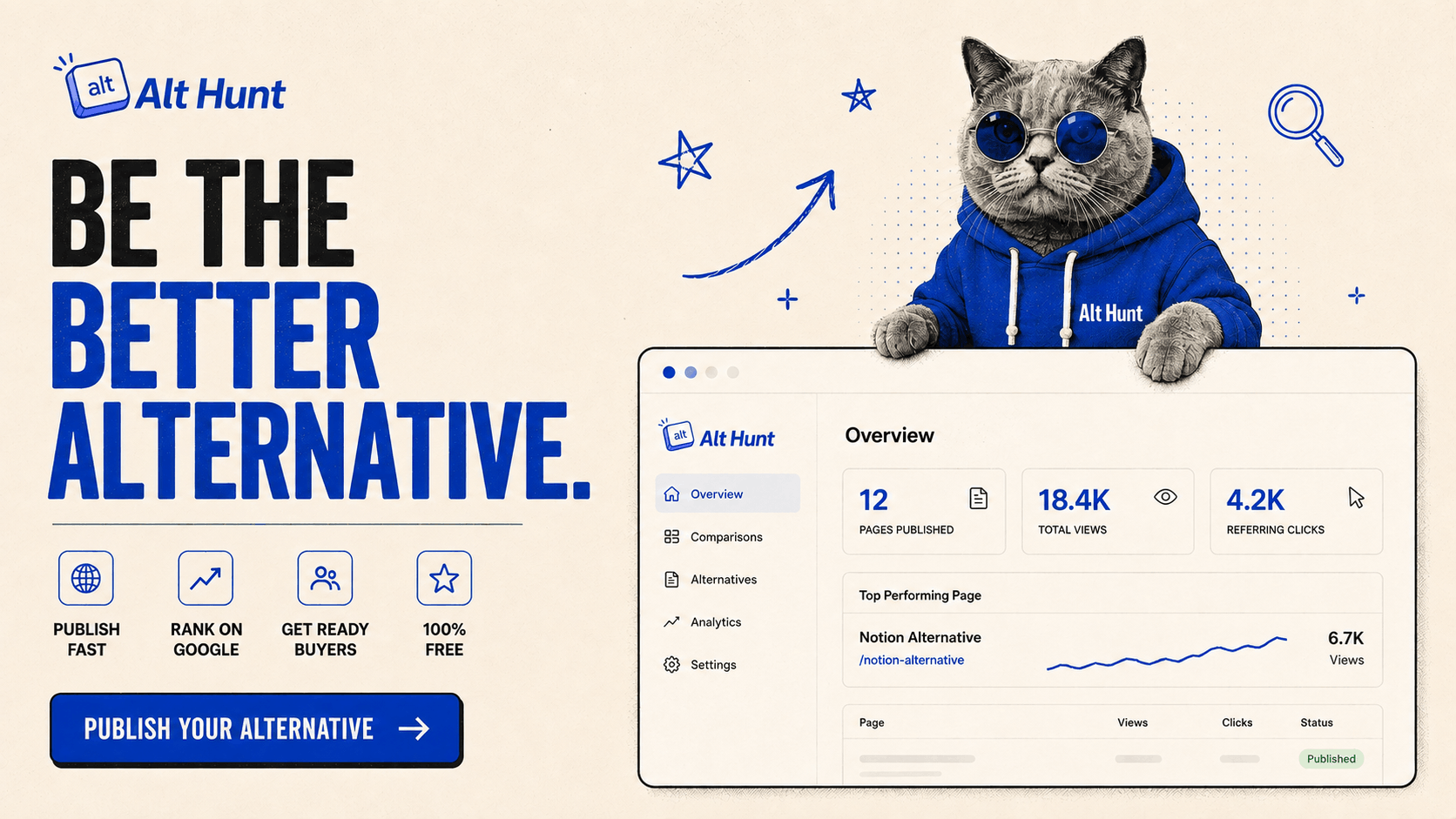
Alt Hunt helps SaaS makers publish alternative pages, comparison matrices, pricing tradeoffs, migration guides, and objection-handling content for buyers already evaluating software.
Alt Hunt is not a generic backlink service.
It is not a promise that publishing one page will create rankings.
Its role is to give founders a structured place to explain:
- Which known product they replace
- Who should switch
- Who should not switch
- Pricing differences
- Feature tradeoffs
- Migration effort
- Best use cases
- Limitations
- Sources and evidence
- Frequently asked questions
Core publishing is free.
Publish an alternative page on Alt Hunt
Frequently asked questions
Does publishing a page guarantee Google rankings?
No. Technical eligibility and good content do not guarantee crawling, indexing, ranking, traffic, or inclusion in AI-powered search experiences.
Should a founder publish hundreds of thin pages?
No. Publish pages only when the intent is distinct and the content provides original evidence, useful analysis, or a clear buyer decision.
No. Alt Hunt is an evergreen competitor-search discovery layer. Launch communities are better for live attention, feedback, and discussion.
How often should comparison pages be updated?
Review them after major product or competitor changes and run a broader accuracy review at least quarterly.
Should competitor claims link to sources?
Yes. Link to official pricing, documentation, changelogs, and direct evidence when the claim can change or materially affects the recommendation.
What is the most important measurement?
Measure qualified discovery: activated users, demos, retained customers, relevant referrals, and buyer questions—not only page views or backlinks.
- 25 Free Startup Directories That Still Accept Submissions in 2026
- 30 SaaS Directories to Submit Your Product in 2026
- 12 Best Startup Directories for Traffic and Backlinks in 2026
- Startup Directory Submission Strategy: Where to List First
- How Many Directories Should You Submit Your SaaS To?
- How SaaS Founders Can Rank for Competitor Keywords
Official sources and further reading
- https://developers.google.com/search/docs/crawling-indexing/links-crawlable
- https://developers.google.com/search/docs/fundamentals/seo-starter-guide
- https://developers.google.com/search/docs/essentials/spam-policies
- https://developers.google.com/search/docs/fundamentals/creating-helpful-content
- https://althunt.io
Search guidance, launch-platform features, submission rules, pricing, and indexing behavior can change. Verify official sources before publishing or acting on the advice.
About the Author

Building Inspo AI | AI-Powered Design Research & Builder Platform | Design Engineer.