

Startup Directory Submission Strategy: Where to List First
Startup Directory Submission Strategy: Where to List First. A practical, evidence-led guide for startup founders building a focused directory-distribution pla
Founders often treat launch platforms, directories, competitor pages, and search visibility as separate tactics.
They are more useful when they operate as one discovery system.
This guide is written for startup founders building a focused directory-distribution plan searching for startup directory submission strategy.
Key takeaway: Prioritize buyer relevance, active pages, profile longevity, accurate data, and measurable traffic instead of submitting everywhere at once.
The recommendations below avoid guaranteed ranking claims, artificial link building, fake reviews, copied comparison content, and other shortcuts that create weak buyer experiences. The goal is to help real buyers understand the market and discover the product when it is genuinely relevant.
Start with the buyer journey
A founder should not begin with a spreadsheet of 500 directories.
Begin with where the buyer discovers, evaluates, validates, and adopts software.
Discovery
Launch platforms, newsletters, communities, and category directories introduce the product.
Evaluation
Alternatives directories, comparison pages, reviews, pricing pages, and use-case pages help the buyer compare.
Validation
Founder profiles, product documentation, customer evidence, public roadmaps, and established directories increase trust.
Adoption
App stores, integration directories, marketplaces, templates, and migration guides help the buyer start.
The strongest directory plan covers each stage.
Priority group 1: The primary launch page
Choose a public platform that fits the product.
Product Hunt is a broad launch community. BetaList is designed for relatively new or unreleased technology startups. Uneed offers a free waiting line and rolling leaderboards. A developer tool may fit Show HN or Peerlist.
Do not schedule every launch surface on the same day.
Priority group 2: Competitor and alternatives discovery
List the product where buyers search for replacements.
Create pages for:
- Alternative to the category leader
- Product A vs Product B
- Cheaper alternative
- Open-source alternative
- Privacy-focused alternative
- Migration from the current tool
Alt Hunt is designed for this group.
Priority group 3: Category directories
Choose platforms with relevant categories and active product pages.
A payroll SaaS belongs in HR and finance directories. A developer API belongs in developer-tool and integration directories. An AI design product belongs in AI and design directories.
Priority group 4: Ecosystem directories
Prioritize:
- Integration marketplaces
- App stores
- Plugin directories
- Template galleries
- Partner listings
- Cloud marketplaces
- Open-source package registries
These can produce higher-intent users because the buyer is already inside the ecosystem.
Priority group 5: Founder and community profiles
Maintain accurate profiles on communities where the founder participates.
These are useful when the profile supports real conversation and proof.
A directory scoring model
Assign each candidate:
- Buyer relevance: 0–5
- Editorial quality: 0–5
- Profile depth: 0–5
- Persistent page: 0–5
- Referral potential: 0–5
- Search visibility: 0–5
- Update control: 0–5
- Submission effort: subtract 0–5
- Cost: subtract 0–5
Prioritize the highest total.
The first 15 submissions
A practical initial portfolio can include:
- One primary launch platform
- One early-stage platform
- One maker community
- Two alternatives or comparison platforms
- Three category directories
- Two ecosystem listings
- Two founder/community profiles
- Two niche buyer directories
- One Alt Hunt comparison page
This is a recommendation, not a search-engine rule.
Submission source document
Keep:
- Product name
- Canonical URL
- Short description
- Long description
- Category
- Target user
- Pricing
- Free trial
- Logo
- Screenshots
- Demo
- Founder names
- Social links
- Support
- Privacy
- Terms
- Competitors
- Integrations
- Launch date
Where to list first
List first where:
- Buyers are active
- The page will remain public
- The product can be explained accurately
- Founders can update the profile
- Traffic can be tracked
- The platform’s rules are clear
- The listing supports the real buyer journey
Submit to fewer strong platforms before expanding.
Editorial and operational checklist
Before publishing this page:
- Verify every changing claim
- Use the official product name
- Check all prices and plan names
- Link to primary sources
- Remove duplicate sections
- Confirm the title matches the intent
- Test every internal and external link
- Review mobile formatting
- Add original examples
- Disclose direct experience
- Separate facts from recommendations
- Include who should not use the recommended product
- Confirm the CTA is relevant
- Add the page to the sitemap
- Link to the page from at least one relevant existing page
- Record the review date internally
- Schedule the next accuracy review
For startup founders building a focused directory-distribution plan, the best content is not the page that repeats the keyword most often. It is the page that reduces uncertainty and helps the buyer complete the decision.
A 90-day directory submission calendar
Days 1–15: Foundation
Create the source-of-truth product record. Audit the homepage, pricing, screenshots, demo, privacy, terms, founder profiles, and analytics.
Select the first ten platforms using the scoring model.
Days 16–30: Primary surfaces
Publish the primary launch page, early-stage listing when eligible, one category directory, one alternatives profile, and the first Alt Hunt page.
Verify every live profile.
Days 31–45: Category depth
Add relevant vertical and buyer directories. Avoid unrelated categories.
Days 46–60: Ecosystems
Publish integration listings, marketplace profiles, plugins, templates, and partner pages.
Days 61–75: Community and founder proof
Improve founder profiles and participate in communities where the buyers or builders are active.
Days 76–90: Review
Compare referral traffic, activation, profile visibility, and maintenance cost.
Expand only where the first wave produced value.
Avoid directory-copy duplication
Using the same factual description across profiles is not automatically harmful, but every platform may need a different emphasis.
A Product Hunt description should explain the launch.
A BetaList page should explain early access.
A category directory should explain the workflow.
An alternatives page should explain why a buyer would switch.
An integration directory should explain the connection.
Adapt the message without changing the facts.
Keep one canonical product website
Directory profiles should link to the main approved website or the most relevant landing page.
Avoid using several accidental URL variations, staging domains, tracking redirects that never resolve cleanly, or old domains.
Use campaign parameters when helpful, but keep the destination stable.
Submission status system
Use these statuses:
- Researching
- Eligible
- Submitted
- Under review
- Published
- Rejected
- Paid only
- Badge required
- Needs correction
- Archived
For each submission, save the login email, profile URL, submission date, category, cost, renewal date, and owner.
This turns directory distribution into an operating process rather than a one-time spreadsheet.
Rejection handling
A rejection can reveal:
- Product is too early
- Product is too mature
- Landing page is weak
- Category is wrong
- Description is unclear
- Platform does not accept the business model
- Submission violates editorial rules
Do not repeatedly resubmit without fixing the reason.
Use the feedback to improve the product page or select a better platform.
Final priority test
Before submitting to any new directory, answer yes or no:
- Does this platform reach a plausible buyer?
- Is the category relevant?
- Is the public page active?
- Can the product be described accurately?
- Will the listing remain useful after launch?
- Can the team update it?
- Can the traffic be measured?
- Are the rules transparent?
- Is the cost justified?
- Would a customer trust the page?
Submit only when most answers are yes.
A directory strategy succeeds when it creates a maintained network of useful product references—not when the submission counter reaches a large number.
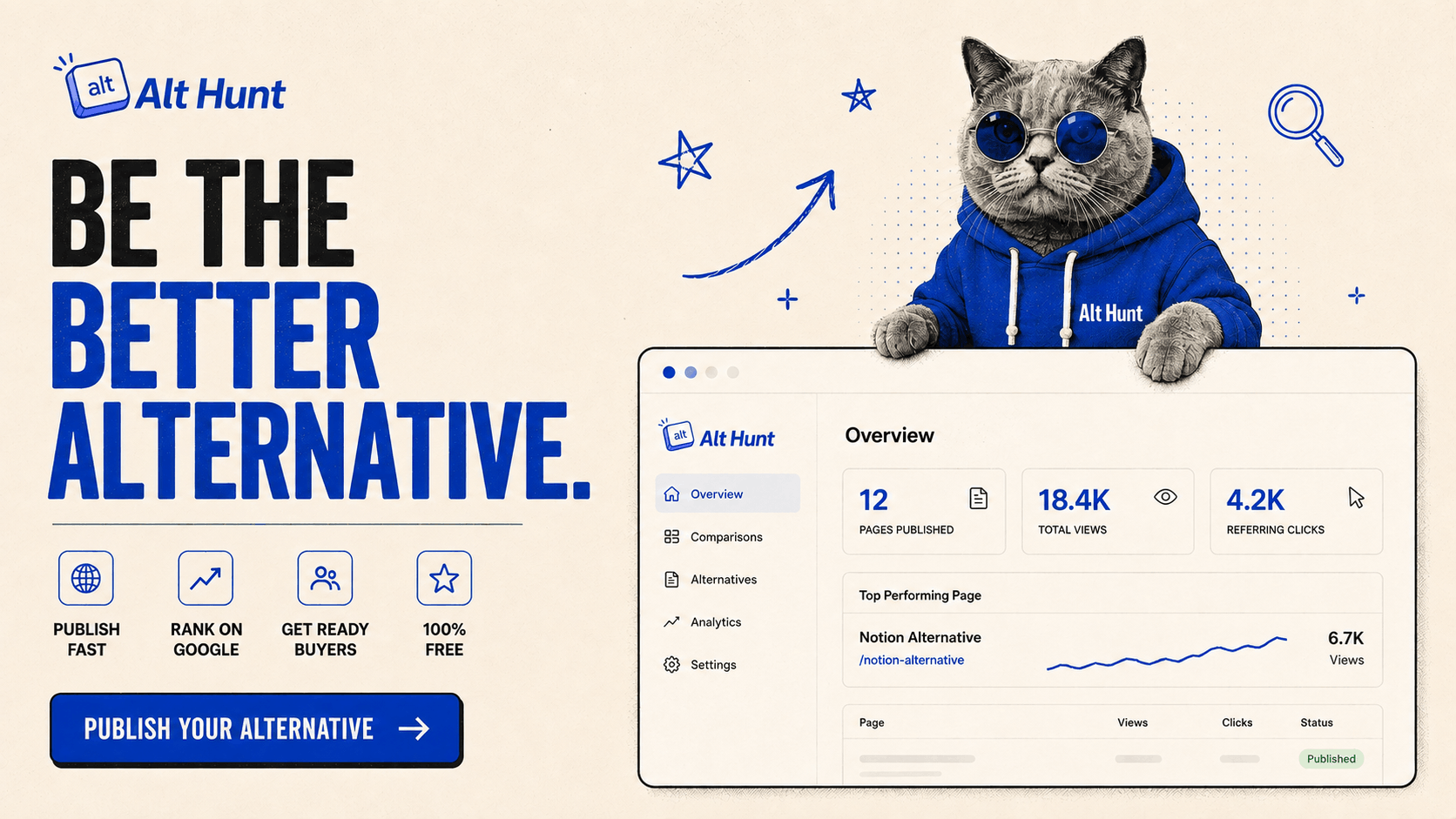
Alt Hunt helps SaaS makers publish alternative pages, comparison matrices, pricing tradeoffs, migration guides, and objection-handling content for buyers already evaluating software.
Alt Hunt is not a generic backlink service.
It is not a promise that publishing one page will create rankings.
Its role is to give founders a structured place to explain:
- Which known product they replace
- Who should switch
- Who should not switch
- Pricing differences
- Feature tradeoffs
- Migration effort
- Best use cases
- Limitations
- Sources and evidence
- Frequently asked questions
Core publishing is free.
Publish an alternative page on Alt Hunt
Frequently asked questions
Does publishing a page guarantee Google rankings?
No. Technical eligibility and good content do not guarantee crawling, indexing, ranking, traffic, or inclusion in AI-powered search experiences.
Should a founder publish hundreds of thin pages?
No. Publish pages only when the intent is distinct and the content provides original evidence, useful analysis, or a clear buyer decision.
No. Alt Hunt is an evergreen competitor-search discovery layer. Launch communities are better for live attention, feedback, and discussion.
How often should comparison pages be updated?
Review them after major product or competitor changes and run a broader accuracy review at least quarterly.
Should competitor claims link to sources?
Yes. Link to official pricing, documentation, changelogs, and direct evidence when the claim can change or materially affects the recommendation.
What is the most important measurement?
Measure qualified discovery: activated users, demos, retained customers, relevant referrals, and buyer questions—not only page views or backlinks.
- 25 Free Startup Directories That Still Accept Submissions in 2026
- 30 SaaS Directories to Submit Your Product in 2026
- 12 Best Startup Directories for Traffic and Backlinks in 2026
- Do SaaS Directory Backlinks Still Work in 2026?
- How Many Directories Should You Submit Your SaaS To?
- Product Hunt vs BetaList vs Uneed vs Alt Hunt
Official sources and further reading
- https://www.producthunt.com/launch
- https://betalist.com/criteria
- https://www.uneed.best/launch-guide
- https://www.saashub.com/submit/list
- https://developers.google.com/search/docs/fundamentals/seo-starter-guide
- https://althunt.io
Search guidance, launch-platform features, submission rules, pricing, and indexing behavior can change. Verify official sources before publishing or acting on the advice.
About the Author

Building Inspo AI | AI-Powered Design Research & Builder Platform | Design Engineer.