

Alternative Pages SEO: How to Rank for ‘Alternative to X’ Keywords
Alternative Pages SEO: How to Rank for ‘Alternative to X’ Keywords. A practical, evidence-led guide for SaaS makers publishing alternative and comparison page
Founders often treat launch platforms, directories, competitor pages, and search visibility as separate tactics.
They are more useful when they operate as one discovery system.
This guide is written for SaaS makers publishing alternative and comparison pages searching for alternative pages seo.
Key takeaway: One strong canonical page per distinct intent should offer original evidence, clear recommendations, internal links, technical accessibility, and ongoing updates.
The recommendations below avoid guaranteed ranking claims, artificial link building, fake reviews, copied comparison content, and other shortcuts that create weak buyer experiences. The goal is to help real buyers understand the market and discover the product when it is genuinely relevant.
Start with search intent, not a template
An “alternative to X” search can mean:
- Buyer dislikes price
- Buyer needs a missing feature
- Buyer wants open source
- Buyer needs a different platform
- Buyer wants better privacy
- Buyer needs an industry-specific product
- Buyer is comparing before purchase
- Buyer must migrate away from a discontinued tool
The page should identify the likely reasons.
Avoid keyword cannibalization
Create one canonical page for one underlying decision.
Do not publish separate thin pages for:
- X alternatives
- Alternative to X
- Best X alternative
- Good alternative for X
when the content and buyer intent are effectively identical.
Google’s canonicalization guidance explains that it selects a representative URL among duplicate or highly similar pages. A canonical link is a hint, but the best approach is reducing unnecessary duplication.
Alternative-page architecture
Direct answer
Give the shortlist quickly.
Selection methodology
Explain how products were chosen and whether they were tested.
Comparison table
Include price, best use case, platform, key advantage, and important limitation.
Individual alternatives
For each product:
- Best for
- Pricing
- Strength
- Limitation
- Migration considerations
- Why it may be better than X
- Why X may still be better
Decision guide
Recommend the product by buyer type.
Migration section
Explain exports, imports, setup, training, integrations, and likely gaps.
FAQs
Answer pricing, free options, platform support, and switching questions.
Sources
Link to official pages.
Product-review quality
Google’s reviews system says it aims to reward insightful analysis and original research rather than thin summaries.
Add:
- Screenshots
- First-hand testing
- Measured outcomes
- Feature verification
- Evidence of experience
- Direct links to official documentation
- Clear editorial methodology
Technical foundation
Crawlability
Important content must be available to crawlers and users.
Internal links
Link from category pages, related comparisons, and product pages.
Sitemap
A sitemap can help discovery but does not guarantee indexing.
Canonical URL
Use one clear URL for the primary page.
Structured data
Structured data should match visible content. It can support eligibility for search features but does not guarantee a rich result.
Page experience
The page should work on mobile, load quickly, and keep the main content clear.
Update system
Track:
- Pricing
- Plan names
- Feature availability
- Platform support
- Ownership
- Product status
- Migration steps
- Screenshots
- Broken links
Add an editorial review date only when the page is genuinely reviewed.
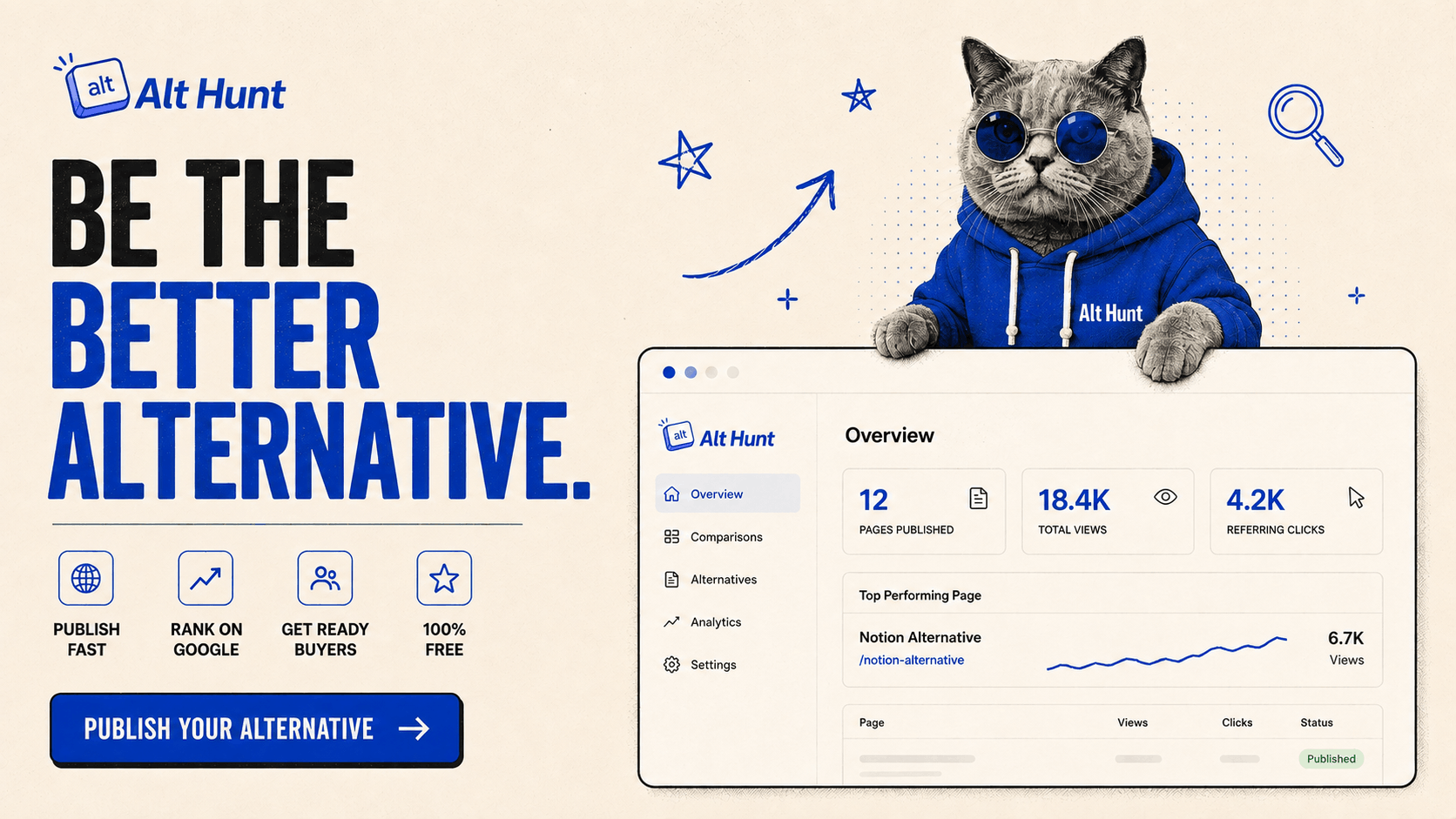
Alt Hunt helps makers structure:
- GEO answer capsules
- Comparison matrices
- Pricing tradeoffs
- Migration guides
- Objection handling
- FAQs
- Metadata
- Feature breakdowns
The structure is a starting point. Evidence and accuracy make the page valuable.
Editorial and operational checklist
Before publishing this page:
- Verify every changing claim
- Use the official product name
- Check all prices and plan names
- Link to primary sources
- Remove duplicate sections
- Confirm the title matches the intent
- Test every internal and external link
- Review mobile formatting
- Add original examples
- Disclose direct experience
- Separate facts from recommendations
- Include who should not use the recommended product
- Confirm the CTA is relevant
- Add the page to the sitemap
- Link to the page from at least one relevant existing page
- Record the review date internally
- Schedule the next accuracy review
For saas makers publishing alternative and comparison pages, the best content is not the page that repeats the keyword most often. It is the page that reduces uncertainty and helps the buyer complete the decision.
Alternative-page content brief
Page goal
Help a buyer understand the best replacements for one known product.
Primary reader
Describe the team, budget, workflow, platform, and reason for switching.
Selection criteria
Explain why each alternative belongs.
First-hand work
Document which products were tested, which plans were used, and what evidence was collected.
Direct answer
Name the best options by buyer type.
Comparison matrix
Use columns that affect the decision—not every available feature.
Product sections
For each alternative:
- Best for
- Main advantage
- Important limitation
- Pricing
- Platform
- Migration
- Why switch
- Why not switch
Buyer recommendations
Recommend options for:
- Small teams
- Enterprise
- Developers
- Privacy
- Budget
- Open source
- Specific industry
Updating
Assign an owner and review schedule.
Canonical content map
Create a spreadsheet with:
- Keyword
- Intent
- Canonical URL
- Related variations
- Current page
- Status
- Internal links
- Last review
- Next review
This prevents accidental duplicate pages.
Alternative-page internal links
Link to:
- Product comparison
- Migration guide
- Category guide
- Pricing page
- Use-case page
- Relevant integration
- Security page
- Documentation
- Related alternative pages
Use descriptive anchor text.
Indexing checklist
- HTTP 200 response
- No accidental `noindex`
- Not blocked by robots
- Canonical points correctly
- Included in sitemap
- Linked internally
- Important content visible as text
- Mobile page works
- Title is distinct
- H1 is clear
- Images have descriptive alt text
- Structured data matches visible content
Technical readiness does not guarantee indexing, but it removes preventable barriers.
Alternative-page editorial policy
Publish an internal policy covering:
- How products are selected
- Whether placement is paid
- How testing is performed
- How pricing is verified
- How conflicts are handled
- How products request corrections
- How updates are scheduled
- How affiliate links are disclosed
- How recommendations are made
- How discontinued products are handled
This policy builds trust across the entire site.
Correction workflow
Provide a clear correction channel.
When a company reports an error:
- Record the request
- Verify against official evidence
- Correct factual mistakes promptly
- Preserve editorial independence
- Note material updates internally
- Recheck related pages
- Update structured data and snippets when necessary
Accurate comparison content benefits both buyers and the products being compared.
Alternative-page launch checklist
Before publishing:
- Intent is distinct
- Canonical URL is selected
- Products are genuinely relevant
- Selection method is disclosed
- Prices are verified
- Important limitations are included
- Competitor strengths are acknowledged
- Migration is explained
- Sources are linked
- Internal links are added
- Sitemap is updated
- Mobile layout is tested
- CTA matches the reader
- Review owner is assigned
- Correction channel exists
A complete page should help the buyer decide without immediately returning to search for a better explanation.
One final quality test
Read only the headings, comparison table, and recommendations.
Can a buyer still understand:
- Why they are switching
- Which options fit
- The main tradeoffs
- The expected cost
- The migration difficulty
- The final recommendation
Then read the full page.
Does the evidence support the summary?
A useful alternative page remains clear at both levels: fast scanning and detailed evaluation.
Alt Hunt helps SaaS makers publish alternative pages, comparison matrices, pricing tradeoffs, migration guides, and objection-handling content for buyers already evaluating software.
Alt Hunt is not a generic backlink service.
It is not a promise that publishing one page will create rankings.
Its role is to give founders a structured place to explain:
- Which known product they replace
- Who should switch
- Who should not switch
- Pricing differences
- Feature tradeoffs
- Migration effort
- Best use cases
- Limitations
- Sources and evidence
- Frequently asked questions
Core publishing is free.
Publish an alternative page on Alt Hunt
Frequently asked questions
Does publishing a page guarantee Google rankings?
No. Technical eligibility and good content do not guarantee crawling, indexing, ranking, traffic, or inclusion in AI-powered search experiences.
Should a founder publish hundreds of thin pages?
No. Publish pages only when the intent is distinct and the content provides original evidence, useful analysis, or a clear buyer decision.
No. Alt Hunt is an evergreen competitor-search discovery layer. Launch communities are better for live attention, feedback, and discussion.
How often should comparison pages be updated?
Review them after major product or competitor changes and run a broader accuracy review at least quarterly.
Should competitor claims link to sources?
Yes. Link to official pricing, documentation, changelogs, and direct evidence when the claim can change or materially affects the recommendation.
What is the most important measurement?
Measure qualified discovery: activated users, demos, retained customers, relevant referrals, and buyer questions—not only page views or backlinks.
- Top 10 Product Hunt Alternatives to Launch Your SaaS in 2026
- 10 Best AppSumo Alternatives for SaaS Founders in 2026
- 10 Best BetaList Alternatives for Early-Stage Startups
- How to Launch Your SaaS on Indie Hackers in 2026
- How SaaS Founders Can Rank for Competitor Keywords
- How to Get Your SaaS Discovered by Google and AI Search
Official sources and further reading
- https://developers.google.com/search/docs/fundamentals/creating-helpful-content
- https://developers.google.com/search/docs/appearance/reviews-system
- https://developers.google.com/search/docs/crawling-indexing/canonicalization
- https://developers.google.com/search/docs/crawling-indexing/sitemaps/overview
- https://developers.google.com/search/docs/appearance/structured-data/sd-policies
- https://althunt.io
Search guidance, launch-platform features, submission rules, pricing, and indexing behavior can change. Verify official sources before publishing or acting on the advice.
About the Author

Building Inspo AI | AI-Powered Design Research & Builder Platform | Design Engineer.