


How Many Directories Should You Submit Your SaaS To?
How Many Directories Should You Submit Your SaaS To?. A practical, evidence-led guide for SaaS founders balancing directory coverage with limited time.
Founders often treat launch platforms, directories, competitor pages, and search visibility as separate tactics.
They are more useful when they operate as one discovery system.
This guide is written for SaaS founders balancing directory coverage with limited time searching for how many directories should i submit my saas to.
Key takeaway: There is no magic number; start with a small, relevant priority set, measure quality, then expand only when listings remain accurate and useful.
The recommendations below avoid guaranteed ranking claims, artificial link building, fake reviews, copied comparison content, and other shortcuts that create weak buyer experiences. The goal is to help real buyers understand the market and discover the product when it is genuinely relevant.
There is no universal number
No official search guideline says a SaaS company must appear in a specific number of directories.
The correct number depends on:
- Category
- Buyer
- Geography
- Product maturity
- Integrations
- Founder time
- Listing quality
- Maintenance ability
- Platform activity
- Whether the profiles send useful discovery
A legal-data-room product may need a different directory portfolio from a design tool or open-source API.
A practical starting recommendation
For a new SaaS product:
- Start with 10–15 high-priority listings.
- Add another 10–20 only after verifying quality and maintaining the first group.
- Create deeper profiles on the platforms that send qualified users.
- Stop expanding when the additional directories are inactive, irrelevant, or difficult to maintain.
This is an operating recommendation—not a ranking formula.
The three-directory model
Organize the list into three groups.
Essential
These strongly match the buyer or category.
Examples:
- Main launch platform
- Alternatives platform
- Core SaaS category directory
- Integration marketplace
- App store
- Relevant technical or professional community
Useful
These add credible discovery but are not central.
Experimental
These have uncertain traffic or relevance. Submit only when the time cost is low and the listing can be maintained.
Signs that you have submitted to enough directories
You may have enough when:
- The product appears across the main category surfaces.
- Buyer-intent platforms include the product.
- Integration ecosystems are covered.
- The information is consistent.
- Existing profiles need maintenance.
- New directories send no qualified users.
- Submission time is taking attention from onboarding or customers.
- Most remaining sites are generic lists.
Signs that you need more coverage
You may need more when:
- Competitors appear in relevant directories but the product does not.
- Buyers repeatedly cite a platform where the company is missing.
- Important integrations have public marketplaces.
- The product is entering a new geography or vertical.
- Existing profiles send qualified traffic.
- The company has the capacity to maintain additional listings.
Quality-control checklist
Before counting a directory as complete:
- Public page is live
- Canonical product URL is correct
- Product name is correct
- Description is accurate
- Pricing is current
- Logo displays correctly
- Category is relevant
- Founder or company information is accurate
- Link works
- Tracking is configured
- Sponsored or affiliate status is disclosed where required
- The profile can be updated
Why “100 backlinks” is the wrong KPI
A founder can have 100 directory links and no qualified discovery.
Better metrics:
- Published high-quality profiles
- Relevant category coverage
- Referral visitors
- Activated users
- Customer conversations
- Branded searches
- Comparison-page engagement
- Partnerships
- Integration installs
- Profiles updated on time
Recommended review cadence
Monthly
Review traffic and fix obvious errors.
Quarterly
Audit pricing, positioning, screenshots, and top directory profiles.
After a rebrand
Update the name, domain, logo, and descriptions.
After pricing changes
Correct profiles that show prices.
After entering a new category
Add the product to relevant vertical platforms.
The right number is the number of relevant profiles the team can keep accurate.
Editorial and operational checklist
Before publishing this page:
- Verify every changing claim
- Use the official product name
- Check all prices and plan names
- Link to primary sources
- Remove duplicate sections
- Confirm the title matches the intent
- Test every internal and external link
- Review mobile formatting
- Add original examples
- Disclose direct experience
- Separate facts from recommendations
- Include who should not use the recommended product
- Confirm the CTA is relevant
- Add the page to the sitemap
- Link to the page from at least one relevant existing page
- Record the review date internally
- Schedule the next accuracy review
For saas founders balancing directory coverage with limited time, the best content is not the page that repeats the keyword most often. It is the page that reduces uncertainty and helps the buyer complete the decision.
Directory portfolio examples
Bootstrapped B2B SaaS
A focused portfolio might include:
- Product Hunt
- Uneed
- BetaList if eligible
- Alt Hunt
- SaaSHub
- One alternatives directory
- Two vertical directories
- LinkedIn founder profile
- One integration marketplace
- One founder community
- Two niche buyer communities
Developer tool
A useful portfolio may include:
- GitHub
- Show HN
- Product Hunt
- Peerlist
- Alt Hunt
- API marketplace
- Package registry
- Developer directory
- Dev.to
- Hashnode
- Relevant subreddit
- Integration documentation
AI tool
A useful portfolio may include:
- Product Hunt
- Uneed
- Peerlist
- One or two active AI directories
- Alt Hunt
- SaaSHub
- Relevant category directory
- Technical article
- Founder social profile
- Integration pages
These are examples, not universal requirements.
The maintenance cost calculation
Estimate the annual cost of each profile:
- Initial submission time
- Approval follow-up
- Account management
- Pricing updates
- Screenshot updates
- Rebrand updates
- Broken-link checks
- Paid-renewal cost
- Support requests
- Data accuracy risk
A free listing can still be expensive if it consumes recurring time and creates inaccurate buyer information.
When to pause submissions
Pause when:
- Onboarding is broken
- Website positioning is unclear
- Pricing is changing
- Product is unavailable
- Support cannot handle more users
- Existing profiles are inaccurate
- The next directories are low relevance
- Tracking is missing
Distribution amplifies the current product experience. Fix the experience before amplifying it.
A directory-capacity formula
Estimate the number of profiles the team can maintain.
Start with:
- Hours available per quarter
- Average minutes per profile review
- Number of pricing or positioning changes
- Number of people responsible
- Complexity of the listings
Example:
If one founder has four hours per quarter and each meaningful profile review takes 12 minutes, the theoretical capacity is 20 profiles.
Reduce that number for unexpected login issues, editorial changes, and corrections.
This is a better limit than an arbitrary backlink target.
Directory debt
Directory debt is the collection of outdated public profiles the company no longer controls.
It grows through:
- Old domains
- Old logos
- Old prices
- Discontinued features
- Former founders
- Wrong categories
- Dead signup links
- Forgotten paid renewals
A smaller maintained portfolio is safer than a large abandoned one.
Final recommendation by team size
Solo founder
Maintain roughly 10–20 high-value profiles before expanding.
Small growth team
Maintain a broader 20–40 profile portfolio across launch, category, ecosystem, and buyer-intent platforms.
Larger SaaS company
Coverage may expand further because dedicated owners can maintain marketplaces, regional directories, integrations, review platforms, and industry profiles.
These ranges are operational examples, not SEO requirements.
The number should increase only when the team can preserve accuracy and prove additional value.

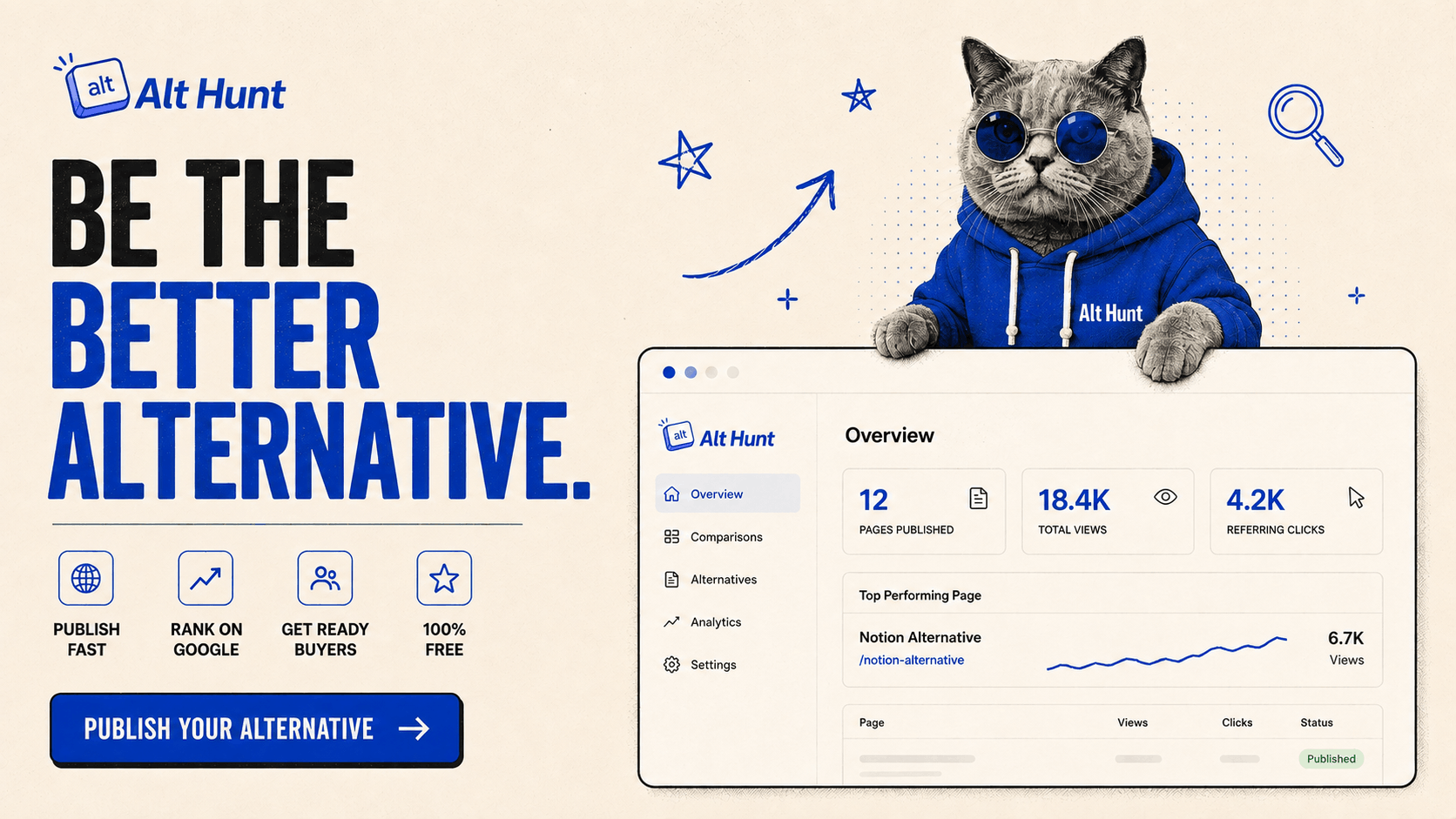
Alt Hunt helps SaaS makers publish alternative pages, comparison matrices, pricing tradeoffs, migration guides, and objection-handling content for buyers already evaluating software.
Alt Hunt is not a generic backlink service.
It is not a promise that publishing one page will create rankings.
Its role is to give founders a structured place to explain:
- Which known product they replace
- Who should switch
- Who should not switch
- Pricing differences
- Feature tradeoffs
- Migration effort
- Best use cases
- Limitations
- Sources and evidence
- Frequently asked questions
Core publishing is free.
Publish an alternative page on Alt Hunt
Frequently asked questions
Does publishing a page guarantee Google rankings?
No. Technical eligibility and good content do not guarantee crawling, indexing, ranking, traffic, or inclusion in AI-powered search experiences.
Should a founder publish hundreds of thin pages?
No. Publish pages only when the intent is distinct and the content provides original evidence, useful analysis, or a clear buyer decision.
No. Alt Hunt is an evergreen competitor-search discovery layer. Launch communities are better for live attention, feedback, and discussion.
How often should comparison pages be updated?
Review them after major product or competitor changes and run a broader accuracy review at least quarterly.
Should competitor claims link to sources?
Yes. Link to official pricing, documentation, changelogs, and direct evidence when the claim can change or materially affects the recommendation.
What is the most important measurement?
Measure qualified discovery: activated users, demos, retained customers, relevant referrals, and buyer questions—not only page views or backlinks.
- 25 Free Startup Directories That Still Accept Submissions in 2026
- 30 SaaS Directories to Submit Your Product in 2026
- 12 Best Startup Directories for Traffic and Backlinks in 2026
- Do SaaS Directory Backlinks Still Work in 2026?
- Startup Directory Submission Strategy: Where to List First
- Alternative Pages SEO: How to Rank for ‘Alternative to X’ Keywords
Official sources and further reading
- https://developers.google.com/search/docs/crawling-indexing/links-crawlable
- https://developers.google.com/search/docs/essentials/spam-policies
- https://developers.google.com/search/docs/fundamentals/creating-helpful-content
- https://www.saashub.com/submit/list
- https://althunt.io
Search guidance, launch-platform features, submission rules, pricing, and indexing behavior can change. Verify official sources before publishing or acting on the advice.
About the Author

Building Inspo AI | AI-Powered Design Research & Builder Platform | Design Engineer.