
Product Hunt vs BetaList vs Uneed vs Alt Hunt
Product Hunt vs BetaList vs Uneed vs Alt Hunt. A practical, evidence-led guide for founders choosing a launch and discovery stack.
Founders often treat launch platforms, directories, competitor pages, and search visibility as separate tactics.
They are more useful when they operate as one discovery system.
This guide is written for founders choosing a launch and discovery stack searching for product launch platform comparison.
Key takeaway: The four platforms solve different jobs: daily launch attention, early-stage curation, rolling launch visibility, and evergreen competitor-search discovery.
The recommendations below avoid guaranteed ranking claims, artificial link building, fake reviews, copied comparison content, and other shortcuts that create weak buyer experiences. The goal is to help real buyers understand the market and discover the product when it is genuinely relevant.
Quick comparison
Comparison Matrix
2026 Verified| Platform | Primary job | Best stage | Launch model | Long-term role |
|---|---|---|---|---|
| Product Hunt | Public product launch and early-adopter feedback | Usable public product | Daily community leaderboard | Product page, reviews, launch record |
| BetaList | Early-stage startup discovery | Unreleased, private beta, or recently launched | Curated submission | Early-access profile |
| Uneed | Free scheduled launch and rolling visibility | Public tech product | Waiting line, launch date, rolling leaderboards | Permanent product page and ongoing votes |
| Alt Hunt | Competitor-search discovery | Product with known alternatives or competitors | Maker-published comparison and alternative pages | Evergreen switching and comparison content |
Product Hunt
Product Hunt describes itself as a global community where makers submit products and community members can upvote, comment, and share them.
Its official launch guide says the platform is free. It is strongest when:
- The product is ready for public users
- The maker can participate throughout launch day
- Visual assets are strong
- The team wants early-adopter feedback
- The launch is treated as an event
It is not designed specifically for pre-launch waitlists or competitor-keyword pages.
BetaList
BetaList’s official criteria emphasize relatively new technology startups.
Good fits include:
- Unreleased products
- Invitation-only private beta
- Recently launched products
- Products with a distinct landing page
- Products that allow signup or access
BetaList says each startup can have a pre-launch feature and a launch feature, separated by at least a few weeks.
It is less suitable for older products, heavily covered launches, agencies, newsletters, or generic landing pages.
Uneed
Uneed’s current launch guide says submitting and joining the waiting line is free. It assigns an automatic launch date, while founders can pay to choose a date sooner.
Uneed currently uses daily, weekly, monthly, and yearly leaderboards. Its guide says products can continue collecting votes after launch.
It is strongest for founders who want:
- Another public launch cycle
- A free queue
- Rolling visibility
- Reviews
- A permanent product page
- Optional paid promotion
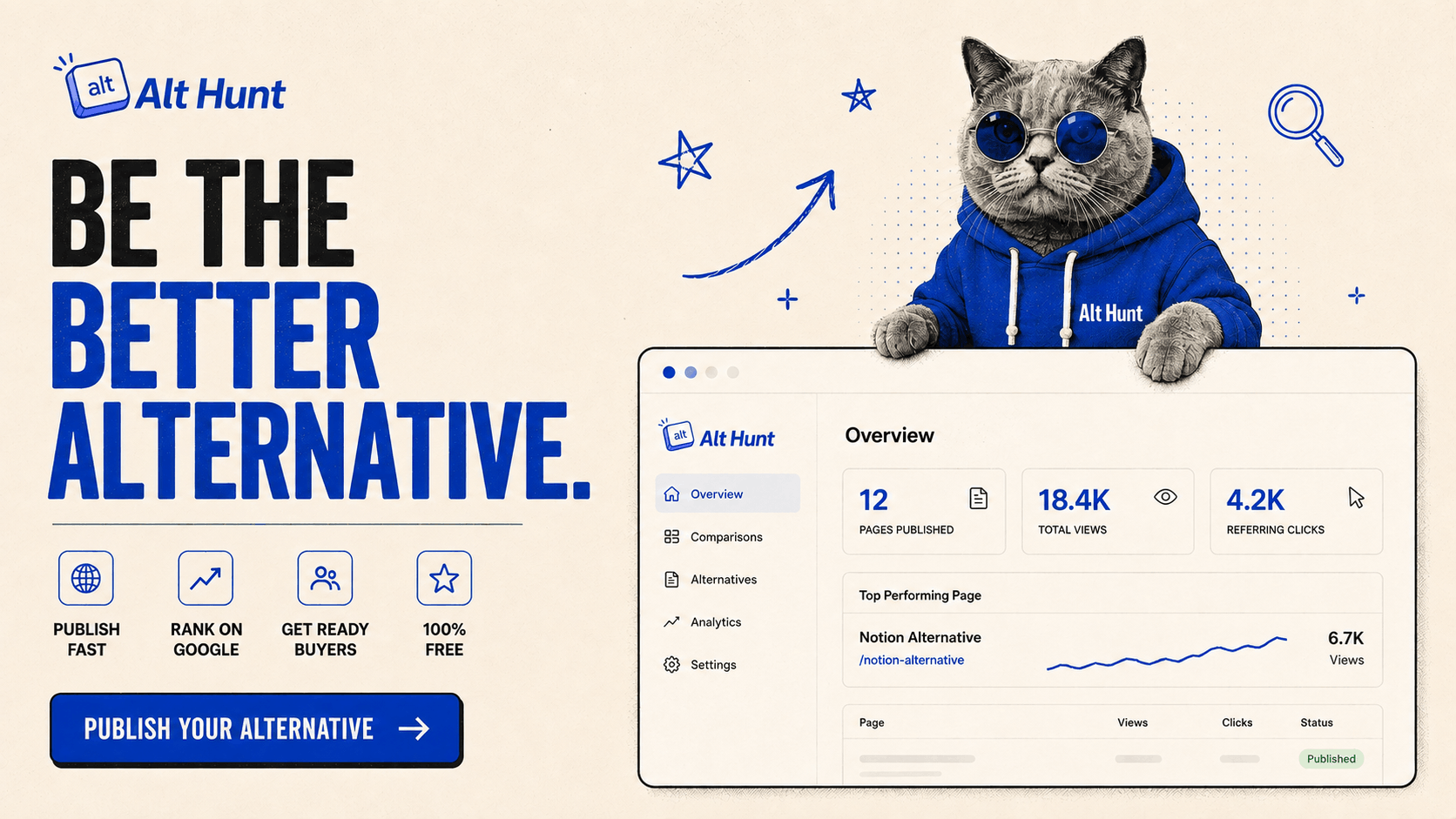
Alt Hunt does not organize discovery around a daily leaderboard.
It is designed for searches such as:
- Product Hunt alternatives
- AppSumo alternatives
- Figma alternative
- Jira vs ClickUp
- Cheaper alternative to X
- Open-source alternative to Y
Makers publish structured pages that explain the decision.
Which platform should you choose?
Choose Product Hunt when
You want a public launch event and early-adopter discussion.
Choose BetaList when
The startup is genuinely early, unreleased, private beta, or recently launched.
Choose Uneed when
You want a free scheduled launch with rolling leaderboards and an ongoing product page.
The product needs durable discovery around competitors, alternatives, and switching decisions.
The best stack
These platforms are complementary.
- Submit early to BetaList if eligible.
- Launch publicly on Product Hunt.
- Schedule another launch cycle on Uneed.
- Publish alternative and comparison pages on Alt Hunt.
- Update every profile after feedback and product changes.
The best platform is determined by the job—not the logo.
Editorial and operational checklist
Before publishing this page:
- Verify every changing claim
- Use the official product name
- Check all prices and plan names
- Link to primary sources
- Remove duplicate sections
- Confirm the title matches the intent
- Test every internal and external link
- Review mobile formatting
- Add original examples
- Disclose direct experience
- Separate facts from recommendations
- Include who should not use the recommended product
- Confirm the CTA is relevant
- Add the page to the sitemap
- Link to the page from at least one relevant existing page
- Record the review date internally
- Schedule the next accuracy review
For founders choosing a launch and discovery stack, the best content is not the page that repeats the keyword most often. It is the page that reduces uncertainty and helps the buyer complete the decision.
A practical four-platform launch sequence
Stage 1: BetaList
Use BetaList before or near the first public release when the startup meets the official early-stage criteria.
Goal:
- Early signups
- Landing-page feedback
- Initial user conversations
- Positioning validation
Stage 2: Product Hunt
Launch when the product is publicly usable and the team can support a concentrated event.
Goal:
- Early-adopter feedback
- Reviews
- Public proof
- New users
- Product-page visibility
Stage 3: Uneed
Use Uneed as another launch cycle rather than copying the exact Product Hunt campaign.
Goal:
- Rolling visibility
- Community feedback
- Reviews
- A permanent product profile
- Another measured acquisition test
Publish competitor and alternative pages based on the questions heard during earlier launches.
Goal:
- Long-term competitor-search discovery
- Pricing and feature explanation
- Migration support
- Buyer qualification
- Search and AI citation opportunities
Content adaptation
BetaList message
“We are opening early access for [specific buyer].”
Product Hunt message
“We launched [product], which helps [buyer] achieve [outcome].”
Uneed message
“Here is what we built, what changed, and the deal or feedback request.”
“Here is when our product is the better alternative, when the competitor is better, and what switching involves.”
One platform should not copy another
Using identical pages wastes the unique audience context.
The product facts remain consistent. The buyer question changes.
Four-platform measurement plan
Use a separate goal for each platform.
BetaList
Measure early signups, interviews, and landing-page clarity.
Product Hunt
Measure public activation, reviews, comments, and early-adopter feedback.
Uneed
Measure referral traffic, reviews, rolling engagement, and performance during another launch cycle.
Measure competitor-query impressions, comparison-page engagement, product visits, and qualified switching interest.
Do not compare the platforms using one metric.
A BetaList waitlist signup is not the same as a Product Hunt review or an Alt Hunt comparison-page conversion.
Recommended founder workload
Do not run all four at once.
Space them so the founder can participate:
- BetaList during early access
- Product Hunt for public launch
- Uneed after initial improvements
- Alt Hunt before and after launch for persistent buyer questions
The sequence produces repeated learning rather than one overloaded day.
Final platform decision
Use the platform that matches the current question:
- “Will early users sign up?” → BetaList
- “Can we create a public launch moment?” → Product Hunt
- “Can another launch community extend visibility?” → Uneed
- “Can buyers find us while comparing competitors?” → Alt Hunt
Do not ask which platform is universally best.
Ask which platform solves the next discovery job.
The strongest founder plan uses the platforms sequentially and updates the message after every round of feedback.
Alt Hunt helps SaaS makers publish alternative pages, comparison matrices, pricing tradeoffs, migration guides, and objection-handling content for buyers already evaluating software.
Alt Hunt is not a generic backlink service.
It is not a promise that publishing one page will create rankings.
Its role is to give founders a structured place to explain:
- Which known product they replace
- Who should switch
- Who should not switch
- Pricing differences
- Feature tradeoffs
- Migration effort
- Best use cases
- Limitations
- Sources and evidence
- Frequently asked questions
Core publishing is free.
Publish an alternative page on Alt Hunt
Frequently asked questions
Does publishing a page guarantee Google rankings?
No. Technical eligibility and good content do not guarantee crawling, indexing, ranking, traffic, or inclusion in AI-powered search experiences.
Should a founder publish hundreds of thin pages?
No. Publish pages only when the intent is distinct and the content provides original evidence, useful analysis, or a clear buyer decision.
No. Alt Hunt is an evergreen competitor-search discovery layer. Launch communities are better for live attention, feedback, and discussion.
How often should comparison pages be updated?
Review them after major product or competitor changes and run a broader accuracy review at least quarterly.
Should competitor claims link to sources?
Yes. Link to official pricing, documentation, changelogs, and direct evidence when the claim can change or materially affects the recommendation.
What is the most important measurement?
Measure qualified discovery: activated users, demos, retained customers, relevant referrals, and buyer questions—not only page views or backlinks.
- Top 10 Product Hunt Alternatives to Launch Your SaaS in 2026
- 15 Best Websites to Launch Your Startup in 2026
- 10 Best BetaList Alternatives for Early-Stage Startups
- 8 Best Uneed Alternatives for Launching SaaS Products
- Do SaaS Directory Backlinks Still Work in 2026?
- Product Hunt vs BetaList: Which Is Better for Early-Stage Startups?
Official sources and further reading
- https://www.producthunt.com/launch
- https://betalist.com/criteria
- https://www.uneed.best/launch-guide
- https://althunt.io
Search guidance, launch-platform features, submission rules, pricing, and indexing behavior can change. Verify official sources before publishing or acting on the advice.
About the Author

Building Inspo AI | AI-Powered Design Research & Builder Platform | Design Engineer.