
Product Hunt vs Indie Hackers: Where Should You Launch?
Product Hunt vs Indie Hackers: Where Should You Launch?. A practical, evidence-led guide for bootstrapped founders choosing between a launch board and founder
Founders often treat launch platforms, directories, competitor pages, and search visibility as separate tactics.
They are more useful when they operate as one discovery system.
This guide is written for bootstrapped founders choosing between a launch board and founder community searching for product hunt vs indie hackers.
Key takeaway: Product Hunt creates a structured public launch event; Indie Hackers is better for transparent founder stories, lessons, and ongoing peer relationships.
The recommendations below avoid guaranteed ranking claims, artificial link building, fake reviews, copied comparison content, and other shortcuts that create weak buyer experiences. The goal is to help real buyers understand the market and discover the product when it is genuinely relevant.
Quick answer
Choose Product Hunt for a structured public launch page, early-adopter exposure, comments, reviews, and a concentrated launch event.
Choose Indie Hackers for a transparent founder story, bootstrapping discussion, numbers, lessons, experiments, and ongoing peer relationships.
The strongest approach is often Product Hunt for the event and Indie Hackers for the story.
Product Hunt format
Product Hunt is organized around products.
A strong launch includes:
- Clear tagline
- Product description
- Gallery
- Demo
- Maker profile
- Maker comment
- Community replies
- Website and onboarding
- Public launch-day support
The official launch guide says the platform is free and encourages makers to launch their own products.
Indie Hackers format
Indie Hackers is organized around builders and the process of creating businesses.
A useful launch post explains:
- What was built
- Why
- Customer problem
- Build journey
- Revenue or users when relevant
- Mistakes
- Pricing decisions
- Distribution lessons
- What feedback is needed
- What happens next
A press-release-style post is weaker than a specific founder story.
Comparison
Comparison Matrix
2026 Verified| Area | Product Hunt | Indie Hackers |
|---|---|---|
| Core object | Product launch | Founder journey and business |
| Best content | Demo, visuals, product page | Story, lessons, numbers, questions |
| Feedback | Product and early-adopter feedback | Founder, business, growth, and product feedback |
| Timing | Concentrated launch window | Ongoing community participation |
| Social proof | Reviews, comments, launch record | Founder reputation and discussion |
| Best fit | Public product release | Bootstrapped and transparent building |
Launch on Product Hunt when
- Product is publicly usable
- Team can support the launch
- Visual demonstration is strong
- Early adopters are relevant
- A public product page is useful
Post on Indie Hackers when
- The journey contains useful lessons
- The founder can share details
- The goal is peer feedback
- Bootstrapping or growth questions matter
- The founder will continue participating
Combined sequence
Before launch
Share the problem and build journey on Indie Hackers.
Launch day
Launch on Product Hunt.
After launch
Publish the results, failures, and changes on Indie Hackers.
Long term
Publish comparison and alternative pages on Alt Hunt.
What not to do
Do not ask every Indie Hackers commenter for a Product Hunt upvote.
Do not copy a Product Hunt tagline into a founder-community post.
Do not disappear after receiving feedback.
Do not measure both channels only by traffic.
Product Hunt creates a moment. Indie Hackers builds a founder relationship.
Editorial and operational checklist
Before publishing this page:
- Verify every changing claim
- Use the official product name
- Check all prices and plan names
- Link to primary sources
- Remove duplicate sections
- Confirm the title matches the intent
- Test every internal and external link
- Review mobile formatting
- Add original examples
- Disclose direct experience
- Separate facts from recommendations
- Include who should not use the recommended product
- Confirm the CTA is relevant
- Add the page to the sitemap
- Link to the page from at least one relevant existing page
- Record the review date internally
- Schedule the next accuracy review
For bootstrapped founders choosing between a launch board and founder community, the best content is not the page that repeats the keyword most often. It is the page that reduces uncertainty and helps the buyer complete the decision.
Adapt the same launch story
Imagine a founder built a SaaS product that helps agencies create client portals.
Product Hunt version
- Strong product tagline
- Screenshots
- Demo
- Maker comment
- Product benefits
- Public trial
- Specific feedback request
Indie Hackers version
- The customer interview that changed the idea
- The first failed version
- Build time
- Pricing decision
- First users
- What distribution failed
- What the founder needs help with
The product is the same. The value to the reader is different.
Metrics by platform
Product Hunt
- Product-page visitors
- Website visitors
- Signups
- Activation
- Reviews
- Comments
- Qualified users
- Referrals
Indie Hackers
- Detailed comments
- Founder conversations
- Introductions
- Beta testers
- Pricing feedback
- Distribution ideas
- Return participation
- Trust built over time
Which platform is better for bootstrapped founders?
Indie Hackers may create deeper peer relationships.
Product Hunt may create a larger public product moment.
Bootstrapped founders benefit from both when they have enough time to participate authentically.
Post-launch content loop
- Launch publicly
- Share the numbers and lessons
- Fix the product
- Publish the comparison questions
- Return with an update
This loop is more credible than repeatedly announcing the same product.
Founder-community credibility
Indie Hackers credibility comes from continued participation.
Useful behavior includes:
- Answering another founder’s question
- Sharing a result after an experiment
- Admitting a failed launch
- Explaining a pricing change
- Publishing a transparent milestone
- Reviewing someone else’s onboarding
- Returning with the outcome
A founder who appears only to post a link receives less trust.
Product Hunt credibility
Product Hunt credibility is supported by:
- Complete maker profile
- Honest maker comment
- Fast replies
- Useful reviews of other products
- Authentic community participation
- Clear disclosure
- Respect for launch rules
Neither platform rewards a founder who treats people as a voting pool.
Build relationships before the launch and maintain them afterward.
Final decision checklist
Choose Product Hunt when the immediate asset is the product launch itself.
Choose Indie Hackers when the immediate asset is the founder’s lesson, experiment, or transparent business story.
Use Product Hunt to answer:
What did you launch?
Use Indie Hackers to answer:
What did you learn while building and growing it?
Use Alt Hunt to answer:
Why should a buyer choose it over a known alternative?
Together, the three pages support attention, trust, and durable discovery.
One final sequencing rule
A founder can publish the Indie Hackers story before Product Hunt, launch publicly on Product Hunt, and then return to Indie Hackers with the real results.
This creates a complete narrative:
- What we are building
- What we launched
- What happened
- What we changed
- What we learned
The follow-up is often more useful than the announcement because it contains evidence.
It also gives future founders a reason to trust the author’s next post.
Final note
Product Hunt can introduce the product. Indie Hackers can explain the founder. The best launch system uses both identities without turning either community into a promotional mailing list.
Practical takeaway
Use the founder story to deepen the product launch, not to repeat it.
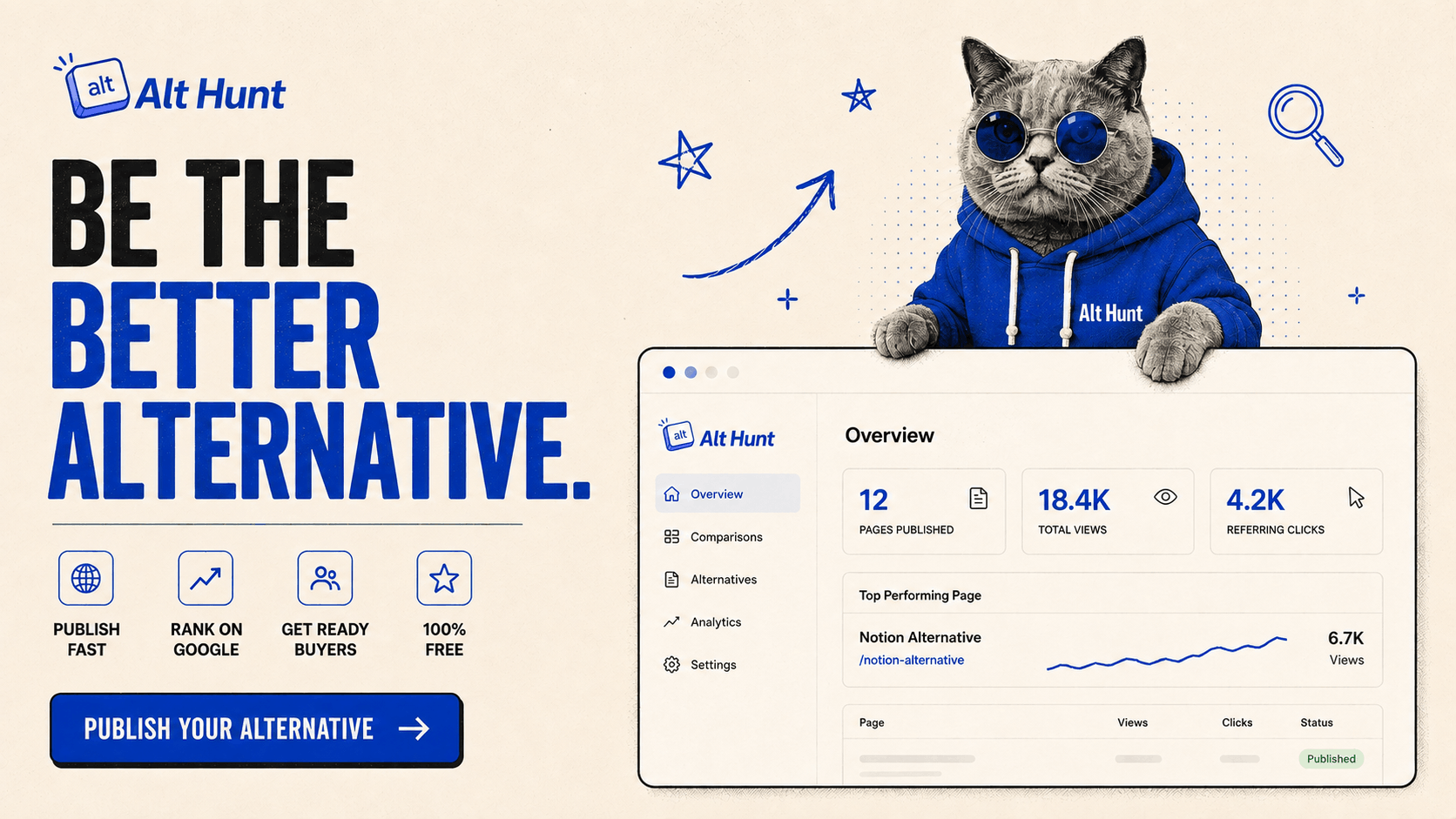
Alt Hunt helps SaaS makers publish alternative pages, comparison matrices, pricing tradeoffs, migration guides, and objection-handling content for buyers already evaluating software.
Alt Hunt is not a generic backlink service.
It is not a promise that publishing one page will create rankings.
Its role is to give founders a structured place to explain:
- Which known product they replace
- Who should switch
- Who should not switch
- Pricing differences
- Feature tradeoffs
- Migration effort
- Best use cases
- Limitations
- Sources and evidence
- Frequently asked questions
Core publishing is free.
Publish an alternative page on Alt Hunt
Frequently asked questions
Does publishing a page guarantee Google rankings?
No. Technical eligibility and good content do not guarantee crawling, indexing, ranking, traffic, or inclusion in AI-powered search experiences.
Should a founder publish hundreds of thin pages?
No. Publish pages only when the intent is distinct and the content provides original evidence, useful analysis, or a clear buyer decision.
No. Alt Hunt is an evergreen competitor-search discovery layer. Launch communities are better for live attention, feedback, and discussion.
How often should comparison pages be updated?
Review them after major product or competitor changes and run a broader accuracy review at least quarterly.
Should competitor claims link to sources?
Yes. Link to official pricing, documentation, changelogs, and direct evidence when the claim can change or materially affects the recommendation.
What is the most important measurement?
Measure qualified discovery: activated users, demos, retained customers, relevant referrals, and buyer questions—not only page views or backlinks.
- How to Launch Your SaaS on Indie Hackers in 2026
- 15 Best Launch Platforms for Indie Hackers in 2026
- The Complete Startup Launch Checklist for 2026
- What to Do After Your Product Hunt Launch
- Product Hunt vs BetaList vs Uneed vs Alt Hunt
- Product Hunt vs Hacker News: Which Launch Channel Is Better?
Official sources and further reading
- https://www.producthunt.com/launch
- https://www.producthunt.com/launch/how-product-hunt-works
- https://www.indiehackers.com/
- https://althunt.io
Search guidance, launch-platform features, submission rules, pricing, and indexing behavior can change. Verify official sources before publishing or acting on the advice.
About the Author

Building Inspo AI | AI-Powered Design Research & Builder Platform | Design Engineer.