
How to Launch Your SaaS on Indie Hackers in 2026
How to Launch Your SaaS on Indie Hackers in 2026. Compare platforms, submission models, audience fit, costs, and the best next step for bootstrapped and indie
Launching a product is easier than building repeatable discovery.
A founder can spend weeks preparing one launch day, receive a short burst of attention, and then disappear from the places where buyers continue researching.
This guide is for bootstrapped and indie SaaS founders. It focuses on indie hackers product launch and evaluates channels by the job they actually perform: launch exposure, feedback, sales, technical credibility, directory discovery, or long-term buyer intent.
Key takeaway: Lead with the building story, numbers, lessons, and a concrete ask—then convert temporary community attention into durable discovery assets.
Quick answer
To succeed with indie hackers product launch, do not treat the launch as a single post.
Prepare a product people can understand quickly, choose platforms that match the audience, publish useful founder context, stay available for questions, and create durable discovery pages that continue working after launch-day attention fades.
Alt Hunt fits the post-launch layer: makers publish structured alternative and comparison pages for high-intent buyers searching competitor terms.
Comparison table
Comparison Matrix
2026 Verified| Platform | Best for | Cost model | Discovery model |
|---|---|---|---|
| Indie Hackers | founder stories, progress, and peer discussion | Free community participation | builder community posts, product pages, and conversations |
| Alt Hunt | evergreen competitor-search discovery | Free core publishing | alternative pages, comparisons, and migration guides |
| Product Hunt | a concentrated launch day and early-adopter feedback | Free submission | daily launch board and product profiles |
| Uneed | a scheduled launch with a free queue | Free queue; paid date selection is optional | social launchpad with an assigned launch date |
| Peerlist Launchpad | developers and designers with credible profiles | Free | weekly profile-linked launches |
Launch as a founder, not a brand account
Indie Hackers is a community of people building and growing products. A launch post works best when it gives the community something useful beyond a link.
Share:
- What you built
- Why you built it
- How long it took
- What stack or method you used
- What failed
- What changed after user feedback
- Current users or revenue, when you are comfortable sharing
- The exact feedback you need
A useful post structure
The hook
State the real situation. Avoid a generic announcement.
Example:
I spent six months watching small SaaS products disappear after launch day, so I built a way for founders to publish the competitor pages buyers already search for.
The problem
Explain what happened to you or your users.
The build
Share the important product decisions. Include screenshots or a short demo.
The result
Share what is working and what is still uncertain.
The ask
Request one type of feedback. A focused ask receives better responses than “thoughts?”
Do not post and disappear
Answer questions, thank people for criticism, and return later with results. Community trust grows when people see the full loop.
Convert attention into a durable asset
Community posts eventually move down the feed. Preserve the learning:
- Update the landing page
- Add FAQ answers
- Publish a comparison
- Write a migration guide
- Create an Alt Hunt page for a relevant competitor search
The launch post creates conversation. The durable page helps future buyers find the product.
How this guide evaluates platforms
The rankings are not based only on popularity.
Each option is evaluated against five questions:
- Audience fit: Are the people browsing the platform plausible users, buyers, partners, or useful reviewers for bootstrapped and indie saas founders?
- Launch mechanics: Is the platform daily, weekly, monthly, curated, community-ranked, marketplace-based, or search-based?
- Cost and commitment: Is submission free? Is there a queue, optional promotion, revenue share, or annual commitment?
- Durability: Does the product receive only a launch moment, or does the profile remain useful and discoverable?
- Founder effort: Does the platform require an established profile, a detailed story, community participation, technical access, or ongoing support?
A platform can be excellent for one job and weak for another. Show HN can be valuable for technical feedback but unsuitable for a product that cannot be tried. AppSumo can create sales but introduces commercial and support considerations. BetaList can fit an early product but may not suit an established launch. Alt Hunt can build search discovery but does not replace live community interaction.
Use the comparison as a portfolio decision, not a universal ranking.
What to share when you have no impressive numbers
Many early founders avoid Indie Hackers because they do not have revenue or a large user count. That is unnecessary.
Useful launch posts can share:
- The original problem
- Customer interviews
- A surprising product decision
- The first failed version
- A difficult technical constraint
- A pricing experiment
- A distribution lesson
- A mistake that cost time
- A request for beta users
- An honest uncertainty
Specificity matters more than size.
Instead of writing, “I launched my SaaS today,” write:
I interviewed 18 agencies and learned that they did not need another reporting dashboard. They needed one client link that explained the work without a meeting. I rebuilt the product around that finding.
That gives readers a reason to respond.
A launch-week Indie Hackers routine
Before posting
Participate in relevant discussions. Review similar launch posts. Prepare screenshots and one clear ask.
Launch day
Publish the story, reply to every serious comment, and record repeated questions. Do not privately message every commenter with a sales pitch.
Two days later
Post a short update with the most useful feedback and what changed.
Two weeks later
Share results: signups, activation, conversations, failures, and the next experiment.
This follow-through separates a builder from a promoter.
Use the community language
Indie Hackers conversations reveal how founders describe alternatives, pricing, switching, and frustration. Save those phrases.
A founder may describe the product as an “alternative to Product Hunt for long-term discovery.” That phrase can become a comparison page. Another may ask whether the product is useful after launch day. That becomes an FAQ or post-launch guide.
Alt Hunt gives those answers a permanent home after the community thread moves down the feed.
A final pre-publish check
Read the draft as another founder. Remove generic marketing language and add one detail only you could know: a customer quote, a failed assumption, a build constraint, or a number from the first version.
End with one focused request. Asking for pricing feedback, onboarding testers, or introductions to a specific buyer produces clearer responses than asking the community for general thoughts.
Most launch platforms help people discover what is new.
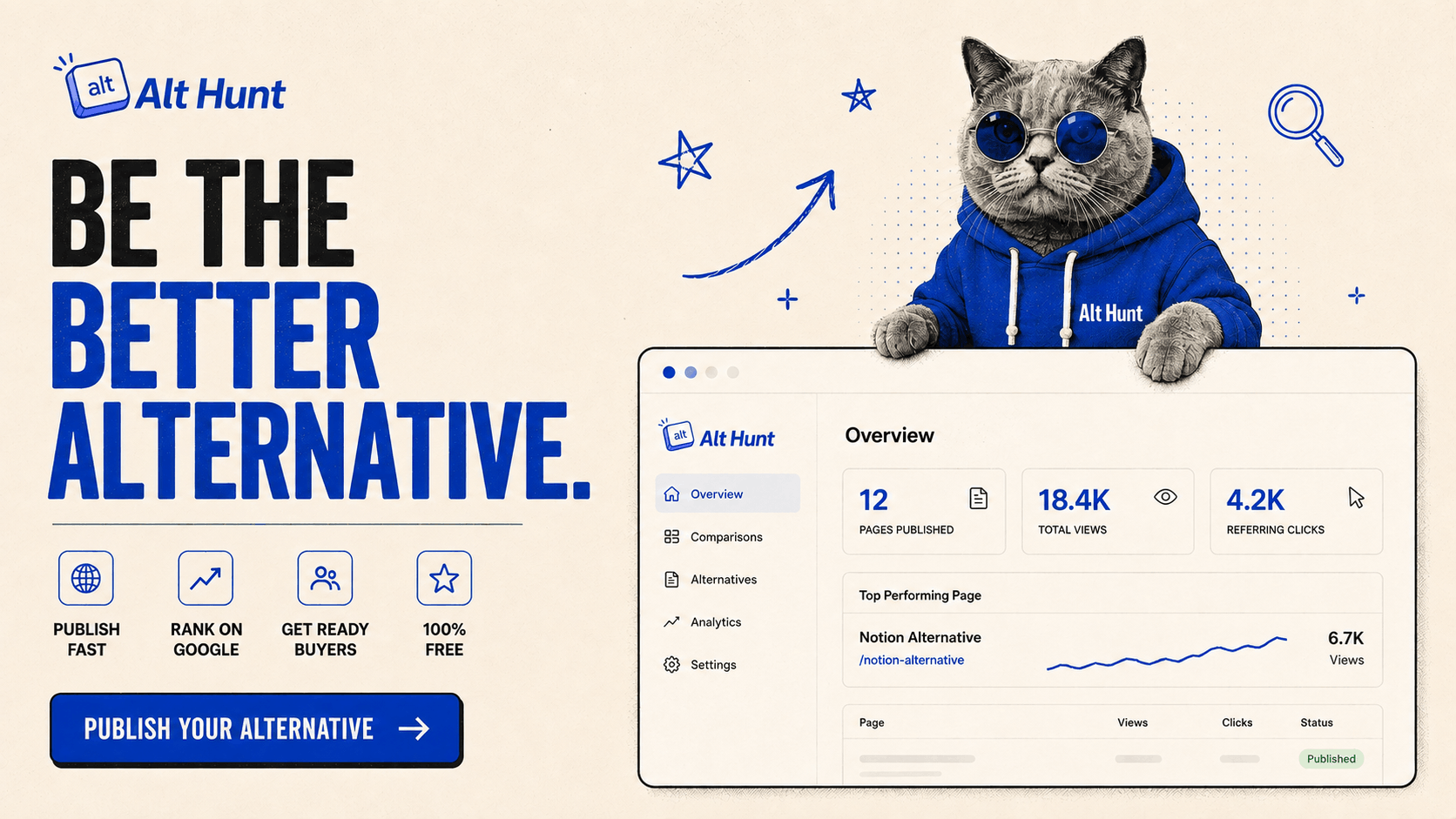
Alt Hunt helps buyers discover what is a better alternative.
That difference matters because product-name demand is usually small for a new startup. Buyers already know the market leaders. They search for phrases such as:
- Notion alternatives
- cheaper alternative to Loom
- Jira vs ClickUp
- open-source alternative to a known tool
- how to migrate from one platform to another
These searches indicate that the buyer understands the category and is actively evaluating a change.
Alt Hunt helps makers publish:
- Alternative pages
- Comparison matrices
- Pricing tradeoffs
- Migration guides
- Honest objection handling
- Community FAQs
- Structured feature breakdowns
- AI-search-friendly metadata
Core publishing is free. The goal is not to manufacture a one-day spike. The goal is to help the product get discovered where buyers are already looking.
Publish your alternative page for free
Frequently asked questions
Should I launch on more than one platform?
Yes. Use different platforms for different jobs: launch attention, technical feedback, early-stage curation, founder discussion, sales, directories, and long-term search discovery.
Is Product Hunt free to use?
Product Hunt provides a product submission flow. Founders should follow the current official launch guide and prepare their product page, assets, goals, and maker participation.
Which free platform is best for indie founders?
Uneed, Peerlist Launchpad, MicroLaunch, Show HN, Indie Hackers, and Alt Hunt solve different needs. The best choice depends on whether the priority is launch timing, feedback, technical users, founder community, or durable search traffic.
Is AppSumo a Product Hunt alternative?
It can be an alternative distribution channel, but it is a marketplace partnership rather than a simple launch board. AppSumo uses negotiated revenue sharing and evaluates products before acceptance.
Product Hunt is centered on discovering and discussing new products. Alt Hunt is centered on publishing alternative and comparison pages for buyers searching known competitors.
How long should a launch campaign run?
Treat the launch as a multi-week campaign. Submit to review queues early, schedule community launches separately, and continue publishing durable content after the launch.
- Where to Launch a SaaS Product in 2026: 25 Proven Platforms
- How to Launch Your SaaS for Free in 2026
- 10 Hacker News Alternatives for Launching a Technical Product
- How to Launch on Show HN Without Getting Ignored
- Top 10 Product Hunt Alternatives to Launch Your SaaS in 2026
Official sources and further reading
- https://www.indiehackers.com/
- https://althunt.io
- https://www.producthunt.com/launch
- https://www.uneed.best/launch-guide
- https://peerlist.io/launchpad
Platform rules, prices, review queues, and submission requirements can change. Verify the live official page before publishing or submitting.
About the Author

Building Inspo AI | AI-Powered Design Research & Builder Platform | Design Engineer.