
Product Hunt vs Hacker News: Which Launch Channel Is Better?
Product Hunt vs Hacker News: Which Launch Channel Is Better?. A practical, evidence-led guide for technical founders deciding where to introduce a product.
Founders often treat launch platforms, directories, competitor pages, and search visibility as separate tactics.
They are more useful when they operate as one discovery system.
This guide is written for technical founders deciding where to introduce a product searching for product hunt vs hacker news.
Key takeaway: Product Hunt is designed around product launches and early adopters; Show HN rewards personally built, non-trivial products that people can try and discuss technically.
The recommendations below avoid guaranteed ranking claims, artificial link building, fake reviews, copied comparison content, and other shortcuts that create weak buyer experiences. The goal is to help real buyers understand the market and discover the product when it is genuinely relevant.
Quick answer
Choose Product Hunt when the product fits a broad technology and early-adopter audience and the team wants a formal launch event.
Choose Show HN when the product is personally built, non-trivial, technically interesting, and easy for people to try without unnecessary barriers.
Show HN is not a general launch board.
Product Hunt
Product Hunt’s official guide says makers submit products to a global community. Community members can upvote, comment, and share them.
It supports:
- Visual product pages
- Maker comments
- Reviews
- Broad technology categories
- Public launch-day promotion
- Repeat launches for significant iterations
Show HN
The official Show HN guidelines say it is for something the maker built that other people can play with.
The guidelines exclude:
- Blog posts
- Signup pages
- Newsletters
- Lists
- Landing pages
- Fundraisers
The project should be non-trivial, personally built, and available for discussion.
HN explicitly recommends making the project easy to try, ideally without signup or email barriers.
Comparison
Comparison Matrix
2026 Verified| Area | Product Hunt | Show HN |
|---|---|---|
| Main audience | Product people and early adopters | Technical builders and HN readers |
| Format | Structured product launch | Discussion thread around usable work |
| Visual polish | Helpful | Not required |
| Technical depth | Optional | Often important |
| Signup barrier | Common | Ideally avoided |
| Marketing tolerance | Product-focused promotion is expected | Low tolerance for advertising tone |
| Best feedback | Product, design, positioning, use case | Technical, architecture, usability, tradeoffs |
Choose Product Hunt when
- The product is visual
- Broad early adopters are relevant
- The team wants reviews and launch social proof
- Signup is a normal part of the product
- The product has a clear public experience
Choose Show HN when
- People can try it immediately
- Technical depth is meaningful
- The founder can explain how and why it was built
- The product is early but usable
- The founder wants direct technical discussion
Use both carefully
A technical SaaS can launch on both, but the content should be different.
Product Hunt
Use polished screenshots, benefit-led copy, maker story, and public CTA.
Show HN
Use a factual title, direct demo, technical backstory, honest limitations, and a specific feedback request.
After the launch
Use recurring comparisons and objections to create Alt Hunt pages.
Product Hunt shows how product buyers describe the value. Show HN shows how technical users describe the tradeoffs.
Both can improve durable comparison content.
Editorial and operational checklist
Before publishing this page:
- Verify every changing claim
- Use the official product name
- Check all prices and plan names
- Link to primary sources
- Remove duplicate sections
- Confirm the title matches the intent
- Test every internal and external link
- Review mobile formatting
- Add original examples
- Disclose direct experience
- Separate facts from recommendations
- Include who should not use the recommended product
- Confirm the CTA is relevant
- Add the page to the sitemap
- Link to the page from at least one relevant existing page
- Record the review date internally
- Schedule the next accuracy review
For technical founders deciding where to introduce a product, the best content is not the page that repeats the keyword most often. It is the page that reduces uncertainty and helps the buyer complete the decision.
One technical SaaS, two different launches
Imagine an observability tool for AI agents.
Product Hunt page
Headline:
Debug AI-agent workflows with session timelines and failure traces.
Assets:
- Product screenshots
- Demo video
- Use cases
- Pricing
- Maker story
- Public signup
Show HN post
Title:
Show HN: AgentTrace – inspect tool calls and failures in local AI-agent runs
Opening comment:
- Why the founder built it
- Architecture
- Data model
- Performance tradeoffs
- How to run it
- What is open source
- What is not
- Technical feedback requested
The Product Hunt launch explains the product to a broad audience.
The Show HN launch explains the work to technical readers.
Risk of launching on Hacker News
A technical audience may question:
- Security
- Benchmarks
- Architecture
- Open-source claims
- Pricing
- Lock-in
- Data handling
- Performance
- Novelty
That is not a reason to avoid the channel.
It is a reason to prepare evidence.
Risk of launching on Product Hunt
A product may receive attention without technical depth or retained use.
Track activation and continued usage.
Final recommendation
Use Product Hunt for the product event.
Use Show HN for the technical conversation.
Use Alt Hunt for the long-term category comparison.
Technical launch preparation
Before Show HN:
- Make the product accessible
- Remove unnecessary signup barriers
- Prepare a demo
- Test the installation
- Publish documentation
- Explain data handling
- Prepare benchmark details
- List known limitations
- Make the founder available
- Use a factual title
- Avoid launch-day vote requests
Before Product Hunt:
- Prepare gallery images
- Record a demo
- Complete the product page
- Write the maker comment
- Define the launch goal
- Prepare support
- Test activation
- Notify the community authentically
Technical founders should prepare both sets rather than assuming one page fits both cultures.
Final decision checklist
Choose Product Hunt when:
- Broad product users matter
- Visual presentation matters
- Signup is expected
- Reviews and launch proof matter
- The product fits a public release
Choose Show HN when:
- Technical readers matter
- The product is personally built
- It is non-trivial
- People can try it
- The founder can discuss the work
- Honest technical feedback matters
A technical SaaS can use both, but should not use the same title, explanation, or barrier-heavy demo.
One final sequencing rule
Do not launch on Show HN merely because the product is technical.
Launch when the work is interesting to discuss and easy to try.
If the product requires procurement, a sales call, or a closed enterprise environment, Product Hunt or a targeted B2B channel may fit better.
If the product contains a public technical component, consider showing that component separately:
- Open-source library
- Benchmark
- Sandbox
- Developer tool
- Public demo
- Research result
Channel fit is more important than founder preference.
Final note
Product Hunt rewards a clear product launch. Show HN rewards a clear technical contribution. Choose the channel where the audience can evaluate the work on its own terms, then preserve the strongest questions as documentation and comparison content.
Practical takeaway
Let technical readers inspect the work, not only the marketing page. A usable demo and a precise explanation create the strongest discussion.
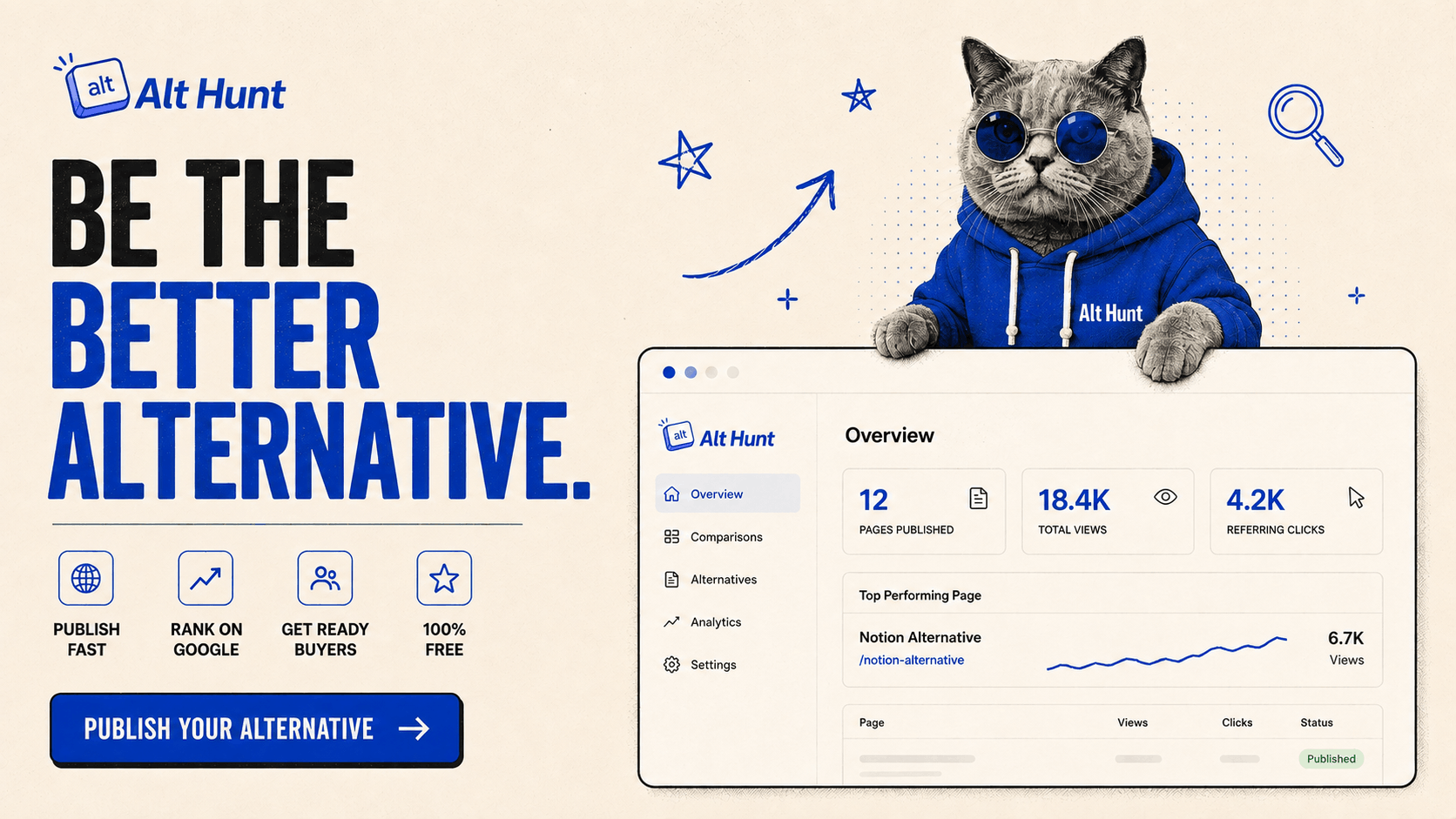
Alt Hunt helps SaaS makers publish alternative pages, comparison matrices, pricing tradeoffs, migration guides, and objection-handling content for buyers already evaluating software.
Alt Hunt is not a generic backlink service.
It is not a promise that publishing one page will create rankings.
Its role is to give founders a structured place to explain:
- Which known product they replace
- Who should switch
- Who should not switch
- Pricing differences
- Feature tradeoffs
- Migration effort
- Best use cases
- Limitations
- Sources and evidence
- Frequently asked questions
Core publishing is free.
Publish an alternative page on Alt Hunt
Frequently asked questions
Does publishing a page guarantee Google rankings?
No. Technical eligibility and good content do not guarantee crawling, indexing, ranking, traffic, or inclusion in AI-powered search experiences.
Should a founder publish hundreds of thin pages?
No. Publish pages only when the intent is distinct and the content provides original evidence, useful analysis, or a clear buyer decision.
No. Alt Hunt is an evergreen competitor-search discovery layer. Launch communities are better for live attention, feedback, and discussion.
How often should comparison pages be updated?
Review them after major product or competitor changes and run a broader accuracy review at least quarterly.
Should competitor claims link to sources?
Yes. Link to official pricing, documentation, changelogs, and direct evidence when the claim can change or materially affects the recommendation.
What is the most important measurement?
Measure qualified discovery: activated users, demos, retained customers, relevant referrals, and buyer questions—not only page views or backlinks.
- Best DevHunt Alternatives for Developer Tools
- 10 Hacker News Alternatives for Launching a Technical Product
- How to Launch on Show HN Without Getting Ignored
- 12 Best Launch Platforms for Developer Tools and APIs
- Product Hunt vs BetaList vs Uneed vs Alt Hunt
- Product Hunt vs Indie Hackers: Where Should You Launch?
Official sources and further reading
- https://www.producthunt.com/launch
- https://news.ycombinator.com/showhn.html
- https://news.ycombinator.com/newsfaq.html
- https://althunt.io
Search guidance, launch-platform features, submission rules, pricing, and indexing behavior can change. Verify official sources before publishing or acting on the advice.
About the Author

Building Inspo AI | AI-Powered Design Research & Builder Platform | Design Engineer.