
How to Launch on Show HN Without Getting Ignored
How to Launch on Show HN Without Getting Ignored. Compare platforms, submission models, audience fit, costs, and the best next step for technical builders pre
Launching a product is easier than building repeatable discovery.
A founder can spend weeks preparing one launch day, receive a short burst of attention, and then disappear from the places where buyers continue researching.
This guide is for technical builders preparing a Show HN post. It focuses on show hn launch guide and evaluates channels by the job they actually perform: launch exposure, feedback, sales, technical credibility, directory discovery, or long-term buyer intent.
Key takeaway: Follow the official rules: launch something personally built and immediately usable, explain the backstory, avoid sales language, and stay active in the discussion.
Quick answer
To succeed with show hn launch guide, do not treat the launch as a single post.
Prepare a product people can understand quickly, choose platforms that match the audience, publish useful founder context, stay available for questions, and create durable discovery pages that continue working after launch-day attention fades.
Alt Hunt fits the post-launch layer: makers publish structured alternative and comparison pages for high-intent buyers searching competitor terms.
Comparison table
Comparison Matrix
2026 Verified| Platform | Best for | Cost model | Discovery model |
|---|---|---|---|
| Show HN | technical products that people can try immediately | Free | community discussion around personally built work |
| Alt Hunt | evergreen competitor-search discovery | Free core publishing | alternative pages, comparisons, and migration guides |
| GitHub | open-source and developer-facing products | Free public repositories | code hosting and developer discovery |
| Product Hunt | a concentrated launch day and early-adopter feedback | Free submission | daily launch board and product profiles |
| Peerlist Launchpad | developers and designers with credible profiles | Free | weekly profile-linked launches |
Understand what Show HN is
Show HN is for something you personally made that other people can try.
The official guidelines explicitly exclude ordinary blog posts, newsletters, lists, signup pages, and other material that cannot be used or tested. A landing page alone is not enough.
The community is comfortable with early work. It is less comfortable with marketing copy, barriers, and vague claims.
Before posting
Reduce barriers. Provide a demo, public example, repository, sandbox, or limited no-signup experience when possible.
Prepare a plain title
Use the format:
`Show HN: Product Name – direct explanation`
Avoid hype words. Explain what the product does.
Write the first comment
Explain:
- Why you built it
- What problem you experienced
- What is technically interesting
- What is incomplete
- What feedback you want
- How people can try it
Be available
A Show HN is a discussion, not a scheduled press release. Stay available to answer technical questions, acknowledge bugs, and explain tradeoffs.
What gets ignored
Posts commonly struggle when the product is inaccessible, the title is vague, the first comment is missing, the founder disappears, or the page is written like an advertisement.
After the thread
Fix the useful issues. Write a technical follow-up. Update documentation. Publish comparison pages when readers repeatedly compare the product with known alternatives.
Alt Hunt is useful here because the HN discussion reveals the exact questions buyers ask. Those questions can become durable comparison, objection-handling, and migration content.
How this guide evaluates platforms
The rankings are not based only on popularity.
Each option is evaluated against five questions:
- Audience fit: Are the people browsing the platform plausible users, buyers, partners, or useful reviewers for technical builders preparing a show hn post?
- Launch mechanics: Is the platform daily, weekly, monthly, curated, community-ranked, marketplace-based, or search-based?
- Cost and commitment: Is submission free? Is there a queue, optional promotion, revenue share, or annual commitment?
- Durability: Does the product receive only a launch moment, or does the profile remain useful and discoverable?
- Founder effort: Does the platform require an established profile, a detailed story, community participation, technical access, or ongoing support?
A platform can be excellent for one job and weak for another. Show HN can be valuable for technical feedback but unsuitable for a product that cannot be tried. AppSumo can create sales but introduces commercial and support considerations. BetaList can fit an early product but may not suit an established launch. Alt Hunt can build search discovery but does not replace live community interaction.
Use the comparison as a portfolio decision, not a universal ranking.
Example Show HN structure
A practical Show HN submission can follow this outline:
Title
`Show HN: Clear product name – factual description`
The title should tell readers what they can try. Avoid words such as revolutionary, game-changing, ultimate, or best.
Opening
Explain the personal problem in two or three sentences.
What it does
Describe the product plainly. Mention the important limitation early.
What is interesting
Explain the technical decision, unusual constraint, dataset, architecture, performance result, open-source component, or design tradeoff that may interest the community.
How to try it
Give readers a working link, public demo, repository, sample input, or sandbox. Explain whether signup is required.
What feedback you want
Ask specific questions. For example:
- Is the onboarding understandable?
- Does the API design feel natural?
- Which deployment concern would block adoption?
- Is the benchmark methodology fair?
- What should be open-sourced?
During the discussion
Answer the strongest criticism first. Do not become defensive. If someone reports a bug, reproduce it and explain the fix. If the answer is unknown, say so.
Avoid turning every comment into a sales reply. The purpose is to discuss the work.
If the post receives little attention
Do not repeatedly repost the same launch immediately. Improve the product, explanation, demo, or technical story. A separate engineering article may fit Hacker News better than another product announcement.
The thread is still useful research. The objections, comparisons, and terminology can improve documentation and future Alt Hunt pages. A launch with low points can still reveal how technical buyers describe the problem.
A final pre-publish check
Open the submission from a logged-out browser. Confirm that the product loads, the core action works, the documentation is understandable, and the title describes the project accurately. Remove forced newsletter popups and unnecessary tracking friction from the first experience.
Prepare to explain one technical compromise honestly. Show HN readers usually respond better to a real tradeoff than to polished claims that avoid limitations.
Preserve what you learn
Save the strongest questions, objections, and technical comparisons from the thread. They are direct language from potential users and can improve documentation, onboarding, future release notes, and comparison content.
Most launch platforms help people discover what is new.
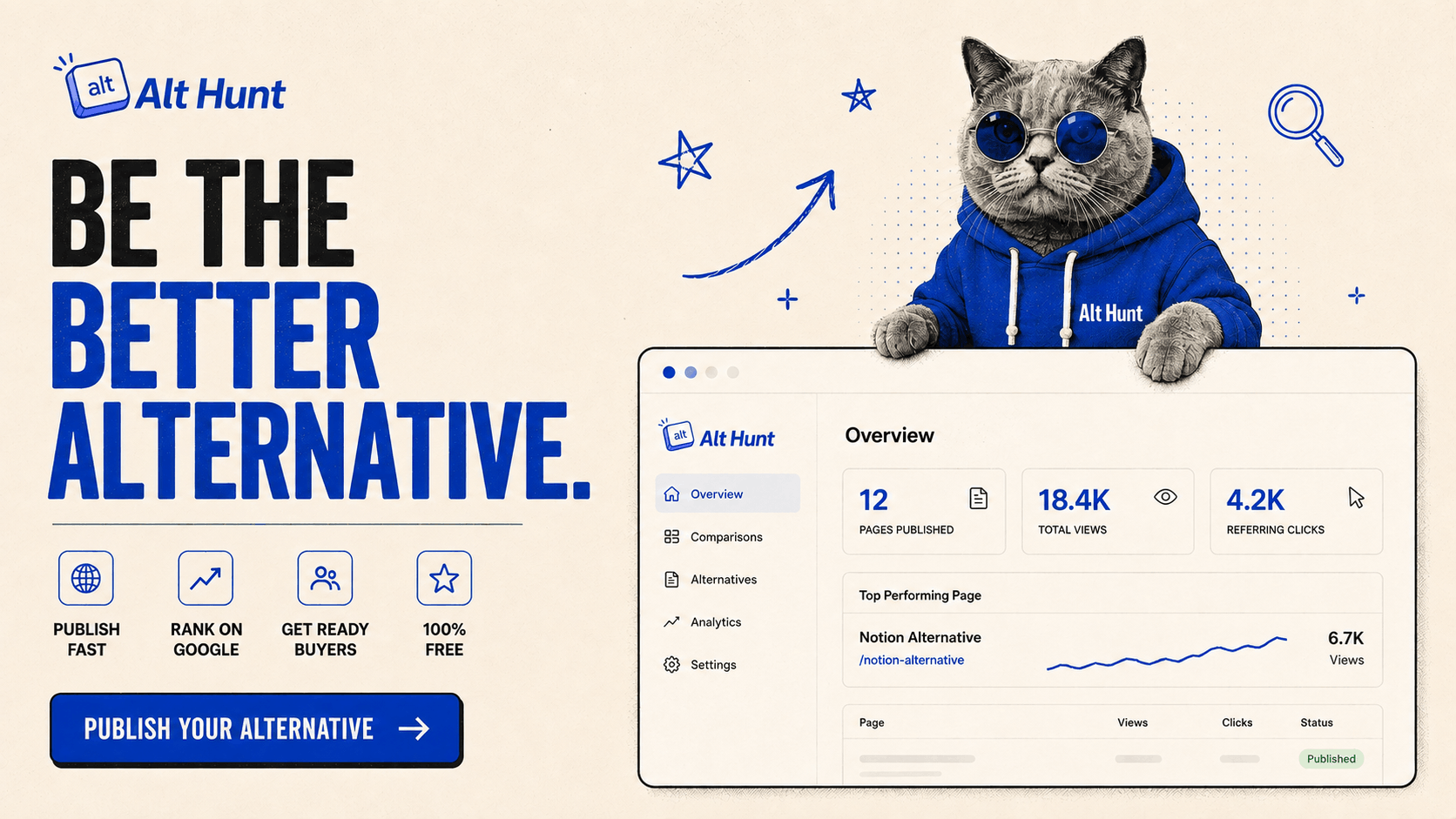
Alt Hunt helps buyers discover what is a better alternative.
That difference matters because product-name demand is usually small for a new startup. Buyers already know the market leaders. They search for phrases such as:
- Notion alternatives
- cheaper alternative to Loom
- Jira vs ClickUp
- open-source alternative to a known tool
- how to migrate from one platform to another
These searches indicate that the buyer understands the category and is actively evaluating a change.
Alt Hunt helps makers publish:
- Alternative pages
- Comparison matrices
- Pricing tradeoffs
- Migration guides
- Honest objection handling
- Community FAQs
- Structured feature breakdowns
- AI-search-friendly metadata
Core publishing is free. The goal is not to manufacture a one-day spike. The goal is to help the product get discovered where buyers are already looking.
Publish your alternative page for free
Frequently asked questions
Should I launch on more than one platform?
Yes. Use different platforms for different jobs: launch attention, technical feedback, early-stage curation, founder discussion, sales, directories, and long-term search discovery.
Is Product Hunt free to use?
Product Hunt provides a product submission flow. Founders should follow the current official launch guide and prepare their product page, assets, goals, and maker participation.
Which free platform is best for indie founders?
Uneed, Peerlist Launchpad, MicroLaunch, Show HN, Indie Hackers, and Alt Hunt solve different needs. The best choice depends on whether the priority is launch timing, feedback, technical users, founder community, or durable search traffic.
Is AppSumo a Product Hunt alternative?
It can be an alternative distribution channel, but it is a marketplace partnership rather than a simple launch board. AppSumo uses negotiated revenue sharing and evaluates products before acceptance.
Product Hunt is centered on discovering and discussing new products. Alt Hunt is centered on publishing alternative and comparison pages for buyers searching known competitors.
How long should a launch campaign run?
Treat the launch as a multi-week campaign. Submit to review queues early, schedule community launches separately, and continue publishing durable content after the launch.
- Best DevHunt Alternatives for Developer Tools
- 10 Hacker News Alternatives for Launching a Technical Product
- How to Launch Your SaaS for Free in 2026
- Best Peerlist Launch Alternatives for Developers and Designers
- How to Launch Your SaaS on Indie Hackers in 2026
Official sources and further reading
- https://news.ycombinator.com/showhn.html
- https://news.ycombinator.com/newsfaq.html
- https://news.ycombinator.com/yli.html
- https://althunt.io
Platform rules, prices, review queues, and submission requirements can change. Verify the live official page before publishing or submitting.
About the Author

Building Inspo AI | AI-Powered Design Research & Builder Platform | Design Engineer.