
How to Launch Your SaaS for Free in 2026
How to Launch Your SaaS for Free in 2026. Compare platforms, submission models, audience fit, costs, and the best next step for bootstrapped founders launchin
Launching a product is easier than building repeatable discovery.
A founder can spend weeks preparing one launch day, receive a short burst of attention, and then disappear from the places where buyers continue researching.
This guide is for bootstrapped founders launching with no marketing budget. It focuses on launch saas for free and evaluates channels by the job they actually perform: launch exposure, feedback, sales, technical credibility, directory discovery, or long-term buyer intent.
Key takeaway: Provide a practical zero-budget launch sequence using owned pages, launch communities, directories, and direct outreach.
Quick answer
To succeed with launch saas for free, do not treat the launch as a single post.
Prepare a product people can understand quickly, choose platforms that match the audience, publish useful founder context, stay available for questions, and create durable discovery pages that continue working after launch-day attention fades.
Alt Hunt fits the post-launch layer: makers publish structured alternative and comparison pages for high-intent buyers searching competitor terms.
Comparison table
Comparison Matrix
2026 Verified| Platform | Best for | Cost model | Discovery model |
|---|---|---|---|
| Alt Hunt | evergreen competitor-search discovery | Free core publishing | alternative pages, comparisons, and migration guides |
| Product Hunt | a concentrated launch day and early-adopter feedback | Free submission | daily launch board and product profiles |
| Uneed | a scheduled launch with a free queue | Free queue; paid date selection is optional | social launchpad with an assigned launch date |
| Peerlist Launchpad | developers and designers with credible profiles | Free | weekly profile-linked launches |
| MicroLaunch | extended exposure, reviews, and gradual feedback | Free entry with optional premium exposure | monthly ranking and extended launch visibility |
| BetaList | unreleased, private-beta, and recently launched startups | Submission available; review and placement rules apply | curated early-stage startup discovery |
| Fazier | daily discovery and optional promoted visibility | Free submission with paid promotion options | product launches and directory discovery |
| Tiny Startups | small, bootstrapped, and indie products | Free review queue plus paid tiers | curated startup launches and profiles |
| Show HN | technical products that people can try immediately | Free | community discussion around personally built work |
| Indie Hackers | founder stories, progress, and peer discussion | Free community participation | builder community posts, product pages, and conversations |
| niche conversations and problem-specific communities | Free | subreddit discussions | |
| B2B founder-led distribution | Free organic publishing | professional network and content feed | |
| X | fast founder updates and network-driven launches | Free organic publishing | public social feed |
A zero-budget SaaS launch plan
Week 1: Prepare the evidence
Create a clear landing page, short demo, screenshots, pricing, FAQ, and one sentence explaining who the product is for. Test signup, onboarding, password resets, mobile layout, and transactional emails.
Create a list of the competitors buyers already know. These names become the foundation for alternative and comparison pages.
Week 2: Prepare launch assets
Create:
- Product name and tagline
- Square logo
- Product screenshots
- Short demo video
- Founder story
- Technical explanation
- FAQ answers
- A launch-day post
- A direct message for early supporters
- An Alt Hunt comparison or alternative page
Week 3: Submit to review queues
BetaList expects relatively new products. Uneed offers a free waiting line. Tiny Startups places free submissions into a review queue. Submit early instead of assuming every platform publishes immediately.
Week 4: Run the community launch
Launch on Product Hunt or the platform best aligned with the audience. Technical products can use Show HN when the project is immediately usable. Developers and designers can use Peerlist Launchpad. Indie founders can share the build story on Indie Hackers.
After launch: keep the discovery alive
Publish relevant directory profiles. Answer every useful question. Turn recurring objections into FAQ content. Publish comparisons and migration guidance on Alt Hunt.
A free launch does not mean zero effort. It means replacing advertising spend with preparation, useful content, participation, and consistent follow-up.
How this guide evaluates platforms
The rankings are not based only on popularity.
Each option is evaluated against five questions:
- Audience fit: Are the people browsing the platform plausible users, buyers, partners, or useful reviewers for bootstrapped founders launching with no marketing budget?
- Launch mechanics: Is the platform daily, weekly, monthly, curated, community-ranked, marketplace-based, or search-based?
- Cost and commitment: Is submission free? Is there a queue, optional promotion, revenue share, or annual commitment?
- Durability: Does the product receive only a launch moment, or does the profile remain useful and discoverable?
- Founder effort: Does the platform require an established profile, a detailed story, community participation, technical access, or ongoing support?
A platform can be excellent for one job and weak for another. Show HN can be valuable for technical feedback but unsuitable for a product that cannot be tried. AppSumo can create sales but introduces commercial and support considerations. BetaList can fit an early product but may not suit an established launch. Alt Hunt can build search discovery but does not replace live community interaction.
Use the comparison as a portfolio decision, not a universal ranking.
Free does not mean careless
A zero-budget launch still needs professional execution.
Use one consistent product identity
Directory submissions often remain online for years. Use the same product name, website URL, logo, short description, category, and founder information everywhere. Inconsistent profiles confuse buyers and search systems.
Protect the founder’s time
Do not submit to 100 random websites in one day. Start with platforms that match the audience. A developer API belongs on technical communities. A B2B workflow product belongs in professional and SaaS directories. A consumer mobile app needs consumer discovery channels.
Track the source
Use tagged URLs or a simple source field during signup so the team can distinguish Product Hunt, Uneed, BetaList, Reddit, LinkedIn, directories, and Alt Hunt traffic.
Measure:
- Qualified signups
- Activation
- Retained users
- Customer conversations
- Useful feedback
- Referring links
- Branded searches
- Comparison-page visits
A platform that produces fewer visits but more activated users may be more valuable than the platform producing a large bounce-heavy spike.
A no-budget asset checklist
Before launch, prepare:
- One-sentence positioning
- Clear homepage headline
- Product screenshots
- Short demo video
- Transparent access or pricing
- Founder story
- FAQ
- Public changelog
- Support contact
- Privacy and terms pages
- Product Hunt assets
- Directory description
- Social launch post
- Competitor list
- Alt Hunt alternative page
The competitor list is especially important. New products rarely have meaningful branded search demand. Competitor and category searches are how many buyers express the problem before they know the new product exists.
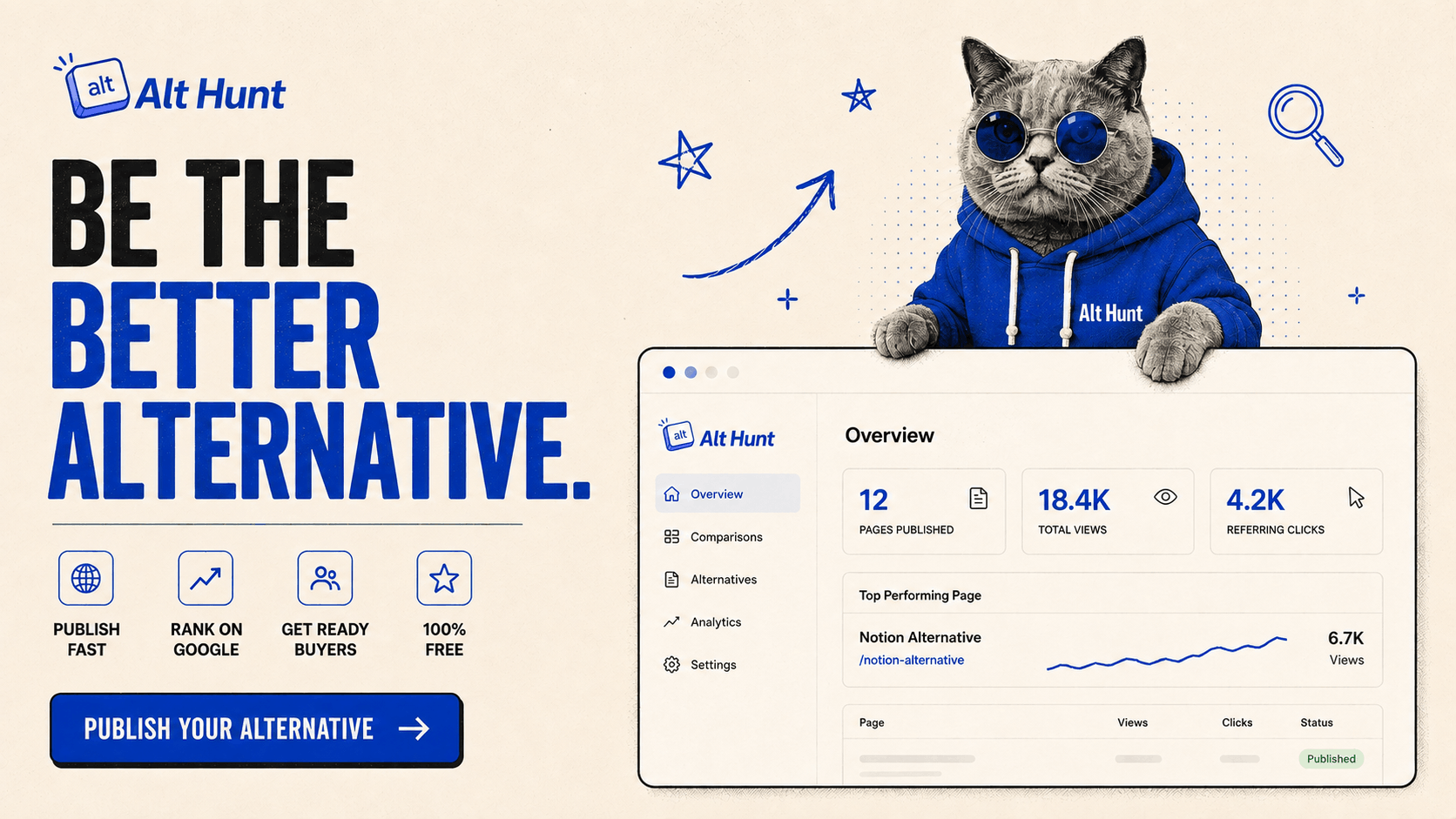
Most launch platforms help people discover what is new.
Alt Hunt helps buyers discover what is a better alternative.
That difference matters because product-name demand is usually small for a new startup. Buyers already know the market leaders. They search for phrases such as:
- Notion alternatives
- cheaper alternative to Loom
- Jira vs ClickUp
- open-source alternative to a known tool
- how to migrate from one platform to another
These searches indicate that the buyer understands the category and is actively evaluating a change.
Alt Hunt helps makers publish:
- Alternative pages
- Comparison matrices
- Pricing tradeoffs
- Migration guides
- Honest objection handling
- Community FAQs
- Structured feature breakdowns
- AI-search-friendly metadata
Core publishing is free. The goal is not to manufacture a one-day spike. The goal is to help the product get discovered where buyers are already looking.
Publish your alternative page for free
Frequently asked questions
Should I launch on more than one platform?
Yes. Use different platforms for different jobs: launch attention, technical feedback, early-stage curation, founder discussion, sales, directories, and long-term search discovery.
Is Product Hunt free to use?
Product Hunt provides a product submission flow. Founders should follow the current official launch guide and prepare their product page, assets, goals, and maker participation.
Which free platform is best for indie founders?
Uneed, Peerlist Launchpad, MicroLaunch, Show HN, Indie Hackers, and Alt Hunt solve different needs. The best choice depends on whether the priority is launch timing, feedback, technical users, founder community, or durable search traffic.
Is AppSumo a Product Hunt alternative?
It can be an alternative distribution channel, but it is a marketplace partnership rather than a simple launch board. AppSumo uses negotiated revenue sharing and evaluates products before acceptance.
Product Hunt is centered on discovering and discussing new products. Alt Hunt is centered on publishing alternative and comparison pages for buyers searching known competitors.
How long should a launch campaign run?
Treat the launch as a multi-week campaign. Submit to review queues early, schedule community launches separately, and continue publishing durable content after the launch.
- 20 Free SaaS Launch Platforms to Submit Your Product in 2026
- Where to Launch a SaaS Product in 2026: 25 Proven Platforms
- Best Free Product Hunt Alternatives for Indie Makers
- How to Launch on Show HN Without Getting Ignored
- How to Launch Your SaaS on Indie Hackers in 2026
Official sources and further reading
- https://althunt.io
- https://www.producthunt.com/launch/before-launch
- https://www.uneed.best/launch-guide
- https://help.peerlist.io/individual/launchpad/guidelines-faqs
- https://news.ycombinator.com/showhn.html
Platform rules, prices, review queues, and submission requirements can change. Verify the live official page before publishing or submitting.
About the Author

Building Inspo AI | AI-Powered Design Research & Builder Platform | Design Engineer.