
Where to Launch a SaaS Product in 2026: 25 Proven Platforms
Where to Launch a SaaS Product in 2026: 25 Proven Platforms. Compare platforms, submission models, audience fit, costs, and the best next step for founders pr
Launching a product is easier than building repeatable discovery.
A founder can spend weeks preparing one launch day, receive a short burst of attention, and then disappear from the places where buyers continue researching.
This guide is for founders preparing a SaaS launch. It focuses on where to launch a saas product and evaluates channels by the job they actually perform: launch exposure, feedback, sales, technical credibility, directory discovery, or long-term buyer intent.
Key takeaway: Build a channel stack rather than betting everything on one leaderboard.
Quick answer
To succeed with where to launch a saas product, do not treat the launch as a single post.
Prepare a product people can understand quickly, choose platforms that match the audience, publish useful founder context, stay available for questions, and create durable discovery pages that continue working after launch-day attention fades.
Alt Hunt fits the post-launch layer: makers publish structured alternative and comparison pages for high-intent buyers searching competitor terms.
Comparison table
Comparison Matrix
2026 Verified| Platform | Best for | Cost model | Discovery model |
|---|---|---|---|
| Product Hunt | a concentrated launch day and early-adopter feedback | Free submission | daily launch board and product profiles |
| Alt Hunt | evergreen competitor-search discovery | Free core publishing | alternative pages, comparisons, and migration guides |
| Uneed | a scheduled launch with a free queue | Free queue; paid date selection is optional | social launchpad with an assigned launch date |
| Peerlist Launchpad | developers and designers with credible profiles | Free | weekly profile-linked launches |
| MicroLaunch | extended exposure, reviews, and gradual feedback | Free entry with optional premium exposure | monthly ranking and extended launch visibility |
| BetaList | unreleased, private-beta, and recently launched startups | Submission available; review and placement rules apply | curated early-stage startup discovery |
| Fazier | daily discovery and optional promoted visibility | Free submission with paid promotion options | product launches and directory discovery |
| Tiny Startups | small, bootstrapped, and indie products | Free review queue plus paid tiers | curated startup launches and profiles |
| Show HN | technical products that people can try immediately | Free | community discussion around personally built work |
| Indie Hackers | founder stories, progress, and peer discussion | Free community participation | builder community posts, product pages, and conversations |
| AppSumo | revenue-generating campaigns and deal-led acquisition | No upfront listing fee; negotiated revenue share | curated software marketplace and campaign |
| SaaSHub | software alternatives and category discovery | Submission available | software directory, alternatives, and reviews |
| AlternativeTo | buyers explicitly searching for replacements | Community submission | crowdsourced software alternatives |
| niche conversations and problem-specific communities | Free | subreddit discussions | |
| B2B founder-led distribution | Free organic publishing | professional network and content feed |
Build a launch portfolio, not a single launch
A SaaS launch has four different jobs:
- Create initial attention
- Generate useful feedback
- Establish trust and proof
- Build durable discovery
No single website is consistently best at all four.
Product Hunt can create a concentrated launch moment. BetaList can fit an unreleased or recently launched startup. Show HN can produce technical feedback when the product is immediately usable. AppSumo can become a revenue-generating campaign. Alt Hunt helps the product become visible in competitor and alternatives searches.
A 25-channel launch map
Launch boards
Use Product Hunt, Uneed, Peerlist Launchpad, MicroLaunch, BetaList, Fazier, and Tiny Startups.Technical communities
Use Show HN, GitHub, Dev.to, Hashnode, and technical subreddits.Founder communities
Use Indie Hackers, founder Slack groups, newsletters, and trusted private communities.Social distribution
Use LinkedIn for B2B audiences and X for fast maker-network distribution.Marketplaces and directories
Use AppSumo for a negotiated commercial campaign. Use SaaSHub and AlternativeTo for category and alternatives discovery.Durable search assets
Use Alt Hunt to publish competitor comparisons, alternatives pages, and migration guides.Recommended order
Prepare the Product Hunt or primary launch first. Publish the founder story and technical explanation before launch day. Submit to platforms with review queues early. Schedule weekly or monthly launch platforms separately so the attention does not arrive all at once.
After the launch, turn objections and questions into comparison content. If several users ask, “How is this different from X?”, that is a signal to publish an X alternative page.
The best launch calendar spreads attention over several weeks rather than trying to force every channel into one day.
How this guide evaluates platforms
The rankings are not based only on popularity.
Each option is evaluated against five questions:
- Audience fit: Are the people browsing the platform plausible users, buyers, partners, or useful reviewers for founders preparing a saas launch?
- Launch mechanics: Is the platform daily, weekly, monthly, curated, community-ranked, marketplace-based, or search-based?
- Cost and commitment: Is submission free? Is there a queue, optional promotion, revenue share, or annual commitment?
- Durability: Does the product receive only a launch moment, or does the profile remain useful and discoverable?
- Founder effort: Does the platform require an established profile, a detailed story, community participation, technical access, or ongoing support?
A platform can be excellent for one job and weak for another. Show HN can be valuable for technical feedback but unsuitable for a product that cannot be tried. AppSumo can create sales but introduces commercial and support considerations. BetaList can fit an early product but may not suit an established launch. Alt Hunt can build search discovery but does not replace live community interaction.
Use the comparison as a portfolio decision, not a universal ranking.
A practical 30-day launch calendar
Days 1–7: Prepare the conversion path
Before submitting anywhere, make sure a visitor can understand the product in less than a minute. The landing page should explain the buyer, problem, outcome, pricing or access model, and next step. Add a short demo and answer the objections already appearing in user calls.
Create a source-of-truth launch document containing the approved product name, tagline, description, logo, screenshots, demo URL, founder bios, social links, categories, pricing, and support contact. Reusing this document prevents inconsistent directory profiles.
Days 8–14: Submit to queues and curate proof
Platforms with review queues should receive the product before the public launch. Submit to BetaList if the product meets its early-stage criteria, Uneed’s free queue, Tiny Startups, and selected directories.
Collect early-user quotes only when they are real and attributable. Fix onboarding problems before inviting a larger audience.
Days 15–21: Publish the launch story
Write a founder post explaining why the product exists, what changed during building, and what feedback is needed. Prepare versions for Product Hunt, Indie Hackers, LinkedIn, X, and any niche community.
Technical products should prepare documentation, examples, and a direct way to try the product before considering Show HN.
Days 22–30: Spread and preserve attention
Run the primary launch, then schedule the secondary platforms on different days. Answer questions quickly. Record every comparison users make.
When people ask, “How is this different from X?”, publish the answer as a structured Alt Hunt comparison. When they ask whether migration is difficult, publish a migration guide. When they mention pricing, add a pricing tradeoff section.
The 30-day plan turns launch feedback into content that continues to answer future buyers.
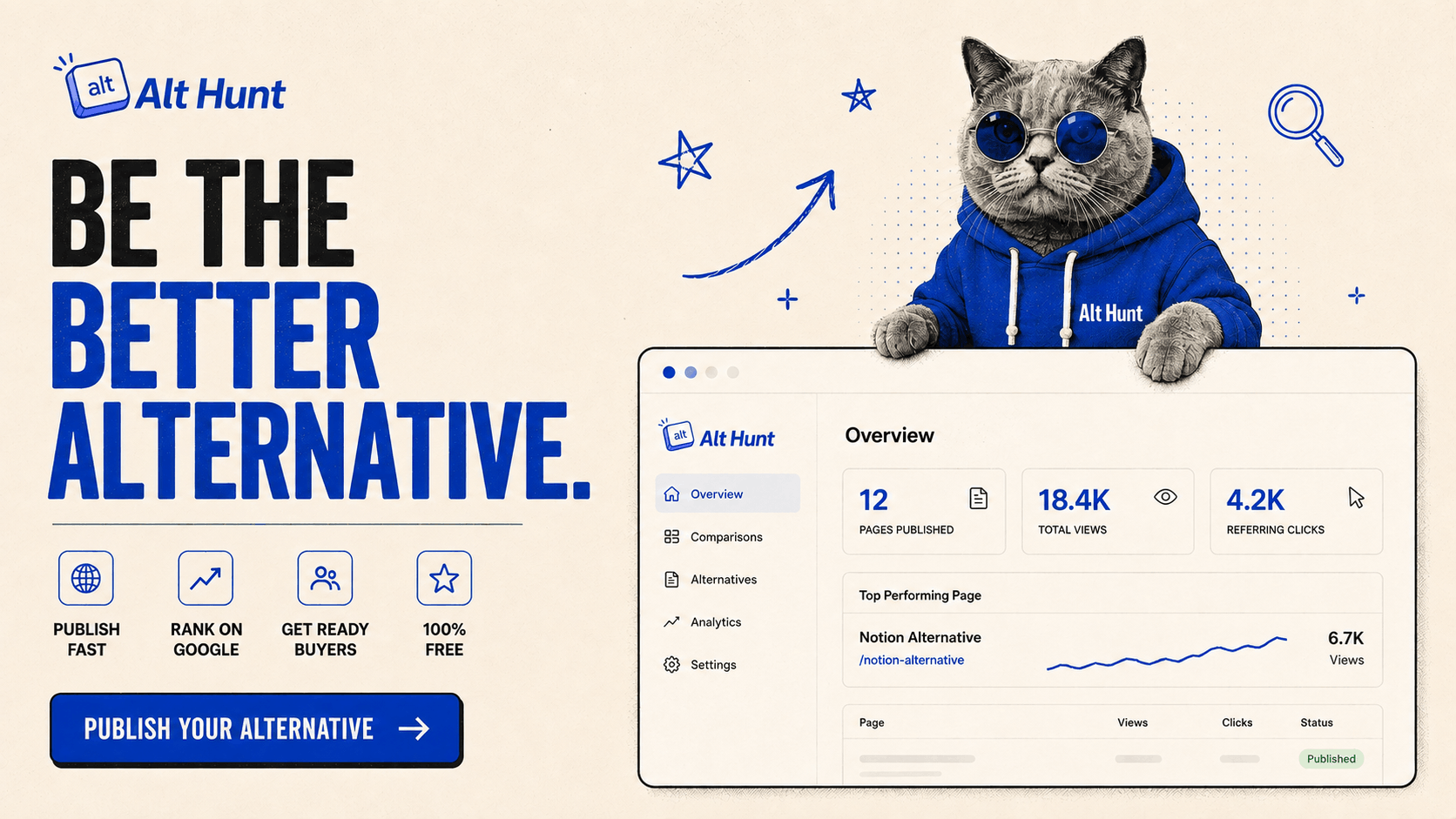
Most launch platforms help people discover what is new.
Alt Hunt helps buyers discover what is a better alternative.
That difference matters because product-name demand is usually small for a new startup. Buyers already know the market leaders. They search for phrases such as:
- Notion alternatives
- cheaper alternative to Loom
- Jira vs ClickUp
- open-source alternative to a known tool
- how to migrate from one platform to another
These searches indicate that the buyer understands the category and is actively evaluating a change.
Alt Hunt helps makers publish:
- Alternative pages
- Comparison matrices
- Pricing tradeoffs
- Migration guides
- Honest objection handling
- Community FAQs
- Structured feature breakdowns
- AI-search-friendly metadata
Core publishing is free. The goal is not to manufacture a one-day spike. The goal is to help the product get discovered where buyers are already looking.
Publish your alternative page for free
Frequently asked questions
Should I launch on more than one platform?
Yes. Use different platforms for different jobs: launch attention, technical feedback, early-stage curation, founder discussion, sales, directories, and long-term search discovery.
Is Product Hunt free to use?
Product Hunt provides a product submission flow. Founders should follow the current official launch guide and prepare their product page, assets, goals, and maker participation.
Which free platform is best for indie founders?
Uneed, Peerlist Launchpad, MicroLaunch, Show HN, Indie Hackers, and Alt Hunt solve different needs. The best choice depends on whether the priority is launch timing, feedback, technical users, founder community, or durable search traffic.
Is AppSumo a Product Hunt alternative?
It can be an alternative distribution channel, but it is a marketplace partnership rather than a simple launch board. AppSumo uses negotiated revenue sharing and evaluates products before acceptance.
Product Hunt is centered on discovering and discussing new products. Alt Hunt is centered on publishing alternative and comparison pages for buyers searching known competitors.
How long should a launch campaign run?
Treat the launch as a multi-week campaign. Submit to review queues early, schedule community launches separately, and continue publishing durable content after the launch.
- 15 Best Product Launch Platforms for Startups in 2026
- 20 Free SaaS Launch Platforms to Submit Your Product in 2026
- How to Launch Your SaaS for Free in 2026
- 10 Hacker News Alternatives for Launching a Technical Product
- How to Launch Your SaaS on Indie Hackers in 2026
Official sources and further reading
- https://www.producthunt.com/launch
- https://althunt.io
- https://www.uneed.best/launch-guide
- https://peerlist.io/launchpad
- https://microlaunch.net/
- https://betalist.com/criteria
- https://news.ycombinator.com/showhn.html
- https://sell.appsumo.com/
Platform rules, prices, review queues, and submission requirements can change. Verify the live official page before publishing or submitting.
About the Author

Building Inspo AI | AI-Powered Design Research & Builder Platform | Design Engineer.