

20 Free AI Tool Directories for More Visibility in 2026
20 Free AI Tool Directories for More Visibility in 2026. A practical guide for bootstrapped AI founders who cannot pay for every directory covering channels,
A launch is not a single announcement. It is a sequence of decisions about audience, proof, participation, conversion, and what remains discoverable after the initial attention disappears.
This guide is written for bootstrapped AI founders who cannot pay for every directory searching for free ai tool directories.
Key takeaway: Focus on genuinely free or community-submitted channels and clearly separate paid editorial listings.
The goal is not to manufacture noise. It is to create qualified conversations, learn from the market, improve the product, and build discovery assets that continue helping buyers after launch day.
The five jobs of a launch
A useful launch system performs five different jobs.
1. Explain the product
A visitor should quickly understand who the product is for, what problem it solves, what changes after using it, and how to try it.
2. Create proof
Screenshots, demos, real examples, customer language, founder context, pricing, and a clear product experience create more trust than generic claims.
3. Reach the right audience
A large audience with weak relevance can create traffic without activation. A smaller community with the exact problem may create fewer visits and more useful customers.
4. Capture feedback
Launch comments should change the product, positioning, onboarding, documentation, and future content. Feedback has little value when it is collected and ignored.
5. Preserve discovery
Community posts and launch boards move quickly. The product needs durable profiles, category listings, comparisons, migration guides, and search pages that remain useful later.
Alt Hunt is designed for the fifth job. It helps makers publish comparison and alternative pages for buyers who already know the category and are actively evaluating a switch.
How to identify a genuinely free directory
Before adding a directory to the submission list, check:
- Is there a no-cost submission form?
- Is payment required before review?
- Is the free listing delayed or limited?
- Is publication guaranteed?
- Does a paid plan control the link?
- Is the listing marked as sponsored?
- Can the maker update the product later?
- Does the platform require a backlink or badge?
- Is the platform active?
- Does the audience match the product?
Futurepedia’s official submission page currently displays paid listing options, so it belongs in a paid AI-directory plan, not a free-directory list.
Free channels include general launch platforms, community submissions, open-source ecosystems, founder communities, and owned publishing. They may require more effort because the founder must earn attention through usefulness.
A free AI distribution stack
- Product Hunt for a public launch
- Show HN for a usable technical product
- GitHub for open-source proof
- Peerlist Launchpad for builder discovery
- Uneed or MicroLaunch for another launch cycle
- Dev.to or Hashnode for technical content
- SaaSHub or AlternativeTo for category discovery
- Reddit for relevant community discussion
- LinkedIn or X for founder distribution
- Alt Hunt for competitor-search pages
Do not submit identical generic copy to every channel. Adapt the explanation to the audience.
Free AI directory submission workflow
Step 1: Build the source record
Create one accurate product record with approved descriptions, screenshots, pricing, categories, privacy details, and competitor names.
Step 2: Verify the directory
Confirm that the site is active, indexed, relevant, and accepts a real free submission.
Step 3: Submit manually
Manual submission reduces category errors and lets the founder adapt the description.
Step 4: Record the status
Track submitted, under review, published, rejected, paid-only, badge required, or unavailable.
Step 5: Verify the live page
Check the title, URL, logo, pricing, links, and category.
Step 6: Maintain the listing
Update major pricing, positioning, and product changes.
Do not trade quality for quantity
A list of 100 unverified directories creates busywork. Prioritize platforms with active pages, relevant buyers, persistent listings, and clear editorial standards.
Use free channels together
A free directory is more useful when it supports a wider system:
- Launch page
- Founder story
- Technical article
- Product demo
- Comparison page
- Integration content
- Customer evidence
Alt Hunt can hold the durable competitor comparison while directories create additional discovery points.
How to evaluate this strategy
Use a simple scorecard for free ai tool directories.
Audience fit
Are likely users, buyers, partners, or useful reviewers active in the channel?
Product fit
Can the product be understood and tried in the format the channel expects?
Founder fit
Can the founder participate authentically, answer questions, and continue the conversation?
Conversion path
Is there one clear next step after the post?
Durability
Will the page, profile, relationship, or content remain useful after the initial attention?
Cost
Consider money, preparation, support, review queues, revenue share, and ongoing maintenance.
Learning value
Will the channel reveal language, objections, comparisons, or product problems that improve the company?
Do not rank channels by visits alone. A small number of activated users, technical contributors, qualified demos, or relevant buyer questions can be more valuable than a large temporary spike.
A practical 30-day operating plan
Week 1: Prepare
Finalize positioning, product access, proof, analytics, support, privacy, terms, and the source-of-truth launch document.
Week 2: Publish the foundation
Create the primary launch page, founder story, demo, technical explanation where relevant, directory profiles, and the first Alt Hunt comparison page.
Week 3: Run the launch
Publish on the main platform, participate in the chosen community, answer questions, fix urgent issues, and record the language people use.
Week 4: Build the baseline
Follow up with activated users, publish a retrospective, update onboarding, add FAQs, create additional comparisons, submit to relevant directories, and start the next repeatable channel.
For bootstrapped ai founders who cannot pay for every directory, the purpose of the 30-day plan is to connect a temporary event with a permanent discovery system.
Execution template for free ai tool directories
A strategy becomes useful only when someone owns the work and reviews the outcome.
Create a source-of-truth launch document
Maintain one internal record with:
- Approved product name
- Canonical website URL
- One-sentence description
- Longer product description
- Target user
- Primary problem
- Core outcome
- Pricing and trial details
- Founder information
- Logo and screenshots
- Demo link
- Support contact
- Privacy and terms links
- Categories
- Competitors
- Launch dates
- Tracking parameters
- Approved claims
- Known limitations
This reduces inconsistent messaging across platforms and makes future updates faster.
Define the conversion event
For bootstrapped ai founders who cannot pay for every directory, a useful conversion event might be:
- Completed signup
- First project
- API call
- Mobile install and core action
- Demo request
- Team invitation
- Published comparison page
- Paid plan
- Qualified customer conversation
Do not call a channel successful merely because it created visits.
Track channel quality
Use a simple table:
Comparison Matrix
2026 Verified| Field | Purpose |
|---|---|
| Channel | Where the visitor came from |
| Campaign | Which launch or post |
| Visitors | Initial reach |
| Signups | Acquisition |
| Activated users | Product value reached |
| Qualified conversations | Buyer or partner value |
| Retained users | Ongoing value |
| Revenue | Commercial outcome |
| Key objection | Learning |
| Next action | Decision |
Save the market language
Launch conversations reveal the phrases people naturally use. Record:
- The competitor they mention
- The alternative they currently use
- The feature they expected
- The pricing concern
- The migration concern
- The trust concern
- The reason they tried the product
- The reason they stopped
Use this language to improve the homepage, onboarding, FAQs, outreach, and Alt Hunt pages.
Publish a short launch retrospective
A useful retrospective includes:
- Goal
- Channels used
- Preparation
- Traffic
- Activation
- Retention
- Qualified conversations
- Strongest feedback
- Product changes
- Next experiment
Do not hide weak results. A clear retrospective helps the team distinguish a channel failure from a product or positioning problem.
Maintain the discovery assets
After the launch:
- Fix broken links
- Update screenshots
- Correct pricing
- Refresh competitor features
- Add real customer evidence
- Remove unsupported claims
- Improve migration guidance
- Update structured data
- Recheck CTAs
- Verify mobile experience
Launch content becomes an asset only when it remains accurate.
Use an honest evidence standard
Separate:
- Verified fact: supported by an official page or direct product testing
- Founder experience: what happened in this launch
- Inference: a reasoned interpretation
- Recommendation: what the reader should consider
This distinction is especially important in platform comparisons and directory roundups.
The purpose of this template is to turn free ai tool directories from a one-time activity into a measurable operating process.
Most launch platforms organize products by what is new.
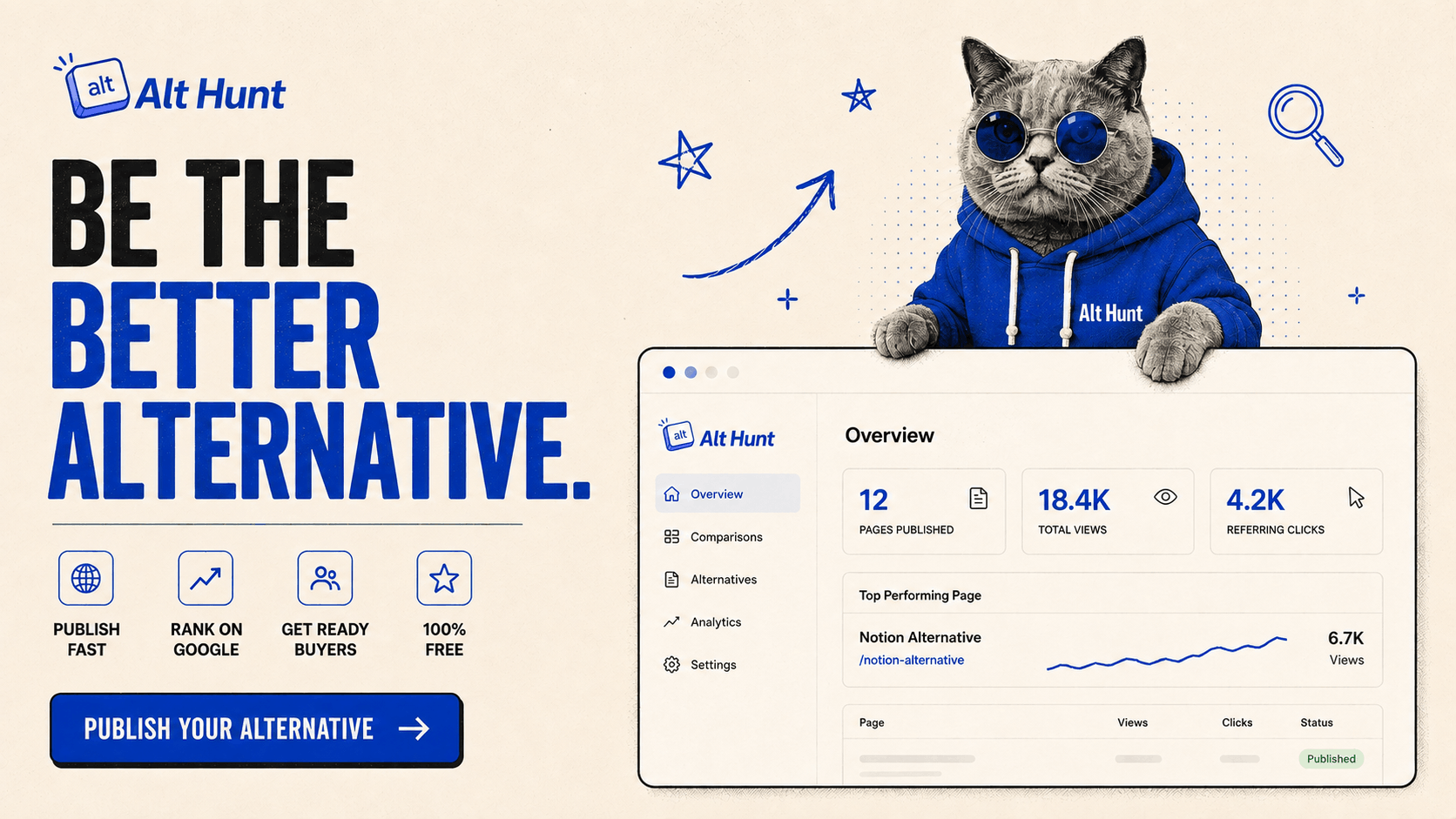
Alt Hunt organizes discovery around what buyers already know.
A new SaaS company may have almost no branded search demand. Buyers still search for:
- alternative to a market leader
- competitor A vs competitor B
- cheaper alternative
- open-source replacement
- migration from one platform
- best tool for a specific workflow
Alt Hunt helps makers publish:
- Alternative pages
- Comparison matrices
- Pricing tradeoffs
- Migration guides
- Objection handling
- FAQs
- Structured feature breakdowns
- Search and AI-friendly metadata
Core publishing is free.
Publish an alternative page on Alt Hunt
Frequently asked questions
How many platforms should a startup use for one launch?
Use one primary launch platform, one or two audience-specific communities, a focused directory set, owned social or email, and a durable post-launch discovery layer.
Should every launch post use the same copy?
No. Adapt the message to the audience. Technical communities need proof and tryability. Founder communities need lessons. B2B networks need workflow and business evidence.
Is Product Hunt free?
Product Hunt’s official launch guide states that it is free to use. Makers should follow its current authenticity rules and avoid directly asking people to upvote.
What should founders measure after launch?
Measure activation, retention, qualified conversations, customer feedback, referrals, comparison-page visits, and revenue—not only clicks or votes.
Alt Hunt focuses on alternative and comparison pages for buyers searching known competitors. It is designed as an evergreen discovery layer rather than a one-day leaderboard.
Should competitor pages be published before or after launch?
Prepare the main competitor map before launch, then improve the pages after hearing real objections and comparisons from users.
- 25 AI Tool Directories to Submit Your Product in 2026
- 12 Best Launch Platforms for Developer Tools and APIs
- 15 Best Launch Platforms for Indie Hackers in 2026
- Best Launch Platforms for No-Code and Vibe-Coded Products
- How to Get Users After Launch Day: 15 Sustainable Channels
Official sources and further reading
- https://www.producthunt.com/launch
- https://www.saashub.com/submit/list
- https://peerlist.io/launchpad
- https://news.ycombinator.com/showhn.html
- https://althunt.io
Platform rules, pricing, moderation practices, review queues, and feature availability can change. Verify official pages before publication or submission.
About the Author

Building Inspo AI | AI-Powered Design Research & Builder Platform | Design Engineer.