
Product Hunt vs BetaList: Which Is Better for Early-Stage Startups?
Product Hunt vs BetaList: Which Is Better for Early-Stage Startups?. A practical, evidence-led guide for pre-launch, beta, and newly launched startup founders
Founders often treat launch platforms, directories, competitor pages, and search visibility as separate tactics.
They are more useful when they operate as one discovery system.
This guide is written for pre-launch, beta, and newly launched startup founders searching for product hunt vs betalist.
Key takeaway: BetaList is designed for relatively new and early-access startups, while Product Hunt is a broader public launch community for products ready to engage users.
The recommendations below avoid guaranteed ranking claims, artificial link building, fake reviews, copied comparison content, and other shortcuts that create weak buyer experiences. The goal is to help real buyers understand the market and discover the product when it is genuinely relevant.
Quick answer
Choose BetaList when the startup is unreleased, invite-only, in private beta, or recently launched.
Choose Product Hunt when the product is usable by a broader public audience and the maker wants a structured launch event, comments, reviews, and early-adopter exposure.
Many startups can use both at different moments.
Official positioning
Product Hunt
Product Hunt’s launch guide describes a global community of makers, early adopters, product people, investors, and technology enthusiasts.
Products are launched daily, and the community can upvote, comment, and share them.
BetaList
BetaList’s submission criteria say the product should be relatively new. Accepted examples include:
- Not publicly available yet
- Private beta
- Recently launched
BetaList also requires a technology startup, a distinct landing page, and a way for visitors to sign up or get access.
Stage comparison
Comparison Matrix
2026 Verified| Stage | Product Hunt | BetaList |
|---|---|---|
| Idea only | Too early | Usually too early without a real landing page |
| Waitlist | Possible, but weaker fit | Strong fit when product is genuinely upcoming |
| Private beta | Possible | Strong fit |
| Newly public | Strong fit | Possible if still recent |
| Established product | Good for meaningful new releases | Often outside the main criteria |
| Major relaunch | Strong fit | Depends on previous coverage and eligibility |
Audience expectation
Product Hunt users expect to understand and try a product.
BetaList users expect early access to something new.
That changes the page.
Product Hunt page
Focus on:
- Product experience
- Demo
- Screenshots
- Maker story
- Newness
- Feedback
- Clear public CTA
BetaList page
Focus on:
- Early access
- The emerging product
- Waitlist or signup
- What is distinct
- Landing-page clarity
- Why the startup is new
Timing strategy
Pre-launch
Use BetaList while gathering early users and validating positioning.
Public launch
Use Product Hunt when onboarding, support, analytics, and the core experience can handle public traffic.
Post-launch
Turn recurring comparisons into Alt Hunt pages.
Common mistakes
Submitting to BetaList too late
The official criteria say products launched weeks ago or already receiving significant press may be less suitable.
Launching on Product Hunt before the product is understandable
A weak landing page and broken onboarding waste the launch event.
Copying the same page
The audiences have different expectations. Adapt the message.
Treating either platform as permanent acquisition
Both should feed a longer system of search, referrals, community, email, and product growth.
Which is better?
BetaList is better for earlier access.
Product Hunt is better for a broad public product launch.
Use both when the timing genuinely fits.
Editorial and operational checklist
Before publishing this page:
- Verify every changing claim
- Use the official product name
- Check all prices and plan names
- Link to primary sources
- Remove duplicate sections
- Confirm the title matches the intent
- Test every internal and external link
- Review mobile formatting
- Add original examples
- Disclose direct experience
- Separate facts from recommendations
- Include who should not use the recommended product
- Confirm the CTA is relevant
- Add the page to the sitemap
- Link to the page from at least one relevant existing page
- Record the review date internally
- Schedule the next accuracy review
For pre-launch, beta, and newly launched startup founders, the best content is not the page that repeats the keyword most often. It is the page that reduces uncertainty and helps the buyer complete the decision.
A two-stage launch calendar
Four to eight weeks before public launch
Use BetaList when eligible.
Prepare:
- Distinct landing page
- Early-access signup
- Clear product explanation
- Real screenshots
- Founder contact
- Beta onboarding
- Interview questions
- Product analytics
Use the early audience to identify:
- Confusing copy
- Missing features
- Activation blockers
- Pricing assumptions
- Competitors
- Reasons to join
Public-launch preparation
Before Product Hunt:
- Improve onboarding
- Fix reliability
- Prepare gallery
- Record demo
- Write maker comment
- Set launch goal
- Prepare support coverage
- Create tracking links
- Inform early users
- Build FAQ
- Draft post-launch content
Product Hunt launch
Invite early users to visit and give feedback without directly asking for upvotes.
After Product Hunt
Publish:
- Launch results
- Updated homepage
- FAQs
- Customer evidence
- Competitor comparisons
- Migration guides
- Alt Hunt pages
Can the startup launch twice?
BetaList says startups can have two opportunities: one pre-launch and one during launch, with at least a few weeks between them.
Product Hunt allows new significant product iterations to launch.
The founder should not create repetitive launch events without meaningful progress.
Each launch should represent a new stage or substantive improvement.
Landing-page differences
BetaList landing page
The visitor should see:
- What is coming
- Who it is for
- Why it is distinct
- Screenshots or product evidence
- Early-access form
- Expected access timing
- Founder or company identity
- Privacy information
BetaList’s official criteria discourage generic templates and free hosting subdomains.
Product Hunt landing page
The visitor should see:
- Product is available
- Main workflow
- Demo
- Pricing or access
- Social proof
- Support
- Fast onboarding
- Clear CTA
Launch readiness test
Ask five people who do not know the product to use the page.
Can they answer:
- What is it?
- Who is it for?
- What problem does it solve?
- Is it available?
- What should I do next?
If they cannot, delay the public launch and improve the page.
Final decision checklist
Choose BetaList first when:
- Product is not fully public
- Early access is the goal
- Landing-page validation matters
- Team wants beta conversations
- Product meets the eligibility rules
Choose Product Hunt first when:
- Product is publicly usable
- Team can support new users
- Visual demo is strong
- Public feedback is useful
- Launch social proof matters
Choose both when the startup can create a meaningful early-access stage followed by a genuinely improved public launch.
One final sequencing rule
Do not choose the public-launch date only because a platform slot is available.
Launch when:
- The core workflow works
- The team can support users
- Early feedback has been applied
- The page clearly explains the product
- Analytics can measure activation
- The founder can participate
BetaList can help the startup reach this point.
Product Hunt is more useful after reaching it.
The sequence should follow product readiness, not founder impatience.
Final note
Use BetaList to learn before the public moment. Use Product Hunt when the product and team are ready to support the public moment.
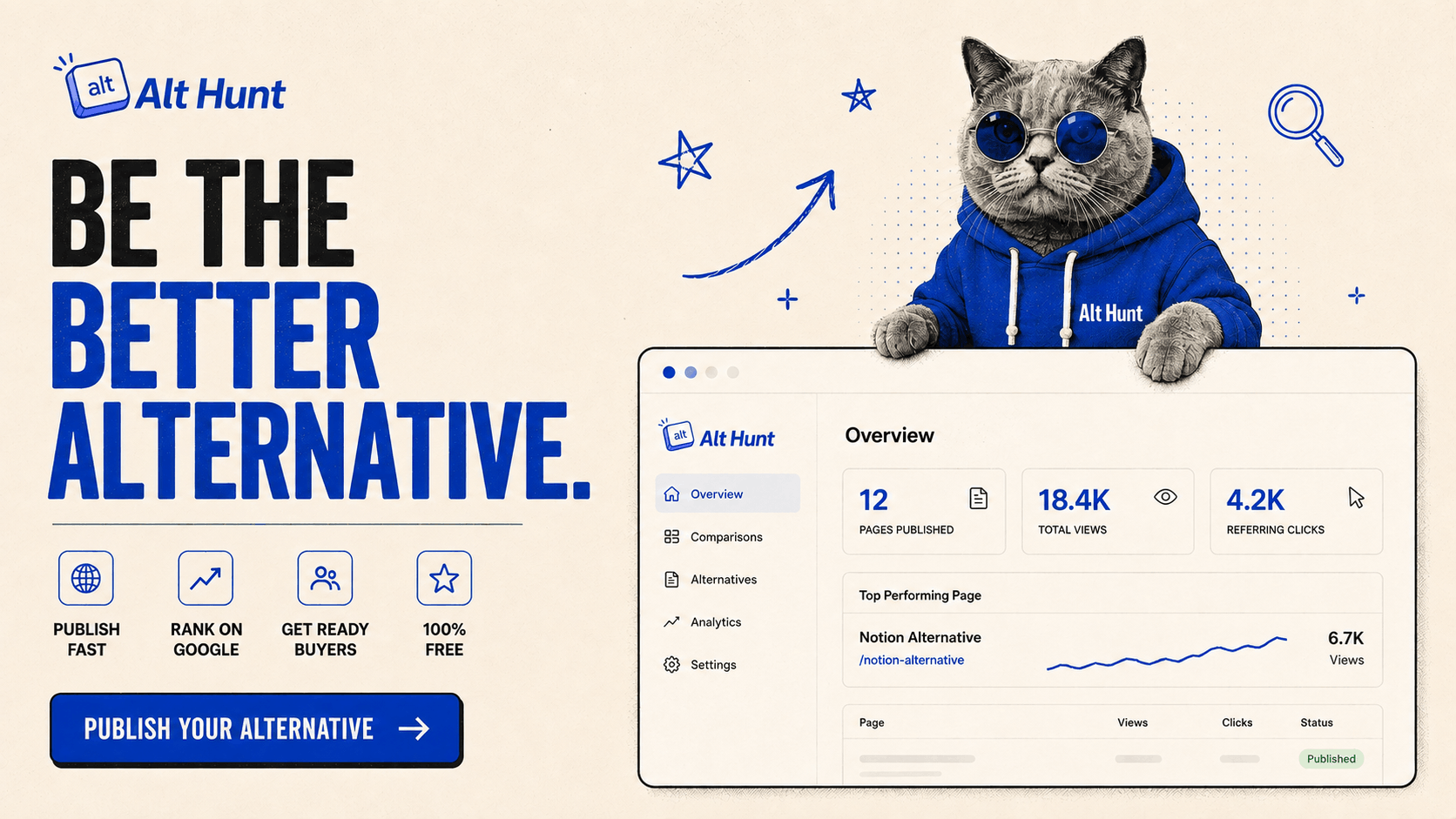
Alt Hunt helps SaaS makers publish alternative pages, comparison matrices, pricing tradeoffs, migration guides, and objection-handling content for buyers already evaluating software.
Alt Hunt is not a generic backlink service.
It is not a promise that publishing one page will create rankings.
Its role is to give founders a structured place to explain:
- Which known product they replace
- Who should switch
- Who should not switch
- Pricing differences
- Feature tradeoffs
- Migration effort
- Best use cases
- Limitations
- Sources and evidence
- Frequently asked questions
Core publishing is free.
Publish an alternative page on Alt Hunt
Frequently asked questions
Does publishing a page guarantee Google rankings?
No. Technical eligibility and good content do not guarantee crawling, indexing, ranking, traffic, or inclusion in AI-powered search experiences.
Should a founder publish hundreds of thin pages?
No. Publish pages only when the intent is distinct and the content provides original evidence, useful analysis, or a clear buyer decision.
No. Alt Hunt is an evergreen competitor-search discovery layer. Launch communities are better for live attention, feedback, and discussion.
How often should comparison pages be updated?
Review them after major product or competitor changes and run a broader accuracy review at least quarterly.
Should competitor claims link to sources?
Yes. Link to official pricing, documentation, changelogs, and direct evidence when the claim can change or materially affects the recommendation.
What is the most important measurement?
Measure qualified discovery: activated users, demos, retained customers, relevant referrals, and buyer questions—not only page views or backlinks.
- Top 10 Product Hunt Alternatives to Launch Your SaaS in 2026
- 15 Best Websites to Launch Your Startup in 2026
- 10 Best BetaList Alternatives for Early-Stage Startups
- The Complete Startup Launch Checklist for 2026
- Product Hunt vs BetaList vs Uneed vs Alt Hunt
- Product Hunt vs Indie Hackers: Where Should You Launch?
Official sources and further reading
- https://www.producthunt.com/launch
- https://www.producthunt.com/launch/how-product-hunt-works
- https://betalist.com/criteria
- https://betalist.com/terms/submissions
- https://althunt.io
Search guidance, launch-platform features, submission rules, pricing, and indexing behavior can change. Verify official sources before publishing or acting on the advice.
About the Author

Building Inspo AI | AI-Powered Design Research & Builder Platform | Design Engineer.