



FixFirst Blood Test Analyzer alternative to Kantesti: Free, No-Account Blood Test Analysis
Updated 9 Nov 2026
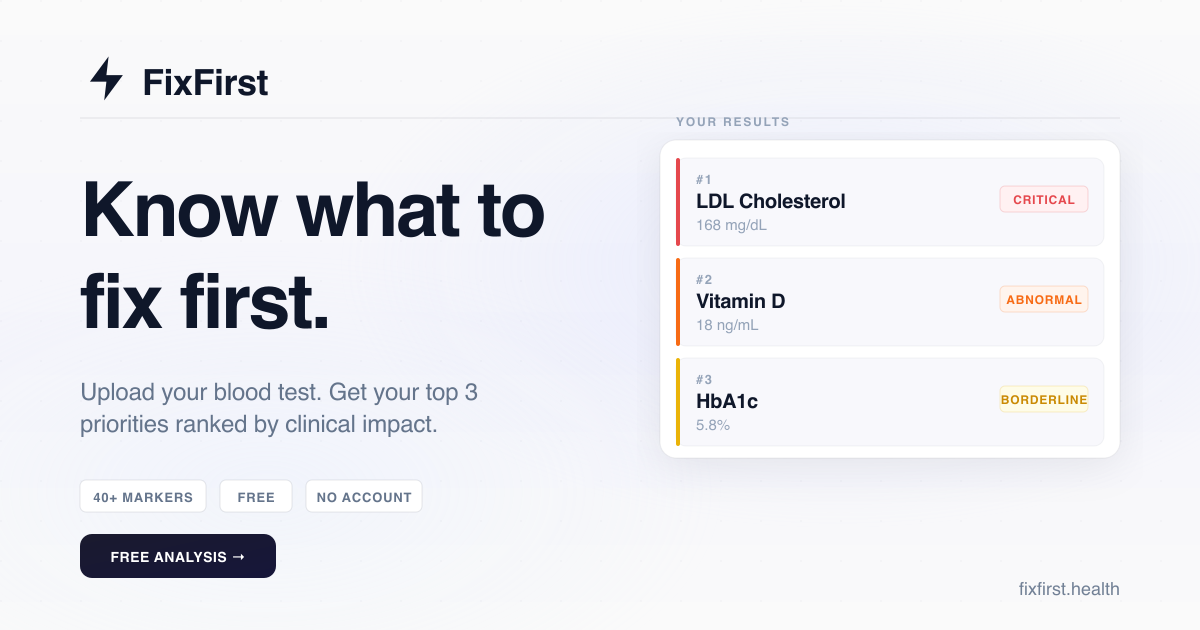
FixFirst Blood Test Analyzer is a free, no-account web app that extracts biomarkers from any lab report and returns your top three health priorities ranked by clinical urgency in about 45 seconds. It applies sex- and age-adjusted reference ranges across 264 biomarkers and works with PDFs or images from any lab. Kantesti's public pages do not disclose pricing or feature details, so a direct cost comparison is not possible from official sources; FixFirst's pricing is explicitly $0 with no subscription.
Feature comparison matrix
| Feature | FixFirst Blood Test Analyzer | Kantesti | Why it matters |
|---|---|---|---|
| Account requirement | No account needed; upload and analyze anonymously | Account requirement not stated on public pages | FixFirst states no name, ID, or contact details are required. |
| Input formats | Blood test PDF or image upload | Input formats not described on public pages | FixFirst normalizes units (e.g., mmol/L to mg/dL) and matches lab name variants. |
| Biomarker coverage | 264 biomarkers analyzed | Biomarker coverage not stated on public pages | FixFirst applies sex- and age-adjusted clinical thresholds. |
| Output format | Top 3 priorities ranked by clinical urgency with plain-English action plan | Output format not described on public pages | FixFirst positions results as a ranked action plan, not a chatbot or raw data dump. |
| Personalization | Personalized by age, sex, and lifestyle | Personalization approach not stated on public pages | FixFirst uses sex- and age-adjusted reference ranges. |
| Speed | Results in about 45 seconds | Processing time not stated on public pages | FixFirst cites 45 seconds from upload to ranked priorities. |
| Data handling | Uploaded report deleted as soon as it is analyzed; anonymous usage analytics only | Data handling practices not described on public pages | FixFirst keeps email only if voluntarily provided. |
| Medical disclaimer | Educational tool, not a medical device; does not diagnose or replace a doctor | Disclaimer not available on public pages | FixFirst explicitly states it is not medical advice. |
Why buyers switch from Kantesti to FixFirst Blood Test Analyzer
People rarely go looking for a blood test analyzer for fun. They go looking because a lab report landed in their inbox, half the values are flagged, and the reference ranges are printed in a font size that suggests nobody was meant to read them. The switch from Kantesti to FixFirst Blood Test Analyzer usually happens at that exact moment — when someone wants a ranked answer rather than a wall of numbers. Here are the concrete reasons buyers cite, drawn from what each product actually publishes.
1. FixFirst publishes a $0 price and no subscription; Kantesti's pricing is not public
FixFirst's structured product data lists an offer of $0 USD for the Blood Test Analyzer, and the site states plainly: "Free — no subscription." There is no paid tier to graduate into, no trial countdown, and no card entry step. Kantesti's public pages do not publish a pricing model, so a buyer evaluating it has to ask what the cost will be rather than reading it. For a tool people reach for once every few months after a physical, a published $0 is a materially different buying experience from pricing not public. It removes the budgeting conversation entirely — a team lead can tell forty employees to use it without routing a purchase order.
2. No account is required, and the upload is deleted after analysis
FixFirst states that no name, ID, or contact details are needed, that the uploaded report is deleted as soon as it is analyzed, and that only anonymous usage analytics are kept — plus an email address if the user chooses to give one. That is a specific, checkable privacy posture. Kantesti's public pages do not state an account requirement either way, so a buyer cannot tell from the outside whether sign-up is mandatory. For anyone handling a colleague's or family member's lab data, the difference between "no account, deleted after analysis" and an unstated policy is the difference between a green light and a legal review.
3. FixFirst commits to a ranked top-3 output in 45 seconds; Kantesti's output format is not described publicly
The core promise on FixFirst is narrow and testable: upload a PDF or image, the system extracts every biomarker, applies sex- and age-adjusted clinical thresholds, and returns the top 3 priorities with a plain-English action plan in 45 seconds. The site is explicit that it is "not a chatbot, not a data dump — a ranked action plan." Buyers who have used report readers that return an unranked list of 40 markers describe the ranking as the actual product. Kantesti's public pages do not describe its output format, so there is nothing to compare against on that axis — which itself pushes cautious buyers toward the product that states its deliverable up front.
4. Unit normalization and lab-name aliasing are documented on FixFirst
FixFirst describes pulling the marker name, value, and unit directly from the text and normalizing units automatically — mmol/L converting to mg/dL — while matching name variants across labs against an alias table. The stated rule is that a report from any lab works as long as the marker name, value, and unit are readable. That matters because most people do not get their blood drawn at the same lab twice, and a tool that only understands one lab's naming convention is a tool that fails on the second report.
5. The framing is "normal isn't the goal" — personalized thresholds, not population averages
FixFirst's homepage leads with the line "A 'normal' range is just an average. You are not an average," and backs it with sex- and age-adjusted reference ranges plus personalization by age, sex, and lifestyle. That is a positioning choice with practical consequences: a 52-year-old woman and a 24-year-old man get different thresholds for the same marker. Buyers who have been told "everything is normal" while feeling otherwise are the ones most responsive to this framing.
Try FixFirst Blood Test Analyzer — start free
Feature deep-dive: the ranked top-3 priority output
Most blood test tools, and most lab portals, give you the same thing: a table. Marker name, your value, the reference range, and a flag if you fell outside it. The table is accurate and almost useless, because it treats a marginally low vitamin D and a genuinely urgent liver enzyme as equivalent rows in a spreadsheet. FixFirst's differentiator is that it refuses to hand you the table as the final answer. It ranks.
What "ranked by clinical urgency" actually means for the reader
FixFirst returns your top 3 priorities ordered by clinical impact, each with a plain-English action plan. The constraint is the feature. By capping the output at three items, the product forces a judgment about what matters most this month rather than presenting 264 biomarkers as an undifferentiated to-do list. A user who opens the tool after a routine physical gets a short, ordered set of next steps instead of a research project. The site frames the alternative directly: "Don't let a fixable issue hide in 'normal.'"
Why sex- and age-adjusted thresholds change the ranking
The ranking is not computed against a single population reference range. FixFirst applies sex- and age-adjusted clinical thresholds and personalizes by age, sex, and lifestyle before ordering the priorities. This is the mechanism behind the "you are not an average" claim. A marker that is unremarkable for one demographic can be the top priority for another, and a tool that skips this step will systematically under-rank issues for the groups whose ranges differ most from the pooled average. Buyers evaluating alternatives should ask specifically whether thresholds are adjusted, because an unadjusted ranking is a different product wearing the same interface.
The 45-second constraint and what it implies about the workflow
FixFirst states results in 45 seconds. That number is only achievable if the pipeline is automated end to end — text extraction, unit normalization, alias matching, threshold application, ranking, and plain-English generation — with no human review step and no queue. For the user this means the tool fits into the gap between opening the lab PDF and closing the laptop. It is not a service you submit to and hear back from; it is a page you use. That shapes expectations honestly: you are getting a fast, deterministic first pass, not a consultation.
What the output deliberately is not
FixFirst is explicit that it is an educational tool, not a medical device, that it does not diagnose conditions, and that it does not replace your doctor. The site repeats "not medical advice" in its footer and FAQ. This is worth stating in a comparison because it defines the boundary of the product: it tells you what to fix first and what to ask about, and it routes the actual clinical decision back to a clinician. Buyers who want a diagnostic opinion are shopping in the wrong category, and the product says so.
Feature deep-dive: input handling, privacy, and access model
The second axis where these two products diverge is the boring, load-bearing stuff: what you can feed the tool, what happens to it afterward, and what stands between you and the first result. These are the details that determine whether a tool gets used once out of curiosity or becomes the thing a team actually standardizes on.
PDF and image upload, with unit normalization built in
FixFirst accepts a blood test PDF or image. Behind that simple input statement is the work that makes multi-lab support possible: extracting the marker name, value, and unit from the text, normalizing units automatically so mmol/L converts to mg/dL, and matching name variants across labs against an alias table. The published rule is generous — a report from any lab works as long as the marker name, value, and unit are readable. Anyone who has tried to paste two different labs' results into the same spreadsheet knows how much of the effort is reconciling naming and units rather than interpreting values. FixFirst absorbs that step. Kantesti's public pages do not describe supported input formats, so there is no published basis for comparison on this point.
No account, and deletion after analysis
The access model is the sharpest contrast. FixFirst requires no account: no name, no ID, no contact details. The uploaded report is deleted as soon as it is analyzed. Anonymous usage analytics are retained, and an email address only if the user volunteers one. For an individual, that means no password to create and no profile to maintain for a tool used a few times a year. For a team, it means the privacy conversation is short — there is no repository of employee lab data being assembled, because the files do not persist. Kantesti's public pages do not state an account requirement, so a buyer cannot determine from the outside whether registration is needed before the first analysis.
264 biomarkers, and why coverage numbers need context
FixFirst lists 264 biomarkers analyzed. Coverage counts are easy to inflate and hard to interpret — a panel with 264 markers is only useful if the ones that matter to you are among them and if the thresholds applied to them are adjusted rather than generic. The combination FixFirst publishes is coverage plus adjustment plus ranking, and it is the third element that determines whether the first two produce anything actionable. Buyers comparing coverage numbers across tools should ask what happens after the marker is detected, because detection without prioritization just relocates the spreadsheet problem.
Reach and distribution signals
FixFirst states that the tool is used in 57 countries and has been featured on launched.tools, with a YouTube presence via The Draw. These are distribution facts rather than quality claims, and they are worth reading as such: a free, no-account tool spreads through exactly this kind of low-friction sharing. The absence of a sign-up wall is what makes cross-border, cross-employer usage plausible in the first place.
Pricing compared
This is the shortest section in most comparisons and the longest in this one, because one product publishes a price and the other does not.
FixFirst: $0, and no subscription behind it
FixFirst's structured data lists the Blood Test Analyzer as a WebApplication with an offer of price 0 in USD. The site states it directly: "Free — no subscription." There is no paid tier listed, no upsell to a premium analysis, and no credit system described on the public pages. The free access is the product, not a trial of the product. That distinction matters for anyone who has been burned by a "free analysis" that returns a blurred summary and a checkout page. FixFirst's published model is a single tier at $0 with no account required.
Kantesti: pricing not public
Kantesti's public pages do not publish a pricing model. There is no listed price, no tier structure, and no statement of free access that can be verified from the outside. The correct characterization is that pricing is not public — not that the product is paid, and not that it lacks a free option. Those are different claims, and only the first is supported. A buyer who needs a budget line before adopting a tool has to contact the vendor or wait for published terms. If a free tier exists, it is not documented in a way an evaluator can cite.
How to compare a published $0 against an unpublished price
The honest comparison is asymmetric. On one side there is a stated $0 with no subscription and no account. On the other there is an absence of published pricing, which could resolve to free, to a one-time fee, or to a subscription — the public record does not say. Buyers should treat that asymmetry as information rather than as a tie. A tool that publishes its price has made a commitment that can be checked; a tool that does not has left the question open. For individual users the stakes are small. For a team lead deciding whether to point fifty people at a tool, an unpublished price is a procurement blocker regardless of what the eventual number turns out to be.
What is not being compared here
No discounts, no savings percentages, and no cost-per-analysis figures appear in either product's published materials, so none are asserted here. FixFirst's $0 is the only price in evidence. Any total-cost comparison beyond that would require Kantesti's published terms, which are not available on its public pages.
Who this is actually for
FixFirst is not a universal replacement for a clinician, a lab portal, or a diagnostic service. It fits specific situations well and others poorly. Three concrete scenarios illustrate where the fit is strong.
Scenario 1: The annual-physical reader with a flagged report
Someone completes a routine physical, receives a PDF with eleven values outside the printed ranges, and has a fifteen-minute follow-up call scheduled in three weeks. Their problem is not access to data — they have all of it — but sequencing. Which of the eleven do they raise first, and which are artifacts of a range that was never built for their age and sex? FixFirst's output is designed for exactly this: top 3 priorities ranked by clinical urgency, with sex- and age-adjusted thresholds applied before ranking, delivered in 45 seconds with no account. They upload the PDF, read three items, and walk into the call with a specific question instead of a general anxiety. The tool explicitly does not diagnose; it tells them what to fix first and what to ask about. This user runs it once or twice a year, which is precisely why a $0 no-account model fits and a subscription would not.
Scenario 2: The benefits or people-ops lead evaluating a wellness perk
A benefits lead is assembling a low-cost health perk for a company and needs something that will not create a data-protection project. The requirements are unglamorous: no account creation, no storage of employee lab files, no per-seat contract to negotiate, and a published price they can put in a slide. FixFirst's stated posture — no name, ID, or contact details required, report deleted as soon as it is analyzed, anonymous usage analytics only, email only if volunteered — answers the privacy review questions directly. The $0 offer answers the budget question. Kantesti's public pages do not state an account requirement or a price, so the same slide cannot be completed without contacting the vendor. For a perk that employees will use sporadically, the absence of a sign-up wall is also the difference between a 60% activation rate and a 6% one; a tool nobody has to register for gets tried.
Scenario 3: The self-tracker comparing results across labs and years
A user who tests quarterly, sometimes at a hospital lab and sometimes at a walk-in clinic, accumulates reports in incompatible formats. Marker names differ, units differ — mmol/L in one report, mg/dL in the next — and the reference ranges shift with the lab. FixFirst's documented handling addresses this directly: it extracts marker name, value, and unit from the text, normalizes units automatically, and matches name variants across labs against an alias table, with the stated rule that any lab's report works as long as those three elements are readable. With 264 biomarkers analyzed, the long tail of a comprehensive panel is covered rather than just the standard dozen. This user is not looking for a diagnosis; they are looking for a consistent ranking across inconsistent inputs, and that is the specific problem the normalization layer solves.
Who should look elsewhere
Anyone who wants a diagnosis, a prescription, or a clinician's judgment should not use this tool, and FixFirst says so itself: it is an educational tool, not a medical device, and it does not replace a doctor. Buyers who need a documented audit trail of every analysis, or who require a vendor contract with published terms before adoption, will find the no-account, delete-after-analysis model works against them rather than for them. And anyone who needs Kantesti-specific capabilities should evaluate Kantesti on its own published terms — which, on pricing and account requirements, are not currently public.
Getting started with FixFirst Blood Test Analyzer
Migration is short because there is nothing to install, no account to provision, and no contract to sign. The steps below reflect what FixFirst publishes about its own workflow.
Get your report into a readable format. FixFirst accepts a blood test PDF or image. The published requirement is that the marker name, value, and unit are readable in the file. If your lab report is a scan, check that the text is legible before uploading — the extraction step depends on it.
Go to the analyzer and upload. The tool lives at fixfirst.health. There is no sign-up screen, no email verification, and no password to set. FixFirst states that no name, ID, or contact details are required to run an analysis.
Let the extraction and normalization run. The system pulls each marker name, value, and unit from the text, normalizes units automatically — converting mmol/L to mg/dL where needed — and matches lab-specific name variants against an alias table. This is why a report from a lab the tool has not seen before can still be processed.
Read the top 3, in order. The output is a ranked list of three priorities by clinical impact, each with a plain-English action plan, personalized by age, sex, and lifestyle and evaluated against sex- and age-adjusted thresholds. Read them in the order given; the ranking is the product.
Take the three items to your clinician. FixFirst is explicit that it is an educational tool and not a medical device, that it does not diagnose conditions, and that it does not replace your doctor. The intended next step is a conversation with a professional, armed with a specific, ordered set of questions rather than a full printout.
Optionally, take the symptom quiz. FixFirst offers a 2-minute symptom quiz as an alternative entry point for people who do not yet have a report in hand. It is a separate path to the same kind of prioritized output.
Know what happens to your file. The uploaded report is deleted as soon as it is analyzed. Anonymous usage analytics are retained; your email is kept only if you provide it. Nothing persists that you would need to request deletion of later.
That is the whole onboarding. There is no seat to assign, no admin console, and no renewal date. If you are still weighing options, the AltHunt comparison index covers how this tool stacks up against other blood test analyzers on pricing, account requirements, and output format — and the fastest way to settle the question is to run one report through FixFirst and see whether the top 3 match the three things you were already worried about.
Pricing breakdown
| Plan | FixFirst Blood Test Analyzer | Kantesti |
|---|---|---|
| Free tier | $0 — free AI blood test analyzer, no subscription, no account | pricing not public |
| Paid subscription | None offered; FixFirst states free — no subscription | pricing not public |
Illustrative pricing — verify current figures before relying on this.
Ready to try FixFirst Blood Test Analyzer?
Visit fixfirst.healthMore alternatives
All Kantesti alternativesCommunity Discussions & Reviews
Real feedback from verified buyers, founders, and engineering teams using these products.