



Bite100 Passport alternative to Solid Starts: A Playful Passport vs a Pediatric Pro in Your Pocket
Updated 9 Nov 2026
Bite100 Passport costs $6.99/month or a one-time $49 Lifetime Pass after a 7-day free trial with no card required, while Solid Starts charges $19.99/month or $99.99 billed yearly ($8.33/month) after its 7-day free trial. Both offer free access: Bite100 keeps its full 100-food checklist and 650+ serving guides free forever, and Solid Starts offers its First Foods® database free. Bite100 leans into a stamp-collecting passport with milestones and no streak pressure; Solid Starts leans on a multidisciplinary pediatric team and a research-backed feeding plan.
Feature comparison matrix
| Feature | Bite100 Passport | Solid Starts | Why it matters |
|---|---|---|---|
| Core concept | A playful food passport: each new food earns a stamp, with milestone seals from Taster to 100 Bites Club | A guided feeding app described as 'a pediatric pro in your pocket' with a research-backed plan for starting solids | Bite100 emphasizes gamified tracking and memory-keeping; Solid Starts emphasizes clinical guidance. |
| Food coverage | 100 passport foods plus how to serve and cut 650+ foods by age | Award-winning First Foods® database covering how to introduce any food to babies | Both provide serving and cutting guidance; Bite100 frames it around a 100-food checklist. |
| Allergen plan | Top 9 allergen introduction plan with reminders | Step-by-step allergen guidance with smart tracking of foods, reactions and sensitivities | Both address the Top 9 allergens; Solid Starts highlights reaction and sensitivity logging. |
| Expert backing | Health content reviewed by dietitians, based on AAP and NIAID guidance | Multidisciplinary team of licensed pediatric professionals, including an MD, OTs and IBCLCs | Solid Starts names individual clinicians on its site; Bite100 cites dietitian review and published guidance. |
| Tracking style | Stamps never expire and there is no streak pressure | Log foods introduced, including common allergens, reactions and sensitivities with smart tracking tools | Bite100 avoids daily streak mechanics; Solid Starts focuses on structured logging. |
| Recipes | Baby and toddler recipes with no added salt or sugar | Recipes and guides available on the site and in the app | Bite100 explicitly states no added salt or sugar in its recipes. |
| Platform | Web app that works on any phone | Mobile app (downloadable) plus a website | Bite100 requires no app-store download; Solid Starts offers a dedicated app. |
| Free tier | Full 100-food checklist and 650+ serving guides free forever; 7-day full-app trial with no card | Free First Foods® database access; 7-day free trial of the app | Both have permanent free resources plus a trial of the paid app. |
Why buyers switch from Solid Starts to Bite100 Passport
Parents rarely abandon Solid Starts because it is a bad product. The site is built by a multidisciplinary team of licensed pediatric professionals, and its First Foods® database is genuinely award-winning. The switch usually happens for a narrower reason: the family wants the same core essentials — a first-foods checklist, allergen guidance, serving instructions — wrapped in something lighter, cheaper, and less clinical. Here are the concrete reasons buyers move.
The price gap is large and structural. Solid Starts lists a Monthly Plan at $19.99 per month and an Annual Plan at $8.33 per month, billed $99.99 yearly. Bite100 Passport lists $6.99 a month, or a one-time $49 Lifetime Pass. Over a single year, the Bite100 monthly plan costs less than half of the Solid Starts annual plan, and the Lifetime Pass costs roughly half of one Solid Starts annual billing cycle — while covering every future child in the household. For a family on a budget, that difference decides the purchase.
The Lifetime Pass removes the renewal decision entirely. Solid Starts offers a 7-day free trial and then recurring billing, cancel anytime. Bite100 offers a 7-day free trial with no card needed, then either $6.99 a month or $49 once. The Lifetime Pass explicitly includes every future update and has no renewals and nothing to cancel. Parents who have already been burned by a subscription they forgot about — or who are planning a second child two years out — find the one-time model easier to justify.
The framing is playful rather than clinical. Solid Starts positions itself as "a pediatric pro in your pocket," with a research-backed plan and step-by-step allergen guidance. That is reassuring for anxious first-time parents, but some families find it heavy. Bite100 reframes the same job as a passport: every new food earns a stamp, milestone seals accumulate from Taster up to the 100 Bites Club, and the passport becomes a memory object rather than a medical record. The maker notes describe it as a lighter, playful food passport for the 6–12 month window.
No streak pressure. Bite100 explicitly states there is no streak pressure and that stamps never expire. The pricing page repeats the promise: "stamps stay readable" on the monthly plan and "stamps never locked" as a general principle. For parents who miss a week because of illness, travel, or daycare, a tracker that does not punish gaps is a meaningful relief.
None of this means Solid Starts is the wrong choice for every family. It means the decision is closer than the marketing on either side suggests, and the deciding factors are price, tone, and how much structure a given household actually wants.
Try Bite100 Passport — start free
Feature deep-dive 1: The stamp-based food passport versus a clinical tracking app
The single biggest differentiator between these two products is not the food database — both cover the essentials — it is what happens after a food is introduced. Solid Starts logs foods introduced, including common allergens, reactions, and sensitivities, using what it calls smart tracking tools. Bite100 turns the same act into a collectible: each new food earns a stamp, and stamps accumulate toward milestone seals.
How the passport mechanic works in practice
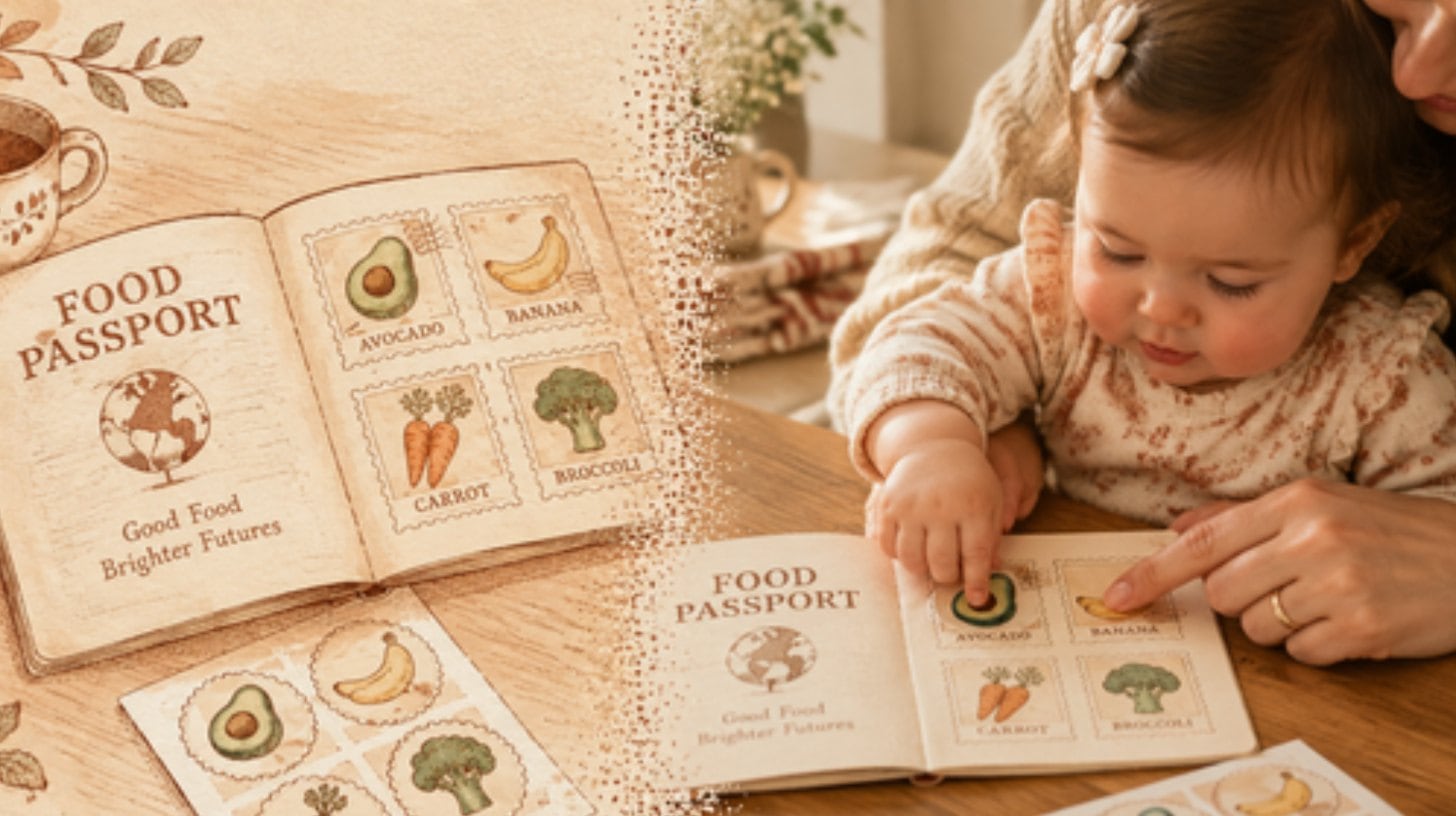
Bite100's product pages show a dated passport spread with entries like a soft Hass spear on 12 October, a roasted baton on 14 October, a steamed finger on 16 October, a well-cooked egg on 20 October, a whole floret on 21 October, and smooshed and plump on 24 October. Each entry carries a preparation method, and allergen entries are tagged with a Top 9 counter such as "Top 9 • 3/3." A queue shows what is next — No. 27 Braised Beef, No. 28 Tahini Dip — with a scheduled day. Milestone seals are earned along the way, starting with a "First Green" seal.
Why the mechanic changes behavior
A log is a record you keep because you feel you should. A passport is a collection you want to complete. The 100-foods framing gives the whole 6–12 month window a finish line, and the milestone seals break that long stretch into smaller wins. The passport also doubles as a keepsake: Bite100 sells a printed passport alongside the app, so the digital stamps can become a physical object for a memory box. Solid Starts does not frame its tracking as a collectible, and its value proposition is clinical confidence rather than completion.
What the passport does not replace
To be fair to Solid Starts, its tracking is tied to a broader clinical apparatus: a multidisciplinary team including an MD, occupational therapists, and lactation consultants, plus content on preventing and reversing picky eating that extends well past the first birthday. Bite100's passport is scoped to starting solids, roughly 6–12 months, with five stages running from first lick to family table. If your child is already a toddler with feeding challenges, the passport framing will feel like it ended without you.
The texture and cut-size layer underneath the stamps
The stamps are the surface; the substance is the serving guidance. Bite100 documents textures and cut sizes across 6–12 months, with stage-specific examples. At the earliest stage the tray shows banana mashed smooth, broccoli steamed and blended smooth, sweet potato as a smooth puree, and lamb minced and blended smooth. At 7–8 months, lumpy mashes: banana, chickpea-size broccoli pieces, soft steamed florets, soft sweet potato cubes, and moist soft lamb crumbles, with fork-mashing replacing blending. By 11–12 months the family table takes over, with baby biting and chewing more and practicing with a preloaded spoon. That progression is the part parents actually use every day, and it is present in both products — Bite100 simply wraps it in a friendlier frame.
Feature deep-dive 2: Allergen introduction and the Top 9 plan
Allergen introduction is where anxiety concentrates, and it is the area where the two products diverge most in presentation even though both take it seriously.
What Bite100 includes
Bite100 ships a Top 9 allergen plan with reminders on the paid tiers, and the free tier includes the full 100-food checklist filterable by the Top 9 allergens. The passport tags allergen foods with a running counter, so a parent can see at a glance that three of three planned exposures in a category are complete. The site also offers an allergen bingo sheet designed for the fridge — a low-tech companion to the app that keeps the plan visible in the kitchen where feeding actually happens. Health content is reviewed by dietitians and based on AAP and NIAID guidance, per the maker notes.
What Solid Starts includes
Solid Starts describes step-by-step allergen guidance as part of its research-backed plan, and its tracking tools log common allergens alongside reactions and sensitivities. The distinction matters: Solid Starts emphasizes reaction logging as a clinical record you can bring to a pediatric appointment, while Bite100 emphasizes completion of an exposure plan. Both are legitimate; they serve different moments. If your baby has already had a reaction and you are documenting severity for a specialist, the clinical framing is more natural. If you are working through the Top 9 for the first time and want a checklist that tells you what is left, the passport framing is faster.
The pediatrician PDF
Bite100's monthly and lifetime tiers include a pediatrician PDF for checkups. This is a practical bridge between the playful framing and the clinical reality: the stamps and reaction logs export into something a doctor can read in a two-minute well-child visit. It is the feature that most directly answers the objection "is a cute passport actually useful?" — yes, if it produces a document at the appointment.
Where the free tiers land on allergens
Bite100's free tier includes the 100-food checklist filterable by the Top 9, plus how-to-serve guidance for 650+ foods. The allergen plan with reminders sits on the paid tiers. Solid Starts offers free access to its First Foods® database and free articles and guides, with full app access on paid plans. Neither product hides allergen information entirely behind a paywall, but both reserve the active reminder and tracking layer for paying users. Families who only want a reference chart can stay free on either.
Pricing compared
The pricing models are the clearest difference between the two products, and they are not structured the same way.
Bite100 Passport pricing
Bite100 publishes three tiers on its pricing page. The Free tier is $0 forever and includes all the guides, the full 100-food checklist, how-to-serve and cut guidance for 650+ foods, recipes, schedules, the choking versus gagging printable, and free tools including a portion calculator and schedule builder. The Monthly plan is $6.99 a month, cancel anytime, and keeps every stamp; it adds unlimited meal and reaction logging, the Top 9 allergen plan and reminders, the pediatrician PDF, and sync with a partner or caregivers. The Lifetime Pass is $49 once, includes the same full app as Monthly, covers every child, includes every future update, and has no renewals. Bite100 also offers a 7-day free trial of the full app with no card needed. The site states the Lifetime Pass costs less than 8 months of Monthly, and notes that most first-foods apps charge around $100 a year.
Solid Starts pricing
Solid Starts publishes two paid plans on its app subscription page. The Monthly Plan is $19.99 per month. The Annual Plan, marked most popular, is $8.33 per month billed $99.99 yearly. Both include full access and can be canceled anytime, and there is a 7-day free trial. Free access covers the First Foods® database and the site's articles and guides.
Reading the comparison honestly
These are both subscription products with free tiers, so the comparison is not free versus paid. It is $6.99 a month versus $19.99 a month on the monthly side, and $49 once versus $99.99 billed yearly on the long side. The Bite100 Lifetime Pass is a one-time purchase that covers future children; the Solid Starts annual plan renews each year. A family planning two children spaced two years apart would pay the Solid Starts annual rate twice before the second child starts solids, while the Bite100 Lifetime Pass is paid once. That said, Solid Starts' annual plan works out to $8.33 per month, which is close enough to Bite100's $6.99 monthly that the monthly-versus-annual framing matters more than the headline numbers suggest. Buyers should compare the plan they will actually keep, not the plan with the lowest sticker.
One caution on both sides: pricing pages change. The figures above come from the vendors' own pricing pages at the time of research. Neither company publishes a discount program beyond what is listed, and any savings claim beyond the stated "less than 8 months of Monthly" should be treated as marketing rather than arithmetic you can rely on.
Who this is actually for
Scenario 1: The budget-conscious second-time parent
This buyer already has one child and knows exactly what starting solids involves. They are not looking for a pediatric team in their pocket; they are looking for a checklist they can trust and a price that does not renew. They have probably already paid for one subscription during their first child's infancy and watched it auto-renew after the baby had moved to table food. For this household, the Bite100 Lifetime Pass at $49 once is the obvious fit: it covers the second child and any future children, includes every future update, and has nothing to cancel. The stamp mechanic is a bonus rather than the reason — the reason is that the purchase ends. Solid Starts' annual plan at $99.99 billed yearly is a harder sell to someone who has already been through the first year and knows the app's active use window is roughly six months.
Scenario 2: The anxious first-time parent with a family history of allergy
This buyer has a sibling with a peanut allergy or a parent with eczema, and they are approaching the Top 9 with genuine fear. They want step-by-step guidance, a record of reactions, and something to hand a pediatrician. Both products serve this buyer, but differently. Solid Starts offers a multidisciplinary team of licensed pediatric professionals and tracking that logs reactions and sensitivities — the clinical reassurance is the product. Bite100 offers a Top 9 allergen plan with reminders, a running completion counter, allergen bingo for the fridge, and a pediatrician PDF for checkups, all reviewed by dietitians and based on AAP and NIAID guidance. The deciding question is whether the parent wants a clinical authority figure or a structured plan they can execute. Many will want both, and the free tiers let them test before paying.
Scenario 3: The two-caregiver household with a daycare handoff
This buyer has a partner, a grandparent, or a nanny doing weekday feedings, and the tracking has to survive the handoff. Bite100's monthly and lifetime tiers include sync with partner and caregivers, so a food introduced at daycare on Tuesday shows up in the passport before the evening feed. The stamp framing also helps here: a caregiver who is not steeped in feeding philosophy can understand "this food has not been stamped yet" more quickly than a clinical log. The choking versus gagging printable and the portion calculator are free-tier tools that can be printed and stuck on the fridge for whoever is feeding that day. Solid Starts also supports logging, but its strength is depth of guidance rather than multi-caregiver coordination.
Getting started with Bite100 Passport
Migration is light because both products are web apps with free tiers. Here is a practical sequence.
Export what you already have. Before canceling anything, pull your existing food log out of Solid Starts — screenshots of the introduced-foods list and any reaction notes are enough. You are not migrating data automatically; you are preserving a record for your pediatrician and for your own memory.
Start the Bite100 free tier and open the 100-food checklist. The full list of 100 passport foods is free to use. Filter it by fruit, vegetables, protein, grains, dairy, or the Top 9 allergens, and tap any food to see how to serve and cut it by age. Cross off the foods you have already introduced using your exported list.
Start the 7-day free trial of the full app. No card is needed. Use the trial week to test the parts that sit behind the paywall: unlimited meal and reaction logging, the Top 9 allergen plan and reminders, the pediatrician PDF, and partner sync. If you feed with a partner or caregiver, set up sync during the trial so you know whether it actually fits your household.
Choose Monthly or Lifetime based on your family plan. If you are one-and-done and want to keep costs low in the short term, $6.99 a month with cancel-anytime is fine. If you expect a second child, the $49 Lifetime Pass covers every child and every future update with no renewals — the pricing page frames it as costing less than 8 months of Monthly.
Print the fridge materials. The choking versus gagging printable and the allergen bingo sheet are the low-tech layer that keeps the plan visible in the kitchen. Print them before the trial ends so you are not locked out of the habit if you decide not to convert.
Set a review point at the 100-food mark. The passport has a natural finish line. When you hit the 100 Bites Club, decide whether to keep the subscription for a future child or cancel — Bite100 states that stamps stay readable and are never locked, so canceling does not erase the record.
If you are still weighing the two products against a wider field, our AltHunt comparison directory covers more options side by side. The short version: Solid Starts is the deeper clinical resource and prices accordingly; Bite100 Passport is the lighter, cheaper, more playful tracker with a one-time option that most subscription apps do not offer. Neither is wrong — but the $49 Lifetime Pass versus $99.99 billed yearly is the number most families will actually decide on.
Pricing breakdown
| Plan | Bite100 Passport | Solid Starts |
|---|---|---|
| Free tier | $0 forever: all guides, 100-food checklist, 650+ foods how-to-serve, recipes, schedules, choking vs. gagging printable, portion calculator and schedule builder | $0: First Foods® database access and free articles/guides on the website |
| Free trial of full app | 7 days free, no card needed | 7-day free trial |
| Monthly subscription | $6.99/month, cancel anytime, stamps stay readable | $19.99/month |
| Annual subscription | Not offered; instead a one-time Lifetime Pass | $99.99 billed yearly ($8.33/month), marked Most Popular |
| One-time / lifetime option | $49 once, covers every child, every future update included, no renewals | No lifetime option listed; subscription renews |
Illustrative pricing — verify current figures before relying on this.
Ready to try Bite100 Passport?
Visit bite100passport.comMore alternatives
All Solid Starts alternativesCommunity Discussions & Reviews
Real feedback from verified buyers, founders, and engineering teams using these products.