



Dodopayments vs Fastspring: Transaction Fees, Usage Billing, and Merchant-of-Record Compared
Updated 17 Nov 2026
Dodopayments charges no fixed platform fee and prices per transaction: 1.5% capped at $15 for ACH and €15 for SEPA Direct Debit, with usage-based billing at $1 per million events and analytics at $10 per month. Fastspring uses a merchant-of-record model with flat-rate pricing quoted through a volume estimator based on monthly gross transaction value, and offers a free trial sign-up. Both handle global tax compliance. The key difference is that Dodopayments publishes granular per-transaction and per-event rates, while Fastspring's rate depends on your volume and geographic split.
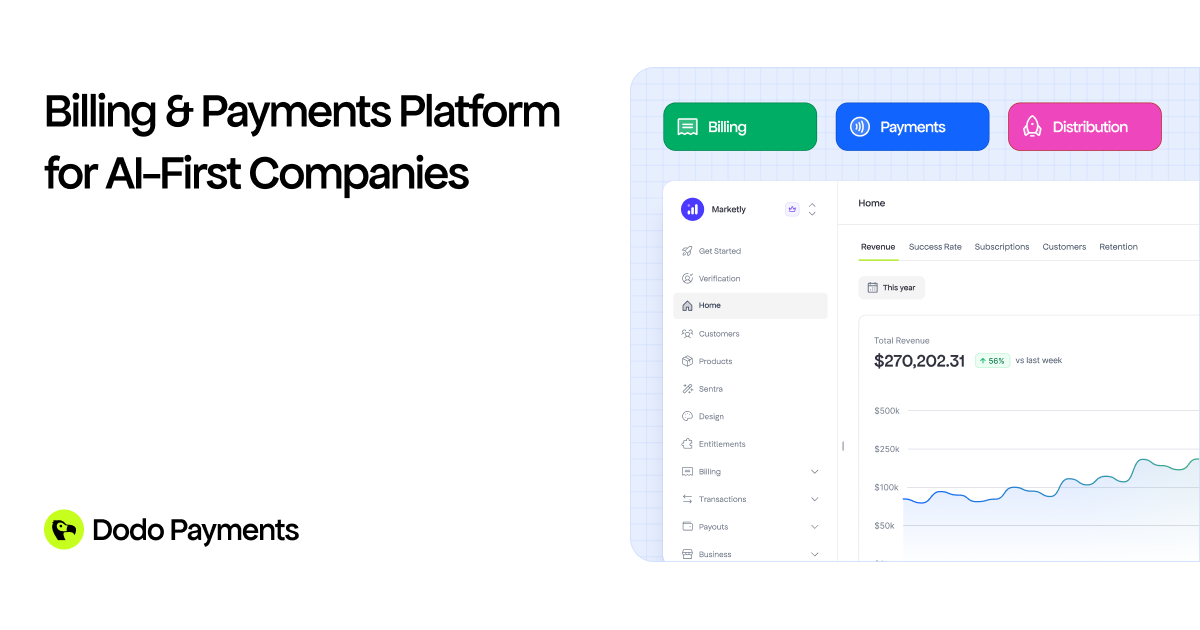
Feature comparison matrix
| Feature | DoDo payments | Fastspring | Why it matters |
|---|---|---|---|
| Pricing model | Pay only when you transact; no fixed platform cost, plus optional add-ons like analytics at $10/month and usage-based billing at $1 per million events | Flat-rate merchant-of-record pricing estimated from monthly gross transaction value, transaction count, and geographic split | Dodopayments publishes per-transaction rates; Fastspring quotes a blended rate via its pricing estimator. |
| Merchant of record | Merchant of record with cross-border tax and compliance handled | Merchant-of-record model handling global tax collection and remittance | Both act as merchant of record, so tax compliance is handled on your behalf. |
| Usage-based and credit billing | Credit-based billing, usage-based billing, and metered billing for token usage and customer credits at $1 per million events | Subscriptions, 1x payments, and interactive quotes for custom SaaS deals | Dodopayments lists metered event pricing explicitly; Fastspring emphasizes subscription and custom-quote workflows. |
| Bank debit pricing | ACH Direct Debit 1.5% capped at $15 per transaction; SEPA Direct Debit 1.5% capped at €15 per transaction, replacing the card fee | Pricing bundled into the flat-rate merchant-of-record estimate rather than published as a separate bank-debit rate | Dodopayments publishes standalone ACH and SEPA rates; Fastspring does not list a separate bank-debit line. |
| Recovery tooling | Abandoned cart recovery, subscription dunning, and payment retries free to use with 5% on the recovered amount | Funnel audits powered by agents and human expertise, plus reporting and analytics | Dodopayments charges a success fee on recovered revenue; Fastspring positions audits and analytics as part of its platform. |
| Global reach | Adaptive currency, local payment methods, and global payments for AI-first companies | 200+ regions, 21+ languages, and 35+ currencies supported | Fastspring publishes specific region, language, and currency counts; Dodopayments describes global coverage qualitatively. |
| Developer tooling | SDKs, API reference, webhooks, MCP servers, agent plugin, and framework adapters | Store Builder Library, API reference, code samples, and webhooks | Dodopayments lists MCP servers and agent skills aimed at AI products; Fastspring offers a JavaScript store builder library. |
| Free trial | Free-to-use recovery features with a 5% success fee on recovered amounts | Free sign-up with an activated free trial | Both offer a no-cost entry point, but the mechanics differ: success-fee tooling versus a trial period. |
Why buyers switch from Fastspring to Dodopayments
Fastspring has been a fixture of the digital commerce world since 2006, and its merchant-of-record model has carried thousands of software sellers through global tax and payment complexity. Yet a specific kind of buyer keeps moving off it: the AI-first product team that ships fast, bills on usage, and does not want a blended rate hiding the true cost of each transaction. Here are the concrete reasons that show up again and again.
Line-item pricing instead of a blended estimate. Fastspring's pricing page asks you to input monthly gross transaction value (from $0 to $100M), monthly transaction count (0 to 500,000), and a geographic split percentage, then produces a quote. Dodopayments publishes its rates directly on its pricing page: ACH Direct Debit in the USA at a flat 1.5% capped at $15 per transaction, SEPA Direct Debit in Europe at 1.5% capped at €15, and domestic USA card and wallet fees listed per transaction. The difference matters when you are modelling unit economics for a product with thin margins and high volume — you can build a spreadsheet from Dodopayments' published numbers without a sales conversation.
Usage and credit billing are native, not bolted on. Dodopayments describes itself as the billing and payments platform for AI-first companies, and its feature list reflects that: credit-based billing, usage-based billing, metered billing for token usage and customer credits, subscriptions, and one-time payments all sit in the same stack. Fastspring's feature set centres on subscriptions, tax compliance, localized payment methods, interactive quotes, and store building. For a company selling tokens or credits, metering is the product, not an edge case.
Add-on pricing that is visible and small. Dodopayments lists analytics and reporting at $10 per month and usage-based billing at $1 per million events. Those are the kind of numbers a founder can approve without a procurement cycle. Fastspring's page presents flat-rate merchant-of-record pricing with no additional fees, but the actual rate is derived from the estimator rather than printed as a table.
Recovery tooling priced on results. Dodopayments makes abandoned cart recovery, subscription dunning, and payment retries free to use, charging 5% on the recovered amount. You pay nothing unless the feature actually brings money back. That aligns the vendor's incentive with yours in a way a flat platform rate cannot.
None of this makes Fastspring a weak product. It makes it a different product, built for a different centre of gravity. The rest of this comparison works through where the two platforms genuinely diverge.
Feature deep-dive 1: usage-based and credit billing for AI products
This is the single largest functional gap between the two platforms, and it is the reason most AI teams end up evaluating Dodopayments in the first place.
What metered billing actually requires
Selling an AI product means your billable unit is not a seat or a month — it is a token, a generation, a credit, an API call. That creates three engineering problems: capturing events reliably at volume, aggregating them into an invoice the customer can understand, and reconciling the invoice against what was actually delivered. Dodopayments treats usage-based billing as a first-class product, listing metered billing for models like token usage and customer credits alongside subscriptions and one-time payments. The pricing page prices it at $1 per million events, which gives you a predictable cost curve as volume grows rather than a percentage that scales with revenue.
Credits as a product surface
Credit-based billing is listed separately from usage-based billing in Dodopayments' feature navigation, which reflects a real distinction. Usage billing meters consumption after the fact; credit billing sells a prepaid balance the customer draws down. AI companies frequently need both — a prepaid credit pack for new customers and metered overage for heavy users. Having both in one platform means one customer record, one invoice stream, and one set of analytics rather than a billing vendor plus an internal ledger service.
Where Fastspring sits
Fastspring's published feature set covers subscriptions, one-time payments, interactive quotes for custom SaaS deals, reporting and analytics, funnel audits, and a merchant-of-record layer. Its strength is the commerce wrapper around a subscription business. For a company whose revenue is metered consumption, the metering logic would sit outside the platform and be pushed in as invoice lines. That is workable, but it means you own the aggregation layer, the edge cases, and the reconciliation.
The practical test
Ask one question during evaluation: can the platform produce an accurate invoice for a customer who consumed 4.2 million tokens, redeemed a 500-credit pack, and upgraded mid-cycle? If the answer requires you to build a service, the platform is not doing the job you are paying it for. Dodopayments' positioning — monetize without building infrastructure — is a direct claim about that scenario.
Feature deep-dive 2: merchant of record, global coverage, and distribution
Both platforms act as merchant of record, which means both absorb tax registration, collection, remittance, and compliance on your behalf. The difference is in what surrounds that core.
Merchant-of-record parity
Fastspring built its reputation on MoR: sell globally and stay compliant, with top payment methods across 200+ regions, 21+ languages, and 35+ currencies supported, according to its homepage. Those are substantial numbers and they reflect two decades of operational build-out. Dodopayments also operates as merchant of record and lists cross-border tax and compliance handling as part of the platform, with no fixed costs and payment only when you transact. On the compliance core, this is closer to parity than the marketing suggests — both take the tax problem off your plate.
Local payment methods and adaptive currency
Dodopayments lists adaptive currency and local payment methods as platform features, and its pricing page details ACH Direct Debit for US customers and SEPA Direct Debit for Eurozone customers at 1.5% capped at $15 and €15 respectively. Critically, the page states that these bank debit fees replace the card fee rather than adding to it, and that neither the international nor the subscription surcharge applies to them. For a subscription business with European customers, SEPA at 1.5% capped at €15 can be materially cheaper than card rails on larger tickets — and the cap means a €2,000 annual invoice does not cost €30 in processing.
Distribution beyond payments
This is where the two platforms diverge most sharply. Dodopayments groups its product into three areas: billing, payments, and distribution. Under distribution it lists purchasing power parity, discount codes, multi-brand support, storefront, affiliates, and digital product delivery including license keys. Purchasing power parity pricing is a meaningful lever for AI products with global user bases — it lets you price to local purchasing power rather than forcing a single USD price everywhere. Fastspring's equivalent surface is its store builder and store experience tooling, which is mature but oriented toward building a hosted storefront rather than a distribution and affiliate layer.
Developer surface
Dodopayments publishes SDKs, an API reference, webhooks, framework adapters, and an integration guide, plus AI-oriented tooling: an agent plugin, MCP servers, agent skills, BillingSDK, and ContextMCP. Fastspring counters with its Store Builder Library, API reference, code samples, and webhooks. Both are developer-credible. Dodopayments' MCP and agent tooling is the newer and more distinctive bet, and it signals which buyer the platform is optimising for.
Pricing compared
Pricing is where the two platforms are least comparable, because they publish in different formats. Treat any side-by-side number with care.
Dodopayments: published per-transaction rates plus optional add-ons
Dodopayments states there are no fixed costs and you pay only when you transact. The pricing page lists domestic USA card and wallet fees per transaction, ACH Direct Debit at 1.5% capped at $15, and SEPA Direct Debit at 1.5% capped at €15. On top of the transaction layer, optional add-ons are priced explicitly: analytics and reporting at $10 per month, and usage-based billing at $1 per million events. Recovery features — abandoned cart recovery, subscription dunning, and automatic payment retries on a smart back-off schedule — are free to use with a 5% charge on the recovered amount. There is also a bring-your-own-processor option for teams routing payments through their own processor, priced at 0.5% per transaction.
Fastspring: a blended merchant-of-record rate
Fastspring's pricing page is an estimator, not a rate card. You enter monthly gross transaction value between $0 and $100M, monthly transaction count between 0 and 500,000, and a geographic split percentage, and the page produces a quote. The page describes the model as simple, flat-rate pricing covering payment processing, subscriptions, global tax collection and remittance, localized payment methods, and currency. The specific percentage is not printed as a public table, so for planning purposes the effective rate is pricing not public until you run the estimator or speak to sales. Fastspring does offer a free sign-up with an activated free trial, so you can evaluate the checkout and store experience before committing.
How to compare them honestly
Do not compare Dodopayments' 5% recovery fee against a Fastspring subscription rate — they are different things. The recovery fee is contingent on money being recovered; if the feature recovers nothing, it costs nothing. Likewise, do not treat Dodopayments' $10 per month analytics add-on as a platform fee; the platform itself carries no fixed cost. The honest comparison is total cost of ownership at your actual volume: run your monthly transaction value and count through Fastspring's estimator, then model the same volume against Dodopayments' published card, ACH, and SEPA rates plus any add-ons you would actually use. Include the currency mix, because the ACH and SEPA caps change the maths on larger tickets.
Who this is actually for
Scenario 1: the AI infrastructure startup billing on tokens
Picture a team of eight engineers selling an inference API. Revenue arrives as metered token consumption, with a prepaid credit pack for new sign-ups and overage billed monthly. Their customers are split between the US and the EU, and a handful of enterprise accounts pay annually on invoices large enough that card fees would be painful. This team needs metered billing, credit balances, ACH and SEPA at capped rates, and an invoice a finance department will accept. Dodopayments' combination of usage-based billing at $1 per million events, credit-based billing, and 1.5% capped bank debits maps directly onto that shape. Building the metering and credit ledger in-house would consume months of engineering time that this team does not have.
Scenario 2: the global consumer app chasing purchasing power
Consider a consumer-facing AI tool with a large international user base across markets with very different willingness to pay. A single $20 per month price point either overcharges most of the world or leaves money on the table in high-income markets. This buyer cares about purchasing power parity pricing, discount codes, multi-brand support, affiliates, and a storefront — the distribution layer Dodopayments lists as a distinct product area. They also want recovery automation, because consumer subscription churn is brutal and abandoned checkouts are common. Free-to-use abandoned cart recovery and dunning at 5% on recovered revenue is an easy line item to justify when the alternative is paying for a recovery tool whether or not it works.
Scenario 3: the established SaaS that needs enterprise commerce wrappers
Now consider a mature B2B SaaS company with a sales-led motion, custom contract terms, and a compliance team that wants a merchant of record with a long operating history. Fastspring's interactive quotes for custom SaaS deals, funnel audits backed by human expertise, and its 3,200+ customers and more than $2B in transactions per year are exactly the signals this buyer is trained to look for. If your revenue is seat-based subscriptions, your deals are negotiated, and your priority is a vendor with two decades of MoR operations, Fastspring remains a defensible choice. The honest read is that this buyer is not the one Dodopayments is optimising for — and that is fine.
Getting started with Dodopayments
Migration is mostly a sequencing problem. Work through these steps in order and the cutover stays boring, which is what you want.
Map your billable units. Before touching any integration, write down every way you charge: flat subscription, seat count, token consumption, credit packs, one-time purchases, overage. For each, note the event source and the aggregation window. This document determines which Dodopayments billing primitives you configure and is the single highest-leverage hour of the project.
Create your account and run a test transaction. Sign up and exercise the checkout in test mode with a domestic card, then an ACH debit, then a SEPA debit if you have Eurozone customers. Confirm the fee behaviour you expect — in particular that the bank debit fee replaces the card fee rather than stacking on top of it.
Wire up metering. Connect your event pipeline to usage-based billing and verify aggregation against a known quantity. If you sell credits, model the credit ledger alongside it so prepaid balances and metered overage reconcile to a single customer view. Budget against the $1 per million events rate as your volume grows.
Configure subscriptions and recovery. Set up plans, trial logic, and dunning. Enable abandoned cart recovery, subscription dunning, and payment retries — all free to use with 5% on the recovered amount — and confirm the retry back-off schedule matches your risk appetite.
Set up distribution. If you sell internationally, configure purchasing power parity pricing, discount codes, and affiliate tracking. If you deliver license keys or digital goods, connect delivery before launch rather than after.
Migrate existing subscribers carefully. Export current subscription records, map plan identifiers, and decide whether to migrate payment methods or let them refresh on next renewal. Run both systems in parallel for one billing cycle and reconcile every invoice.
Turn on analytics and cut over. Enable reporting at $10 per month once you are live so you have payment, revenue, customer, and churn analytics from day one, then retire the old stack.
If you are still weighing alternatives beyond these two platforms, AltHunt tracks the wider comparison set so you can check how each option stacks up before you commit engineering time.
Pricing breakdown
| Plan | DoDo payments | Fastspring |
|---|---|---|
| Free access / trial | Recovery features (abandoned cart, dunning, payment retries) free to use with 5% on recovered amount | Free sign-up with an activated free trial |
| Card payments (domestic USA) | Per-transaction card and wallet fees published on the pricing page | Flat-rate merchant-of-record rate estimated from monthly gross transaction value |
| Bank debit (ACH / SEPA) | 1.5% capped at $15 per ACH transaction; 1.5% capped at €15 per SEPA transaction | Included within the flat-rate merchant-of-record estimate; no separate published bank-debit rate |
| Usage-based billing add-on | $1 per million events for metered billing | Subscriptions and 1x payments included in the platform rate; metered event pricing not listed separately |
| Analytics add-on | $10 per month for comprehensive payment, revenue, customer, and churn analytics | Reporting and analytics included in the platform offering |
Illustrative pricing — verify current figures before relying on this.
Ready to try DoDo payments?
Visit dodopayments.comMore alternatives
All Fastspring alternativesCommunity Discussions & Reviews
Real feedback from verified buyers, founders, and engineering teams using these products.