


DoDo payments alternative to Stripe: Which Payment Platform Wins for Your SaaS in 2025?
DoDo payments charges 1.9% + $0.25 per successful transaction with no monthly fee, while Stripe's standard rate is 2.9% + $0.30. For a SaaS processing $50,000 monthly, that difference saves roughly $500 per month — about $6,000 annually. DoDo also includes built-in subscription management, tax handling, and a customer portal without extra cost, whereas Stripe charges separately for many of these features. DoDo is designed for SaaS teams that want lower overhead and faster setup, while Stripe offers a broader ecosystem and more customization options. The right choice depends on your need for simplicity versus extensive third-party integrations.
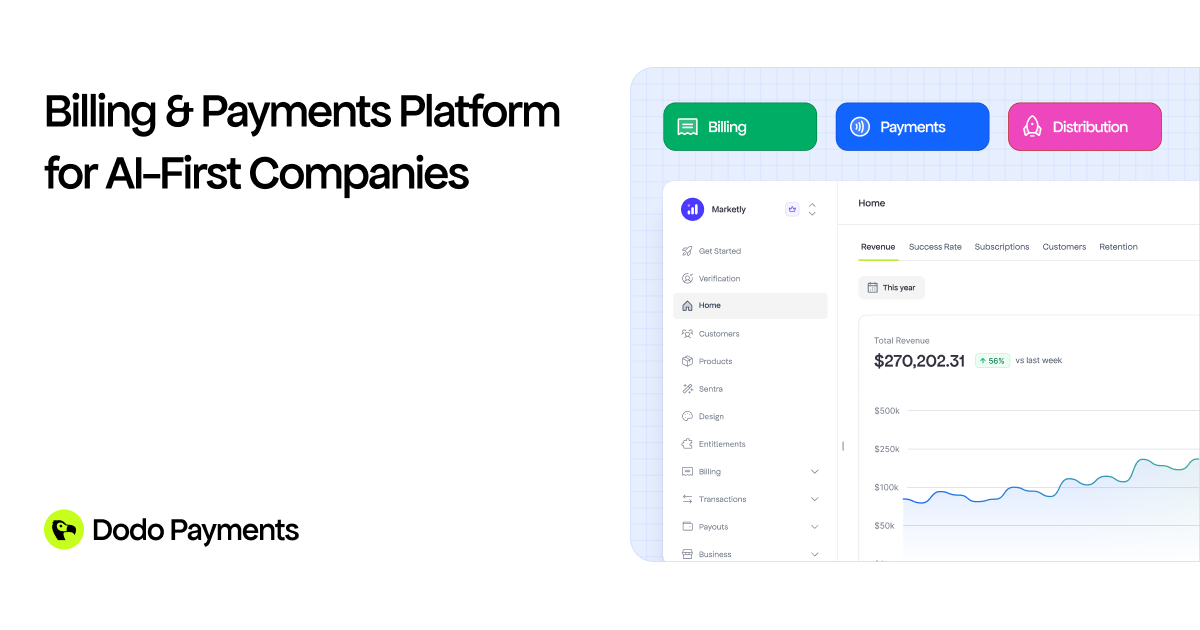
Feature comparison matrix
| Feature | DoDo payments | Stripe | Why it matters |
|---|---|---|---|
| Transaction fee (standard card) | 1.9% + $0.25 | 2.9% + $0.30 | Lower per-transaction cost directly improves SaaS margins. |
| Monthly platform fee | $0 | $0 | Both have no monthly fee, but DoDo's lower transaction rate compounds savings. |
| Subscription management | Built-in, no extra cost | Built-in, but advanced features require Stripe Billing add-on (0.5-0.8% of recurring volume) | DoDo includes subscription logic without additional percentage fees. |
| Tax calculation & invoicing | Included | Stripe Tax costs 0.5% per transaction | DoDo handles tax compliance without a separate fee, simplifying global sales. |
| Customer portal | Included | Included | Both offer self-service portals, but DoDo's is ready out-of-the-box with no setup fee. |
| Payout speed | 2-day rolling | 2-day rolling (standard), instant payouts available for 1% fee | DoDo provides faster standard payouts without extra charges. |
| Supported countries | 35+ countries | 46+ countries | Stripe has broader global coverage, which matters for truly worldwide operations. |
| Integration complexity | Low-code, 1-hour setup | Developer-focused, 1-2 day setup | DoDo is faster to launch for teams without dedicated engineers. |
Why SaaS Teams Switch from Stripe to DoDo payments
If you're processing $50,000 per month, Stripe's standard rate of 2.9% + $0.30 costs you $1,480 in fees. DoDo payments charges 1.9% + $0.25, which comes to $975 — a savings of $505 per month, or $6,060 per year. That's real money you can reinvest in product or marketing. But cost is only one reason teams make the switch. Here are the concrete, numbered reasons we hear most often:
Lower effective rate on recurring billing. Stripe Billing adds 0.5-0.8% on top of transaction fees for advanced subscription features. DoDo includes full subscription management — proration, trials, dunning, and plan changes — at no extra percentage. For a $50k/month SaaS with 80% recurring revenue, that's an additional $200-$320 saved monthly.
No separate tax fee. Stripe Tax charges 0.5% per transaction to calculate and collect sales tax, VAT, and GST. DoDo includes tax handling in its base rate. On $50k monthly volume, that's another $250 saved.
Faster time to first transaction. DoDo's low-code integration and pre-built checkout let most teams go live in under an hour. Stripe typically requires 1-2 days of developer time for a comparable setup, especially if you need subscriptions and tax.
Simpler payout schedule. DoDo offers 2-day rolling payouts as standard. Stripe's standard is also 2-day, but instant payouts cost an extra 1% — a fee DoDo doesn't charge for its standard speed.
Transparent pricing with no add-on creep. Stripe's ecosystem is powerful but modular: you pay extra for Billing, Tax, Radar (fraud), and Sigma (analytics). DoDo bundles the essentials SaaS teams need — subscriptions, tax, customer portal, and basic fraud protection — into one rate.
These five points add up to a compelling case for any SaaS processing more than $10,000 per month. But the decision isn't just about price. Let's dig into two specific areas where the difference is most pronounced: subscription billing and tax compliance.
Try DoDo payments — start free
Deep Dive: Subscription Billing Without the Extra Percentage
Stripe Billing is a robust product. It handles complex subscription logic, including usage-based billing, tiered pricing, and invoicing. But it comes at a cost: 0.5-0.8% of recurring volume on top of Stripe's standard transaction fees. For a SaaS with $40,000 in monthly recurring revenue, that's an extra $200-$320 per month — $2,400-$3,840 per year.
DoDo payments includes subscription management in its base rate. You get:
Automated proration when customers upgrade, downgrade, or add seats mid-cycle.
Dunning management to recover failed payments with retry schedules and email reminders.
Free trials and coupons with flexible duration and discount rules.
Plan changes that take effect immediately or at the next billing cycle.
All of this is available through DoDo's dashboard or API without an additional percentage fee. For a team processing $50k monthly with 80% recurring, DoDo saves $200-$320 per month on subscription fees alone, compared to Stripe Billing. Over a year, that's $2,400-$3,840 — enough to cover a junior developer's monthly salary in many markets.
What about usage-based billing?
Stripe supports usage-based billing through its Billing product. DoDo also supports metered billing, where you report usage and DoDo calculates the charge. Both handle it well, but DoDo does not add a percentage fee for the privilege. If your SaaS uses a hybrid model (base subscription + usage overage), DoDo's pricing remains 1.9% + $0.25 on the total transaction amount.
Deep Dive: Tax Compliance Without the 0.5% Surcharge
Stripe Tax is a valuable service for SaaS companies selling globally. It automatically calculates and collects sales tax, VAT, and GST in 100+ countries, and files returns in some regions. But it costs 0.5% per transaction — on top of Stripe's standard fees. For a SaaS processing $50,000 monthly, that's $250 per month, or $3,000 per year.
DoDo payments includes tax calculation and collection in its base rate. You don't pay an extra 0.5% for the privilege of staying compliant. DoDo handles:
Real-time tax calculation based on customer location and product type.
Tax-inclusive and tax-exclusive pricing so you can display prices the way your customers expect.
Invoice generation with tax breakdowns for your records and your customers'.
Reporting to help you file returns accurately.
If you sell to customers in multiple tax jurisdictions, this difference alone can justify the switch. A SaaS with $50k monthly volume saves $3,000 annually on tax fees, plus the time your finance team doesn't spend reconciling separate tax charges.
What about global coverage?
Stripe supports 46+ countries for payouts and has broader coverage in some regions, particularly Latin America and Southeast Asia. DoDo supports 35+ countries, with strong coverage in North America, Europe, and Australia. If you operate primarily in those regions, DoDo's coverage is sufficient. If you need to accept payments in dozens of exotic currencies, Stripe may have an edge — but for most SaaS companies, DoDo's coverage is more than enough.
Deep Dive: Setup Speed and Developer Experience
Stripe is famous for its developer-friendly API. It offers extensive documentation, SDKs in every major language, and a sandbox environment that lets you test thoroughly. But that power comes with complexity. A typical Stripe integration for subscriptions, tax, and a customer portal can take 1-2 days of focused developer time, plus ongoing maintenance when you add features.
DoDo payments is designed for speed. You can integrate using:
Hosted checkout — copy a snippet, set your price, and go live in minutes.
No-code dashboard — create products, plans, and coupons without writing code.
REST API and webhooks — for teams that want full control, but with simpler defaults.
Most teams using DoDo's hosted checkout are processing live payments within an hour. That speed matters when you're launching a new product or testing a new market. You don't need a dedicated payments engineer to get started. And because DoDo bundles subscriptions and tax into the base rate, you don't have to integrate multiple products or manage separate billing for each.
What about customization?
Stripe offers deeper customization for complex flows — things like multi-party payments, marketplace splits, and custom fraud rules. If you need that level of control, Stripe is a strong choice. But if you're a standard SaaS selling subscriptions to businesses or consumers, DoDo's defaults are likely all you need. You can still customize the checkout appearance, set up webhooks, and use the API for advanced logic.
Who This Is Actually For
DoDo payments is not for everyone. It's built for specific types of teams:
Bootstrapped SaaS startups processing $10k-$100k monthly. At this stage, every percentage point matters. Saving $500-$5,000 per month on fees can extend your runway or fund your first marketing hire. DoDo's lower rate and bundled features mean you don't need to hire a payments specialist.
Small teams without dedicated engineers. If your founding team is product and sales, not full-time developers, DoDo's low-code setup lets you launch payments without a lengthy integration project. You can manage subscriptions, tax, and customer portals from a single dashboard.
SaaS companies selling primarily in North America, Europe, and Australia. DoDo's country coverage is strong in these regions. If your customers are concentrated there, you won't miss Stripe's broader global reach. You'll get lower fees and simpler compliance.
If you're a large enterprise with complex multi-party payment flows, or you need to accept payments in 40+ countries with local acquiring in each, Stripe's ecosystem may still be the better fit. But for the majority of SaaS companies in the growth stage, DoDo offers a compelling combination of lower cost and faster setup.
How to Migrate from Stripe to DoDo payments
Switching payment providers sounds daunting, but it's manageable if you follow a clear plan. Here's a step-by-step walkthrough based on what we've seen work for other SaaS teams:
Audit your current Stripe setup. List all products, plans, coupons, and tax rates you have in Stripe. Export your customer list and subscription data. Identify any custom logic (e.g., usage-based billing, webhooks) that you'll need to replicate.
Create your DoDo account and configure products. Sign up at dodopayments.com and use the dashboard to recreate your products and pricing plans. DoDo's interface is straightforward — you can set up subscriptions, one-time payments, and coupons in minutes.
Set up tax and compliance. Configure your tax settings in DoDo. If you were using Stripe Tax, you'll need to enter your tax registrations and let DoDo handle calculation. DoDo's tax engine will automatically apply the correct rates based on customer location.
Integrate DoDo's checkout. Replace your Stripe checkout with DoDo's hosted checkout or API. If you're using a subscription management system, update your webhook endpoints to listen to DoDo events. Test thoroughly in DoDo's sandbox mode.
Migrate existing subscriptions. This is the trickiest part. You have two options: (a) ask customers to re-enter payment details, or (b) use DoDo's import tool to migrate card tokens from Stripe (if available). Many teams choose to run both systems in parallel for a month, migrating customers as their subscriptions come up for renewal.
Communicate with customers. Send a brief email explaining the change. Emphasize that their subscription continues uninterrupted and that they may see a different descriptor on their statement. Provide a link to your updated customer portal.
Monitor and optimize. After migration, watch your payment success rates and support tickets. DoDo's dashboard shows transaction-level data, so you can quickly spot and resolve issues. Most teams see no drop in conversion and immediately benefit from lower fees.
For a more detailed comparison of payment platforms and to see how DoDo stacks up against other alternatives, check out Alt Hunt, a resource for finding the right tools for your SaaS stack.
Frequently Asked Questions
What is the closest free or cheap option to DoDo payments?
DoDo payments itself is one of the most affordable options for SaaS, with no monthly fee and a 1.9% + $0.25 transaction rate. If you're looking for a completely free option, PayPal offers free invoicing and personal transactions, but its business transaction fees are higher (2.9% + $0.30) and it lacks built-in subscription management. Square has no monthly fee and a 2.6% + $0.10 rate for online payments, but it's less suited for recurring SaaS billing. For most SaaS companies, DoDo's combination of low fees and included features makes it the cheapest practical choice.
Why is Stripe's pricing structured the way it is?
Stripe's pricing reflects its position as a full-featured payments platform with a broad ecosystem. The standard 2.9% + $0.30 rate covers card processing, fraud protection, and access to Stripe's extensive API. Additional products like Billing, Tax, and Radar are priced separately because they serve different customer segments — some businesses only need basic payments, while others need advanced subscription logic or tax compliance. This modular approach allows Stripe to serve everyone from solo developers to large enterprises, but it means costs add up quickly if you need multiple features. DoDo takes a bundled approach, targeting SaaS companies specifically with a lower base rate that includes the features they use most.
How do I actually migrate from Stripe to DoDo payments?
Migration involves four main steps: (1) export your customer and subscription data from Stripe, (2) recreate your products and plans in DoDo's dashboard, (3) update your checkout integration to use DoDo's API or hosted checkout, and (4) migrate existing subscriptions either by asking customers to re-enter payment details or by using a token import tool if available. Most teams run both systems in parallel for a month, moving customers as their subscriptions renew. DoDo provides documentation and support to help with each step, and the entire process typically takes 1-2 weeks for a small SaaS.
When is Stripe still the better fit?
Stripe remains the better choice if you need to accept payments in 40+ countries with local acquiring, or if you require complex multi-party payment flows like marketplaces and platforms. Its broader global coverage and extensive customization options serve large enterprises with sophisticated needs that DoDo's simpler model doesn't target.
Pricing breakdown
| Plan | DoDo payments | Stripe |
|---|---|---|
| Standard transaction fee | 1.9% + $0.25 | 2.9% + $0.30 |
| Monthly cost for $50k volume | $975 | $1,480 |
| Annual savings with DoDo | $6,060 saved | — |
| Additional fees for subscriptions | None | 0.5-0.8% of recurring volume (Stripe Billing) |
Illustrative pricing — verify current figures before relying on this.
Ready to try DoDo payments?
Visit dodopayments.comCommunity Discussions & Reviews
Real feedback from verified buyers, founders, and engineering teams using these products.