



Troviun alternative to Klue: Structural Overlap Scoring vs Enterprise Competitive Enablement
Updated 21 Nov 2026
Troviun starts free and its paid plans run from US$19/mo (Radar) to US$390/mo (Comando), with a one-off US$29 Evidence Dossier. Klue is an enterprise competitive-intelligence platform for battlecards, win-loss research and sales enablement, and its pricing is not public. Troviun scores how structurally close two digital products are across five dimensions and returns a 0–100 overlap index with dated, hashed evidence; Klue organizes ongoing competitor monitoring and distributes intel to revenue teams.
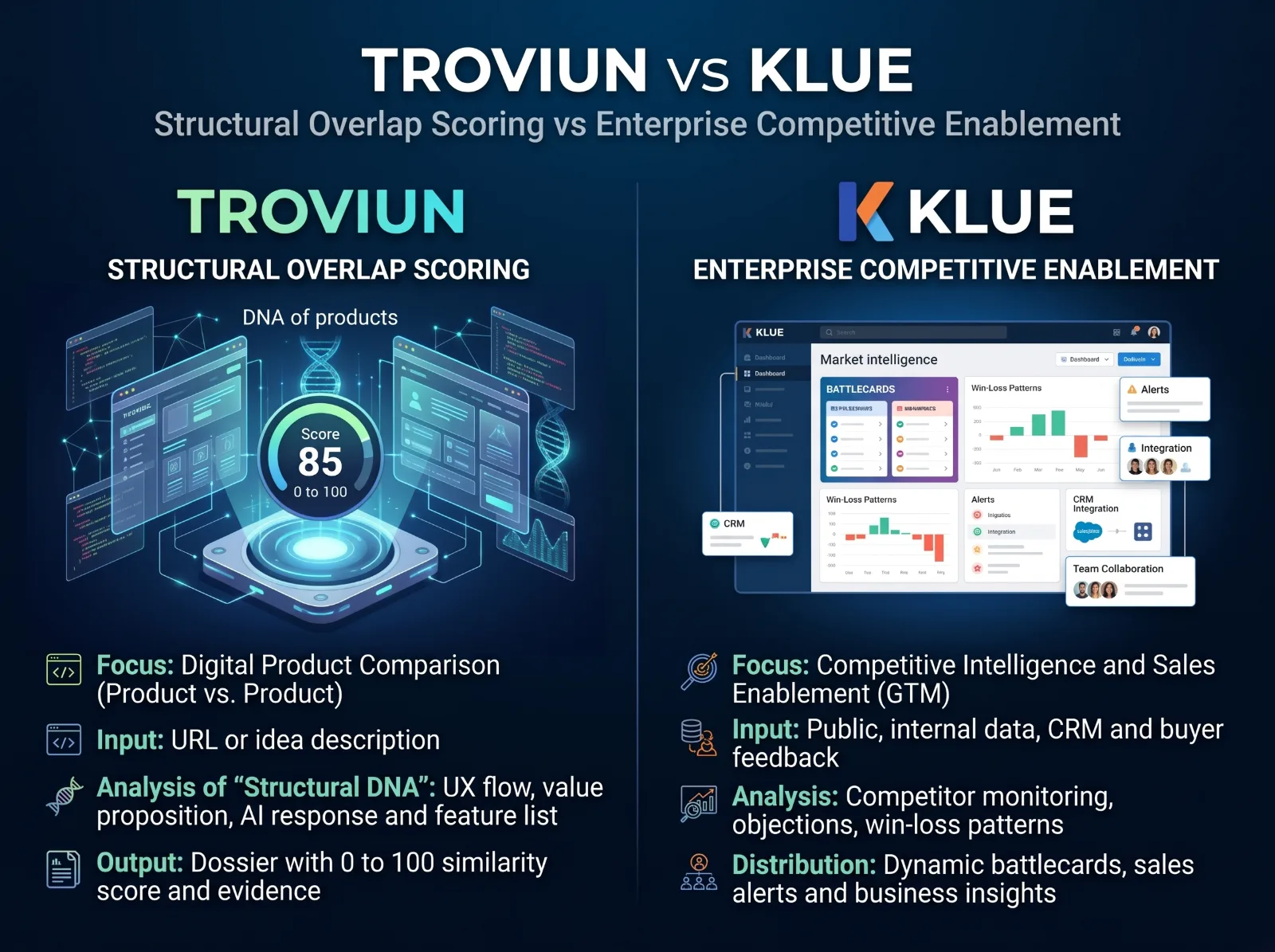
Feature comparison matrix
| Feature | Troviun | Klue | Why it matters |
|---|---|---|---|
| Core purpose | Measures structural overlap between digital products and returns a 0–100 index with the evidence behind each reading. | Competitive intelligence and win-loss platform for collecting research, building battlecards and enabling sales teams. | Different jobs: product-level structural similarity vs organizational competitive enablement. |
| Analysis dimensions | Five dimensions: flow, value promise, AI response, feature architecture and structural signature. | Competitive intelligence, Compete Agent, Auto Insights, win-loss interviews and battlecards. | Troviun's dimensions are structural signals; Klue's are market and sales-enablement workflows. |
| Evidence trail | Dated chain of evidence, a hash for each snapshot and the engine version that produced it, so a third party can rerun the reading. | Research and insights are collected and curated inside the platform for internal distribution. | Troviun emphasizes reproducible, hash-stamped evidence; Klue emphasizes curated internal intel. |
| Input method | Paste a product URL or upload a Pitch Deck (PDF); the scanner collects the landing page, pricing page and feature list. | Structured research, analyst-led win-loss interviews, AI Interviewer and integrations with workplace tools. | Troviun is self-serve and scan-based; Klue is research-program and workflow based. |
| Output format | Overlap score and verdict, 5-dimension readout, and on higher plans a forensic evidence dossier with SHA-256 and timestamp plus PDF export. | Battlecards, deal tips, auto-generated content for sellers and competitive research outputs. | Troviun outputs an analytical dossier; Klue outputs sales-facing enablement content. |
| Primary audience | Founders, product leaders, venture builders and investors assessing whether an idea already exists and how close it is. | Enterprise competitive-intelligence, product marketing and sales-enablement teams. | Troviun targets early-stage and investor use; Klue targets established revenue organizations. |
| Free access | Public scans at no cost: score 0 to 100 and verdict visible to anyone, 3 scans per hour without login and 10 scans per day after creating a free account. | Free access evidence appears in Klue's published case-study content; no public self-serve free tier is described on the site. | Troviun publishes a free scan allowance; Klue's entry path is a demo request. |
| Integrations and monitoring | Focused ad-hoc scanning; no continuous monitoring, automated alerts or enterprise integrations are offered. | Integrations with workplace tools and automated insight delivery to sellers in live deals. | Klue covers ongoing workflow and integration needs that Troviun does not claim. |
Why buyers switch from Klue to Troviun
Klue is a competitive intelligence and win-loss platform built for enterprise enablement teams: it collects research, builds battlecards, and pushes deal-specific intel to sellers. Troviun answers a narrower, earlier question — how structurally close is a product to what already exists in its market — and it answers it with a dated evidence chain rather than a battlecard. Buyers who move from Klue to Troviun usually do so for one of the following reasons.
The question is product-level, not sales-level. Klue is organized around enabling reps in live deals and around ongoing competitive programs. Troviun is organized around a single measurement: paste a product URL or upload a pitch deck, and the scanner collects the landing page, the pricing page and the feature list — headline, block order and user journey — then compares structure across five dimensions. If your actual question is "does this product already exist, and how close is it structurally," a battlecard platform is the wrong instrument.
Evidence is dated and hash-stamped, not narrative. Troviun's forensic posture means every reading comes with a dated chain of evidence, a hash for each snapshot and the engine version that produced it, so any third party can rerun and verify. The Defesa plan and above unlock the forensic SHA-256 evidence dossier with timestamp and PDF export. Teams that need to defend a positioning decision in a board deck or an investment memo value that verifiability over a curated narrative.
Access is self-serve and immediate. Troviun's free tier requires no card: public scans are at no cost, the score and verdict are visible to anyone, and you get 3 scans per hour without login and 10 scans per day after creating a free account. Paid plans start at US$19/mo. Klue's entry path is a demo request, which fits enterprise procurement but not a founder testing an idea on a Tuesday afternoon.
The output is a number you can compare across candidates. Troviun returns a 0–100 structural overlap index with three bands and three different outcomes, plus a five-dimension readout. That makes it possible to rank several product ideas or several competitors on the same scale instead of reading prose assessments written by different analysts at different times.
None of this makes Klue obsolete. Klue's published outcomes describe large-scale enablement programs — its site cites 65% increased win-rate percentage on notable competitors, 10K deals influenced by 50 win-loss interviews in 12 months, and a 30% reduction in deal cycle time. Those are organizational sales outcomes. Troviun does not claim to deliver them, and buyers should not expect it to. The switch happens when the job to be done changes from enabling a sales floor to assessing structural similarity before you build.
Five-dimension structural overlap: what Troviun actually measures
The core differentiator is the measurement model. Troviun does not summarize competitors in prose; it separates what is category convention from what is an execution choice, and it does so across five named dimensions. Each dimension is scored, and the composite produces the 0–100 overlap index.
Flow, promise and AI response
The first dimension is user experience flow — the sequence a visitor moves through, the block order of the page, the journey from headline to conversion. The second is value promise: what the product claims to solve, and how closely that claim converges with another product's claim. The third is the AI response: the shape of what the AI returns, which matters increasingly as more products embed generative features that look similar on the surface but diverge in output structure. Troviun's own illustrative case data shows how these separate: an anonymized B2B fintech case scored 58 overlap and was labeled "Crowded ground," with the notes that value promise overlaps almost entirely, pricing and packaging converge, and the AI response diverges. That is a genuinely useful distinction — two products can look identical on the marketing page and still differ in what the model actually produces.
Feature architecture and structural signature
Feature architecture asks which pieces exist and how they connect — not a checklist of feature names but the topology of the product. Structural signature is described in Troviun's materials as the hardest mark to disguise: paraphrasing copy is easy, hiding a reverse-engineered product is not. This is the dimension that most directly answers the founder's real question. A competitor can rewrite every headline; it is much harder to rearrange the underlying architecture and journey that the scanner observes.
Bands, not just scores
Troviun frames its output as three bands with three different outcomes. The illustrative cases on the site show the range: a 58 labeled "Crowded ground" with converging promise and pricing, and a 7 labeled "Open space" with the same category but a different journey, natural feature convergence and no mirrored structure. A score of 56 versus 40 changes the decision, and the band tells you which decision you are making. For teams that need to justify a build-or-pivot call, that framing is more actionable than a qualitative competitor profile.
Evidence posture and verifiability compared
The second major dimension is how each platform treats evidence. This is where the two products diverge most sharply in philosophy, and it is the reason many analytical buyers prefer Troviun for product-level work.
Dated chains and hashes
Troviun describes itself as "a measuring instrument, with a forensic posture." Every reading comes with a dated chain of evidence, a hash for each snapshot and the engine version that produced it. The Defesa plan (US$69/mo) adds the forensic SHA-256 evidence dossier with timestamp and PDF export. The Fortaleza plan (US$169/mo) adds a risk matrix and SWOT plus a market positioning quadrant. The Comando plan (US$390/mo) adds private validation and calibration plus a methodology annex in the PDF. If you need a single proof point rather than a subscription, a One-Off Evidence Dossier at US$29 unlocks the SHA-256 plus timestamp evidence dossier for one of your scans, whether from a URL or a pitch deck.
What Klue's evidence looks like
Klue's evidence model is customer-outcome oriented. Its site presents case studies with quantified results — the Blackbaud case study describes win rates against top competitors improving by 28% with Compete Agent, and Klue's homepage cites 65% increased win-rate percentage on notable competitors, 10K deals influenced by 50 win-loss interviews in 12 months, and a 30% reduction in deal cycle time. Klue also covers broad landscapes: one quoted customer describes covering about 60 direct and indirect competitors so the team has broad, consistent coverage rather than nitty-gritty depth on each. That is a legitimate and valuable evidence model for enablement — but it is testimonial and outcome evidence, not a reproducible measurement of structural distance between two products.
Why verifiability matters for product decisions
When the decision is "should we build this," the audience is often internal: a co-founder, a product lead, an investment committee. Those audiences ask how you know. A hash-stamped snapshot with a timestamp and an engine version is a different kind of answer than a battlecard. It also means the analysis can be re-run later and compared — if a competitor ships a major redesign, the new scan sits against the old one on the same scale. Troviun explicitly states that where evidence is absent it records the absence instead of filling the gap with an estimate, which is the correct posture for a measurement tool and a meaningful contrast with narrative-first competitive research.
Pricing compared
Troviun publishes its pricing openly and offers a genuine free tier alongside paid plans. Klue's pricing is not public on the pages reviewed; its entry path is a demo request, which is standard for enterprise competitive enablement platforms. The two models are not directly comparable line by line, and buyers should treat them as different categories of spend.
Troviun's published tiers
Free · no card. Public scans at no cost, score 0 to 100 and verdict visible to anyone, 3 scans per hour without login (with Turnstile), 10 scans per day after creating a free account, shareable on LinkedIn and X.
Radar — US$19/mo. For founders watching the market: unlimited ad-hoc scans (fair use), overlap score and verdict, five-dimension readout, and history of your scans.
Defesa — US$69/mo. For PMs and product teams: forensic SHA-256 evidence, unlimited ad-hoc scans (fair use), full five-dimension report, evidence dossier with SHA-256 plus timestamp, and PDF export.
Fortaleza — US$169/mo. For accelerators and small portfolios: everything in Defesa plus risk matrix and SWOT and a market positioning quadrant.
Comando — US$390/mo. For funds and venture builders: everything in Fortaleza plus private validation and calibration and a methodology annex in the PDF.
One-Off Evidence Dossier — US$29. A one-time payment that unlocks the SHA-256 plus timestamp evidence dossier of one of your scans.
Annual billing is listed at a 20% discount across the subscription tiers. The free tier is a real product surface, not a trial: the score and verdict are public and shareable, which is unusual and useful for founders who want to circulate a reading without buying seats.
How to think about the comparison
Klue's pricing is not public, so any comparison of absolute cost is speculative. What can be said is structural: Troviun's entry paid plan is US$19/mo and its free tier requires no card, while Klue's documented entry is a demo request. For a solo founder or a two-person product team, that difference in procurement friction is often the deciding factor. For an enterprise with an existing enablement program, Klue's model — research services, analyst-led win-loss interviews, AI Interviewer for scaled voice conversations with buyers and sellers, and integrations with workplace tools — is a different purchase entirely, and the absence of public pricing reflects a sales-led motion rather than a gap. Buyers should map spend to the job: a US$19/mo Radar subscription does not replace a competitive enablement program, and an enablement program does not produce a hash-stamped structural overlap index.
Who this is actually for
Troviun's maker notes are explicit about the audience: founders, product leaders, venture builders and investors who need to assess structural similarity between digital products. Three concrete scenarios illustrate where it fits and where Klue remains the better choice.
Scenario 1: The pre-seed founder validating an idea
A founder has a thesis for a B2B workflow tool and wants to know whether the space is already crowded before writing a line of code. The workflow is simple: paste the product URL or upload the pitch deck, run a free scan, read the 0–100 score and the band. A reading in the "Crowded ground" range with converging value promise and pricing is a signal to differentiate or reposition; a low score in "Open space" with the same category but a different journey suggests room. The five-dimension readout shows where the convergence actually sits — maybe the promise overlaps but the AI response diverges, which is a viable wedge. Cost of the first pass: nothing. Cost of ongoing monitoring at Radar: US$19/mo. This buyer would never clear procurement for an enterprise enablement platform, and does not need to.
Scenario 2: The product manager preparing a positioning review
A PM at a Series A company is preparing a quarterly positioning review and needs defensible evidence that the product's differentiation is real. Here the Defesa plan at US$69/mo matters: the forensic SHA-256 evidence dossier with timestamp and PDF export turns a scan into a document that can go into the review pack. The PM can show the five-dimension report, note which dimensions converge with a named competitor and which diverge, and attach the dated evidence. If the company also runs a sales enablement function, that function may well use Klue for battlecards and deal tips — the two tools sit at different layers and are not mutually exclusive. Troviun does not claim continuous monitoring, automated alerts, integrations or enterprise capabilities, so the PM should not expect it to replace an enablement workflow.
Scenario 3: The venture builder or fund screening a portfolio
A venture builder evaluating several candidate products in the same category needs a consistent scale across them. Fortaleza at US$169/mo adds a risk matrix and SWOT plus a market positioning quadrant, which supports portfolio-level comparison; Comando at US$390/mo adds private validation and calibration and a methodology annex in the PDF for funds and venture builders who need to show their measurement methodology to LPs or investment committees. The value here is comparability: the same five dimensions and the same 0–100 index applied to every candidate, with dated evidence behind each reading. A fund that also needs win-loss research on portfolio companies' sales cycles is buying a different product from Klue, and should budget for both if both jobs exist.
Getting started with Troviun
Migration from a Klue-centric workflow to Troviun is not a data migration — there is nothing to export from a battlecard platform that maps onto a structural overlap scan. It is a workflow change, and it can be done in an afternoon.
Run a free scan first. Go to troviun.com and paste your product URL, or upload your pitch deck as a PDF. No card is required. You get 3 scans per hour without login and 10 scans per day after creating a free account. Read the score, the band and the five-dimension readout before deciding anything.
Scan your top three competitors on the same day. Consistency matters: the same engine version and the same day's snapshots make the readings comparable. Note which dimensions converge and which diverge for each — the divergence is where your differentiation argument lives.
Decide whether you need the evidence dossier. If the output is for internal orientation, the free tier and Radar at US$19/mo cover score, verdict, five-dimension readout and scan history. If the output goes into a board deck, an investment memo or a positioning review, move to Defesa at US$69/mo for the SHA-256 plus timestamp dossier and PDF export — or buy a single One-Off Evidence Dossier at US$29 if you need exactly one proof point.
Set a re-scan cadence. Troviun is a measuring instrument, not a monitoring service. It does not push alerts or integrate with your stack. Pick a cadence — quarterly for most teams, monthly during a competitive launch window — and re-run the scans so the dated evidence chain accumulates and you can compare readings over time.
Keep Klue where it earns its place. If your organization runs a sales enablement program with battlecards, deal tips and win-loss interviews, that work stays with Klue. Troviun answers the product-level structural question; Klue answers the in-deal enablement question. Document which tool owns which decision so the two do not get conflated in review meetings.
For teams comparing tools across categories, AltHunt is a useful starting point for mapping the wider landscape before you commit to a workflow. The short version: if your question is "how structurally close is this product to what already exists, and can you prove it," start with a free Troviun scan and let the score and the evidence chain make the case.
Pricing breakdown
| Plan | Troviun | Klue |
|---|---|---|
| Free | Free · no card: public scans at no cost, score and verdict visible to anyone, 3 scans per hour without login, 10 scans per day with a free account. | No public self-serve free tier described; entry is via a demo request. |
| Entry paid | Radar — US$19/mo: unlimited ad-hoc scans (fair use), overlap score and verdict, 5-dimension readout, scan history. | pricing not public |
| Mid tier | Defesa — US$69/mo: forensic SHA-256 evidence, full 5-dimension report, evidence dossier with SHA-256 and timestamp, PDF export. | pricing not public |
| Upper tier | Fortaleza — US$169/mo: everything in Defesa plus risk matrix and SWOT, market positioning quadrant. | pricing not public |
| Top tier / one-off | Comando — US$390/mo: everything in Fortaleza plus private validation and calibration and a methodology annex in the PDF. One-Off Evidence Dossier — US$29 one-time for the SHA-256 and timestamp dossier of one scan. | pricing not public |
Illustrative pricing — verify current figures before relying on this.
Ready to try Troviun?
Visit troviun.comMore alternatives
All Klue alternativesCommunity Discussions & Reviews
Real feedback from verified buyers, founders, and engineering teams using these products.