


Runs.Space vs Product Hunt: A Race That Keeps Going vs a One-Day Launch
Updated 5 Nov 2026
runs.space is free to launch and free to vote, no card. Product Hunt is also free to submit. The core difference is format: a Product Hunt launch is built around one day's ranking, while on runs.space a product is a rocket that keeps racing for as long as people fuel it, climbing to Orbit at 500 fuel, with a Weekly Sprint winner when a rocket qualifies. Fuel comes only from other people, never from you, and a winner needs fuel from at least two different people. Money buys labelled visibility only (optional extras start at $3, a founding price), never fuel, rank or a better chance to win, and there is no cash prize. Product Hunt has a far bigger audience; runs.space is young and promises no traffic.
Feature comparison matrix
| Feature | Runs.Space | Producthunt | Why it matters |
|---|---|---|---|
| Launch format | A rocket stays on the track and keeps racing for as long as people fuel it; nothing dies. | A one-day launch with a daily ranking. | Runs.Space is built around an ongoing race rather than a single launch day. |
| How ranking works | Real people give fuel, one fuel per person per rocket per week, and never to their own rocket; a rocket reaches Orbit at 500 fuel. | Upvotes accumulate on launch day and feed a daily leaderboard. | Both rely on community signals, but Runs.Space spreads voting across weeks. |
| Weekly winner | A Weekly Sprint crowns the rocket with the most fuel from at least two different people. | Daily rankings highlight the top products of each day. | Runs.Space requires support from more than one person to win a sprint. |
| Role of money | Money buys labelled visibility only, never fuel, rank or a better chance to win; there is no cash prize. | Product Hunt offers promoted placements; specific pricing is not public. | Runs.Space states that money never buys a vote. |
| Prizes | Winners earn a gold badge, a story page. a blessing and a 1 day spotlight. | Recognition comes from leaderboard placement and badges. | Runs.Space explicitly offers no cash prize. |
| Audience size | Young platform with about forty rockets racing now; no traffic is promised. | Far bigger audience. | Product Hunt offers reach; Runs.Space offers an ongoing track. |
| Transparency | Every rule and change is public. | Community guidelines and moderation policies are published. | Runs.Space emphasises a public rulebook. |
| Cost to start | Free to launch and free to vote, no card required. | Free to submit a product. | Both let you start without paying. |
Why buyers switch from Product Hunt to Runs.Space
Product Hunt is the default reflex for most founders: you prepare a launch, you line up supporters, you go live at 12:01 AM Pacific, and you watch a daily leaderboard for roughly 24 hours. Then the day ends, the ranking freezes, and your product becomes an archive entry. Runs.Space was built as a direct answer to that lifecycle, and the reasons teams move over are concrete rather than philosophical.
The launch does not expire. On Product Hunt, a launch is a one-day event with a daily ranking. On Runs.Space, every product is a rocket that stays on the track and keeps racing for as long as people fuel it. The site states it plainly: "Nothing dies — keep your fuel, resubmit forever." A team that has a slow Tuesday is not erased; they simply keep climbing in the following weeks. That single structural difference removes the most stressful part of a launch calendar — the idea that one bad day permanently defines your public reception.
Ranking is gated by real people, not by campaign size. Fuel is a vote from a real person. The rules are explicit: one fuel per person per rocket per week, and you can never fuel your own rocket. A rocket reaches Orbit at 500 fuel. The Weekly Sprint crowns the rocket with the most fuel from at least two different people. Compare that to a daily upvote leaderboard where the volume of a coordinated push is the dominant variable. Runs.Space caps individual influence by design, which means a small team with genuine users can compete against a team with a large mailing list.
Money cannot buy position. Runs.Space sells visibility, and it labels it. A paid Boost adds a gold halo, never height. Altitude is always pure fuel. The pricing page repeats the promise: "Fuel is a vote from a real person. Money never buys fuel." There is no cash prize either — the weekly winner earns a gold badge, a story page, a blessing and a free day of Spotlight. For teams that have watched paid placement quietly reshape a leaderboard elsewhere, a written, public rule that money never buys a vote is the whole reason to switch.
One honest caveat belongs up front: Product Hunt has a far bigger audience, and Runs.Space is young — roughly forty rockets racing now. Runs.Space promises no traffic. What it promises is a track that stays open. If your goal is a single spike of awareness from an established audience, Product Hunt still does that job. If your goal is a durable public page and a race you can re-enter, the rest of this comparison is for you.
The endless race format: a rocket that keeps climbing instead of a launch day that ends
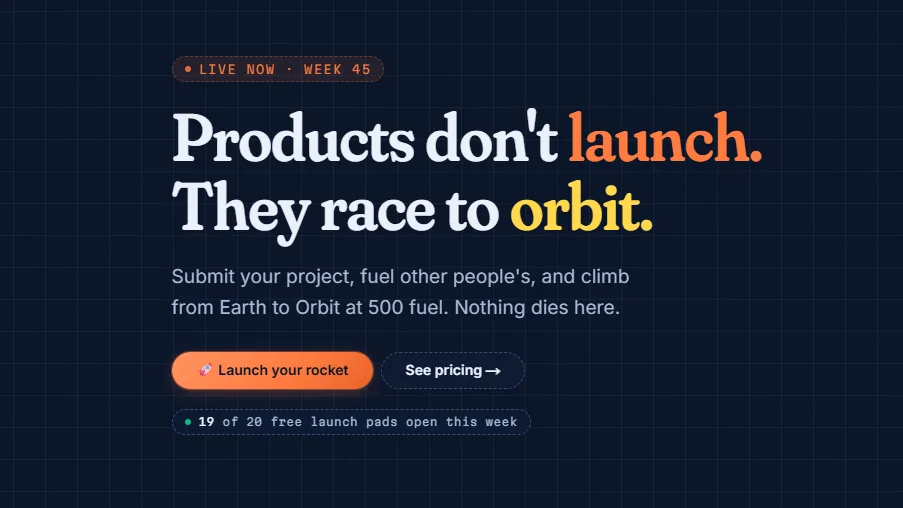
The core differentiator is the format itself. Runs.Space describes itself as "the endless space race for products: each one a rocket that real people fuel on its climb to Orbit." The homepage headline is blunt about the contrast: "Products don't launch. They race to orbit." That is not a slogan layered on top of a standard directory — it changes what a submission actually is.
Two races run at once
The Mission Briefing on the site lays out the structure: "Two races at once. Nothing dies." There is a weekly sprint and an eternal marathon. The weekly sprint resets and crowns a winner; the marathon is the cumulative climb toward Orbit at 500 fuel. A product can win a week, or it can grind upward over months, or both. That dual structure is what lets a team with a modest but steady user base stay visible without needing a single explosive day.
Fuel is capped per person, per rocket, per week
The mechanic is deliberately narrow. One fuel per person per rocket per week. You cannot fuel your own rocket. A rocket reaches Orbit at 500 fuel. The Weekly Sprint requires the most fuel from at least two different people — which means a single enthusiastic supporter cannot carry a rocket to a weekly win alone. These constraints are the product. They are why the leaderboard reflects a broader set of real people rather than the depth of one person's network.
Nothing dies, and resubmission is free
"Nothing dies — keep your fuel, resubmit forever" appears in the pricing copy as a feature of both tiers. On a one-day launch platform, a missed day is a lost launch. Here, a quiet week costs you position but not your page, your accumulated fuel, or your ability to try again next Monday. For founders launching something that is still hardening — a beta, an API, a tool waiting on a integration — that forgiveness is worth more than a spike.
Everything is public, including the rules
The site publishes its contest rules, terms, privacy policy, and an llms.txt file. The maker notes are explicit that every rule and change is public. When a platform's ranking mechanic is the product, publishing the mechanic is the trust signal. You can read exactly how a weekly winner is determined before you enter.
Fair ranking mechanics: how fuel, Super Fuel and Spotlight stay separate from altitude
The second dimension worth a deep dive is the separation between earned rank and paid visibility. Most launch platforms blur that line, sometimes unintentionally. Runs.Space draws it in writing and then builds features on either side of it.
Altitude is pure fuel — nothing else
The site's own wording: "Altitude is always pure fuel. A paid Boost adds a gold halo, never height." A rocket's position on the climb to Orbit at 500 fuel is determined only by fuel from real people. A Boost — a paid promotion — is visually marked with a gold halo and does not move the rocket up. That is a meaningfully different design from platforms where promoted placement and organic ranking share the same column.
Super Fuel amplifies support, not self-promotion
Runner subscribers get "one 5× Super Fuel/week for an ally." Note the word ally. The multiplier is spent on someone else's rocket, not your own. The paid tier increases your capacity to support other builders — 10 fuel/day to give versus 3 fuel/day on the free Walker tier — but it never grants you a vote for yourself. The pricing page summarizes the philosophy: "Money buys a bigger voice for supporting others, never a vote for yourself."
Spotlight is a booked, labelled slot
Spotlight is a separate, one-time purchase: $3 for 1 day, $8 for 3 days (saves 11%), $13 for 7 days (saves 38%). It is explicitly "one-time, no subscription," and the founding price rises as the audience grows while a booked run keeps its price. Spotlight is free with Runner — 3 days with a ticket, 7 days with each monthly payment — and a free day is awarded for each weekly win. Crucially, Spotlight is visibility, not altitude. It does not add fuel and does not change your standing in the race.
Weekly winners get recognition, not cash
The weekly winner earns a gold badge, a story page, a blessing and a free day of Spotlight — never cash. That is a deliberate choice. Cash prizes invite gaming; badges, a story page and a day of visibility reward the product without creating a financial incentive to manipulate the vote. Combined with the two-different-people requirement for a weekly win, the incentive structure points toward genuine community support rather than engineered campaigns.
Pricing compared: free forever versus paid visibility, and what Product Hunt charges
Runs.Space publishes its full price list. Product Hunt's promoted placement pricing is not public, so this section compares what is documented on each side and flags where evidence is absent rather than guessing.
Runs.Space Walker — free forever
Walker is the free tier and it is genuinely free, not a trial. It includes up to 3 free launches per account each week, each racing to 500 fuel. There are 20 pads open to everyone together, and both the pads and the weekly cycle reset Monday. Walker gives you 3 fuel/day to give to other rockets, plus 1 free launch fuel a day. No card is required to launch or to vote. For a solo founder or a small team testing the waters, Walker is the entire product experience minus the amplification tools.
Runs.Space Runner — $13 for 7 days or $21 per month
Runner is the paid subscription, cancel anytime. It includes everything in Walker plus 10 fuel/day to give, one 5× Super Fuel per week for an ally, up to 10 launches a week, and a guarantee that a full free week never blocks you. It also bundles Spotlight days: 3 days with a ticket, 7 days with each monthly payment. At $21 per month, Runner is priced like a modest SaaS tool, and the value is concentrated in giving capacity and launch volume rather than in rank.
Runs.Space Hangar Pass — $34 one-time
The Hangar Pass is a one-time purchase at a founding price that rises as the race grows, locked in for early buyers. It grants a permanent page for one rocket at [rocket-name].runs.space — the same kind of page a rocket earns by reaching Orbit. For teams that want a stable, linkable home for their product regardless of weekly standings, this is the cheapest durable asset on the menu.
Product Hunt — free to submit, promoted placement pricing not public
Product Hunt is free to submit a product. Its promoted placement pricing is not public, so no dollar comparison can be drawn honestly. What can be said is structural: Product Hunt's model centers on a one-day launch with a daily ranking, and its paid promotion options sit alongside that. Runs.Space's model separates free racing from optional paid visibility and states that money never buys fuel. Neither model is inherently cheaper — they are priced for different jobs. If you need a large audience on a specific date, Product Hunt's free submission is the entry point. If you need a race that persists and a permanent page, Runs.Space's Walker tier costs nothing and the Hangar Pass costs $34 once.
Who this is actually for
Runs.Space is not a drop-in replacement for every Product Hunt use case. Three buyer profiles map cleanly onto what the platform actually does.
Scenario 1: The pre-revenue indie team that cannot afford a bad launch day
A two-person team shipping a developer tool has maybe 200 people on a waitlist. On a one-day launch platform, a Tuesday launch that lands outside the top of the daily ranking is effectively invisible, and there is no second attempt without a rebrand. On Runs.Space, that team launches under Walker for free, gets 3 fuel/day to give to other rockets, and enters the weekly sprint. If week one is quiet, they keep their fuel and resubmit. Over a month they build a story page, a gold badge if they win a week, and a permanent record. The cost of trying is zero, and the cost of a slow week is zero. For a team whose runway is measured in months, that asymmetry is the entire argument.
Scenario 2: The API or infrastructure company that needs a permanent, linkable page
Consider a hosted licensing API — the kind of product that is hard to explain in a one-line launch post and impossible to evaluate in a single day. This buyer does not need a spike; they need a URL they can put in docs, in a README, and in outbound emails. The Hangar Pass at $34 one-time delivers a permanent page at [rocket-name].runs.space, the same kind of page a rocket earns by reaching Orbit. Combined with the eternal marathon — a rocket stays on the track and keeps racing for as long as people fuel it — the page accumulates history rather than freezing on launch day. For a B2B infrastructure vendor, a stable page with visible momentum beats a 24-hour ranking every time.
Scenario 3: The community-led product with genuine advocates
Some products have a small but real fan base — a niche tool, a learning platform, a directory. Those advocates can each give one fuel per person per rocket per week, and a Runner subscriber among them can spend a 5× Super Fuel on an ally. Because a weekly win requires the most fuel from at least two different people, a product with ten genuine supporters outperforms a product with one well-connected founder. This is the profile Runs.Space is optimized for: teams whose growth comes from people who actually use the thing, not from a launch-day mailing list blast. The trade-off is reach — Runs.Space is young, with roughly forty rockets racing now, and promises no traffic. A community-led team should treat it as a durable home base, not as an audience acquisition channel.
Getting started with Runs.Space
Migration is light because there is nothing to import — you are creating a rocket, not syncing a CRM. Here is the sequence that matches how the platform is actually structured.
Read the rules before you launch. Open the contest rules, terms, and the llms.txt file on runs.space. Confirm you understand the fuel cap (one per person per rocket per week, never your own), the Orbit threshold at 500 fuel, and the two-different-people requirement for a Weekly Sprint win. Ten minutes here prevents a wasted first week.
Create your account and launch under Walker. Walker is free forever and requires no card. You get up to 3 free launches per account each week, each racing to 500 fuel, plus 3 fuel/day to give and 1 free launch fuel a day. Launch your product as a rocket and note that 20 pads are open to everyone together, resetting Monday.
Fuel other rockets deliberately. Your 3 fuel/day is the mechanism that makes the race work for everyone. Spend it on products you would genuinely recommend. This is also how you learn the platform's norms — you will see how other teams write their rocket pages and how the gold halo on a Boost is displayed.
Decide between Runner and the Hangar Pass based on what you need. If you want more giving capacity (10 fuel/day), a weekly 5× Super Fuel for an ally, up to 10 launches a week, and bundled Spotlight days, Runner is $13 for 7 days or $21 per month, cancel anytime. If you want a permanent page at [rocket-name].runs.space regardless of standings, the Hangar Pass is $34 one-time at the founding price. These solve different problems — amplification versus permanence — and you can hold both.
Book Spotlight only if you want labelled visibility. Spotlight is $3 for 1 day, $8 for 3 days, or $13 for 7 days, one-time with no subscription. Remember that Spotlight adds visibility, not altitude — it will not move you toward Orbit at 500 fuel. If you are on Runner, check your bundled days first (3 days with a ticket, 7 days with each monthly payment) before buying.
Keep racing through quiet weeks. Nothing dies. Keep your fuel, resubmit forever. If a week goes badly, the correct move is to return the following Monday with the same rocket and the same accumulated fuel, not to start over.
If you are still weighing the switch, the honest framing is this: Product Hunt gives you a large audience and a single day; Runs.Space gives you a persistent race, a permanent page, and a written promise that money never buys a vote. Compare the two side by side on AltHunt before you commit your launch calendar, and pick the format that matches how your product actually grows.
Pricing breakdown
| Plan | Runs.Space | Producthunt |
|---|---|---|
| Free tier | Walker: free forever, up to 3 free launches per account each week, each racing to 500 fuel; 3 fuel/day to give plus 1 free launch fuel a day. | Free to submit a product; promoted placement pricing is not public. |
| Entry paid plan | Runner: $13 for 7 days or $21 per month, cancel anytime; includes 10 fuel/day to give, one 5× Super Fuel per week for an ally, up to 10 launches a week and a free Spotlight. | Promoted placement is optional; pricing not public. |
| Permanent page | Hangar Pass: $34 one-time founding price, locked in for early buyers, for a permanent page at [rocket-name].runs.space. | No equivalent permanent product page product is described on the public site. |
| Spotlight (optional visibility) | $3 for 1 day, $8 for 3 days, $13 for 7 days; one-time, no subscription; free with Runner and for each weekly win. | Optional promoted placement; pricing not public. |
Illustrative pricing — verify current figures before relying on this.
Ready to try Runs.Space?
Visit runs.spaceMore alternatives
All Producthunt alternativesCommunity Discussions & Reviews
Real feedback from verified buyers, founders, and engineering teams using these products.