


Alphagrowth alternative to Defillama: Free Crypto MCP Server for AI Agents
Updated 10 Nov 2026
Both Alphagrowth and Defillama offer MCP servers for crypto data, but Alphagrowth stands out with a completely free, no-API-key model that bundles 27 read-only tools covering TVL, funding rounds, investors, yields, token unlocks, and DAO treasuries in one server. Defillama's MCP page provides no public pricing or feature details, so its exact capabilities remain unclear. For AI agent developers who need a single, zero-cost endpoint with documented tools, Alphagrowth provides a transparent, ready-to-use option. Defillama may still appeal if you already rely on its broader analytics platform.

Feature comparison matrix
| Feature | Alphagrowth | Defillama | Why it matters |
|---|---|---|---|
| Free access | Yes, completely free with no API key required | pricing not public | Alphagrowth explicitly states free access; Defillama's MCP page does not disclose pricing. |
| API key requirement | No API key needed | pricing not public | Alphagrowth emphasizes no API key; Defillama's requirements are not listed on its MCP page. |
| Number of tools | 27 read-only tools | pricing not public | Alphagrowth lists 27 tools; Defillama's tool count is not provided. |
| Data coverage | TVL, funding rounds, investors, yields, token unlocks, DAO treasuries | pricing not public | Alphagrowth details six data categories; Defillama's MCP data coverage is not specified. |
| Client support | Claude, ChatGPT, Cursor, VS Code, Claude Code, and any MCP client | pricing not public | Alphagrowth lists multiple supported clients; Defillama's client compatibility is not documented. |
| Unified project slug | Matches every project to one slug across data sources | pricing not public | Alphagrowth standardizes project identifiers; Defillama's approach is not described. |
| Developer resources | llms.txt, openapi.json, server-card.json | pricing not public | Alphagrowth provides machine-readable guides and API specs; Defillama's developer docs are not mentioned. |
| Read-only safety | All tools are read-only | pricing not public | Alphagrowth specifies read-only operations; Defillama's tool permissions are not stated. |
Why buyers switch from Defillama to Alphagrowth
Teams evaluating a crypto MCP server for AI agents usually start with Defillama because the name is familiar. The switch to Alphagrowth rarely happens because Defillama is bad — it happens because the two products answer different questions. Defillama's MCP page is thin on published detail, while Alphagrowth publishes its tool surface, its data model and its access terms openly. Below are the concrete reasons buyers move.
One server replaces a dozen tabs and a dozen naming conventions. Alphagrowth states the problem directly: crypto data is spread over a dozen sites, each with its own API, key and names for the same project. Alphagrowth pulls it together, matches every project to one slug, and serves it through one MCP server. That slug matching matters more than it sounds — when your agent asks about a protocol, you want one canonical identifier rather than three spellings across three sources.
No API key, no signup wall. Alphagrowth's MCP server is free and requires no API key. You paste one server URL into Claude, ChatGPT, Cursor, VS Code or any MCP client and the tools are live. For a team prototyping an agent, that removes an entire procurement and secrets-management step from week one. Defillama's MCP page does not disclose its access requirements, so a buyer cannot plan around them without asking.
A published, countable tool surface. Alphagrowth documents 27 read-only tools, with named examples such as yield_pools and token_unlocks, plus a developer surface that includes llms.txt, an OpenAPI description of the REST API at /api/v1, and server-card.json for MCP registries and scanners. When you are deciding whether an MCP server can support a production agent, a documented tool list is the difference between an evaluation and a guess.
There is a fourth, quieter reason: read-only by design. Every one of the 27 tools reads data. Nothing writes, nothing signs, nothing moves funds. For teams shipping agents that touch wallets, a read-only data layer is the safest possible first integration.
Feature deep-dive: the 27-tool read-only data surface
The core differentiator is not a single feature but the breadth of the tool set behind one URL. Alphagrowth describes the server as covering TVL, funding rounds, investors, yields, token unlocks and DAO treasuries — six data families that normally live in six different products.
What the tools actually answer
Alphagrowth publishes example prompts alongside the tools that serve them. Asking “Which stablecoin pools pay the highest yield with over $10M TVL?” calls yield_pools. Asking “What token unlocks are coming up in the next 30 days?” calls token_unlocks. Asking “How big is Uniswap's DAO treasury, and what does it hold?” routes to the treasury tool. These are not toy examples — they are the exact questions analysts type into a chat window every morning, and each one maps to a named, callable tool rather than a free-text scrape.
Token unlock data with real granularity
The unlock tooling is unusually specific. Alphagrowth documents filtering by days ahead, allocation category, a minimum value in USD, and pagination at 50 per page, with sorting by date or value. Each unlock carries the change of linear vesting (tokens a week), the allocations broken out by team, investors, airdrop and other categories, the value in USD at the token's latest price, and the share of circulating supply. Alphagrowth is also honest about a limitation most vendors hide: schedules are taken as published, and a team's unlock may vest per person rather than reach the market at once. That caveat is exactly the kind of detail a treasury or research analyst needs before building a model on top of the data.
Why read-only is a feature, not a limitation
An agent that can only read cannot drain a wallet, mis-sign a transaction or hallucinate a transfer. Alphagrowth labels all 27 tools read-only, which means you can hand the server to a junior analyst's Claude instance or wire it into a Cursor session without a security review cycle about write permissions. The blast radius of a bad prompt is a bad answer, not a bad transaction.
Developer surface beyond the chat client
For teams that outgrow the chat window, Alphagrowth exposes llms.txt as a guide to the server and API for language models, /openapi.json as an OpenAPI description of the REST API at /api/v1 serving the same data, and server-card.json as the server card that MCP registries and scanners read. That trio means the same data your agent queries in Claude can be called from your own backend with a standard HTTP client — no re-integration when you move from prototype to product.
Feature deep-dive: client coverage and zero-friction setup
The second differentiator is distribution. An MCP server is only useful if it installs into the client your team already uses, and Alphagrowth ships first-class paths for the major ones.
One-click and one-command installs
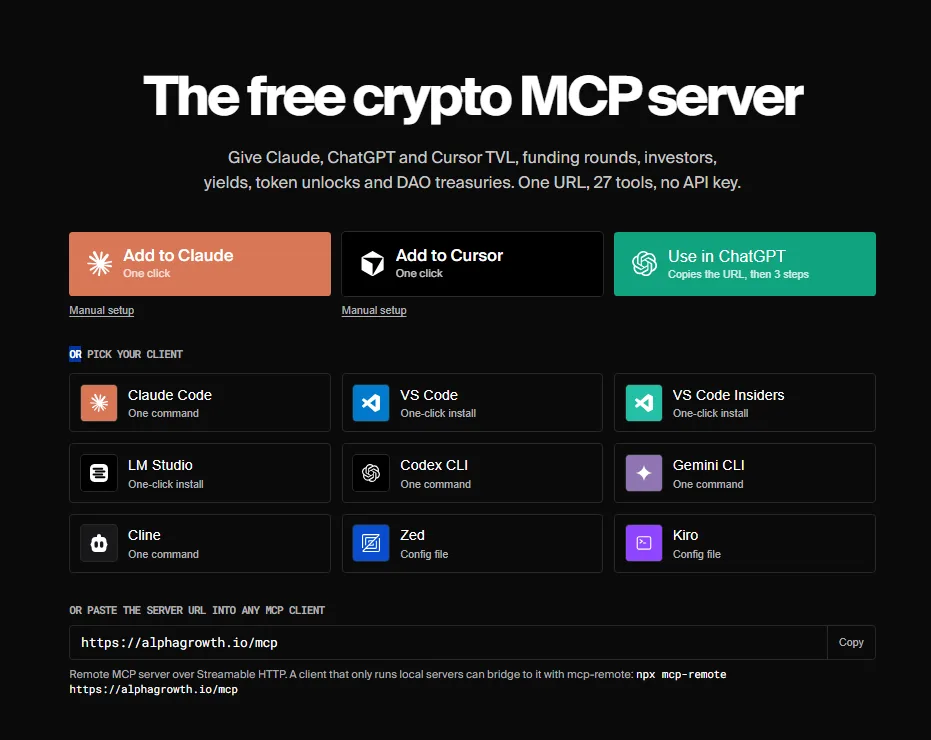
Alphagrowth lists Add to Claude (one click, or manual setup), Add to Cursor (one click, or manual setup), Use in ChatGPT (copies the URL, then three steps), Claude Code (one command) and VS Code (one command). It also supports pasting the server URL into any MCP client. That last option is the important one for teams on less common tooling — the server is not gated behind a specific vendor's marketplace.
No key management
Because there is no API key, there is no secret to rotate, no per-developer key to provision, and no risk of a key leaking into a public repo. For a team of five analysts each running their own Claude or Cursor session, that is five fewer credentials to track. It also means onboarding a contractor takes a URL paste rather than an IT ticket.
Consistent project identity across sources
Alphagrowth matches every project to one slug before serving it. In practice this is what stops an agent from returning Tether's fees under one spelling and Circle's under another, or from confusing two projects with similar names. The fees dataset Alphagrowth publishes illustrates the shape of the data: Tether at $16,617,427 in 1d fees with $116,886,008 over 7d, Circle at $6,727,619 in 1d fees with $47,079,123 over 7d, Pump at $3,636,933 in 1d fees with $25,967,803 over 7d, Hyperliquid at $3,376,496 in 1d fees with $21,102,471 over 7d, and Polymarket at $3,192,012 in 1d fees. Revenue is tracked alongside fees — Circle shows $6,669,752 in 1d revenue against $46,935,693 over 7d, and Hyperliquid shows $2,525,577 in 1d revenue against $16,059,203 over 7d. An agent that can pull fees and revenue for the same slug in one call is doing work that otherwise takes three tabs and a spreadsheet.
Where Defillama stands on this dimension
Defillama's MCP page does not publish a comparable feature list, client matrix or tool inventory in the material available. That is not a claim that the product lacks these things — it is a statement that a buyer cannot verify them from the page. When two products are candidates for the same integration slot, the one that documents its install paths and tool names wins the evaluation by default.
Pricing compared
Pricing is where the comparison is shortest, because one side publishes its terms and the other does not.
Alphagrowth: free, no API key
Alphagrowth's MCP server is free. The site states it plainly: a free crypto MCP server for Claude, ChatGPT, Cursor and VS Code, with no API key. There is no seat count, no usage meter and no credit card step described on the MCP page. The data is attributed to AlphaGrowth (alphagrowth.io) within the tool output. For budgeting purposes, the marginal cost of adding another analyst or another agent to the integration is zero as described.
Defillama: pricing not public
Defillama's MCP page does not disclose pricing. That is the whole of what can be said with confidence: pricing not public. It would be wrong to describe Defillama as having no free plan, and equally wrong to assume it is free — the page simply does not say. Buyers who need a cost line in a budget before they can proceed will have to contact the vendor, and that delay is itself a cost when an agent sprint is already underway.
How to read the asymmetry
When one product publishes “free, no API key” and the other publishes nothing, the comparison is not free-versus-paid. It is known-versus-unknown. A team can approve Alphagrowth today because the number is zero and the terms are on the page. A team evaluating Defillama needs a vendor conversation first, and the outcome of that conversation is not something this page can predict. Note also that Alphagrowth's fees dataset is a separate published data view, not a subscription tier — do not confuse the two. The MCP server is the free product; the fees table is data the server can surface.
Total cost beyond the sticker
The hidden cost in any MCP integration is engineering time. Alphagrowth's no-key, one-URL model means the integration cost is measured in minutes. If a competing server requires key provisioning, the true cost includes the secrets management, the rotation policy and the onboarding documentation — none of which appear on a pricing page. On the evidence available, Alphagrowth's published model is the cheaper one to try and the cheaper one to abandon if it does not fit.
Who this is actually for
Scenario 1: The DeFi research desk running daily yield and unlock screens
A research analyst at a fund starts every morning with the same two questions: which stablecoin pools pay the highest yield above a TVL threshold, and what unlocks are coming in the next 30 days. Today that means a yield aggregator, an unlock calendar, a spreadsheet and a lot of copy-paste. With Alphagrowth, both questions go to the same MCP server — yield_pools for the first, token_unlocks for the second — and the unlock answer arrives with vesting schedules, allocation categories, USD value at the latest price and share of circulating supply, 50 rows per page, sortable by date or value. The analyst keeps the judgment; the agent does the collection. A desk of three analysts can run this against a free server with no key to share around.
Scenario 2: The protocol growth team preparing a funding and treasury narrative
A growth lead needs to brief investors on where the protocol sits relative to peers: who raised what, which investors are on the cap table, how large comparable DAO treasuries are, and what the fee and revenue picture looks like. Alphagrowth covers funding rounds, investors and DAO treasuries in the same 27-tool surface, and the fees view gives a peer snapshot — Tether at $16,617,427 in 1d fees, Circle at $6,727,619, Pump at $3,636,933, Hyperliquid at $3,376,496, Polymarket at $3,192,012. Instead of ten tabs, the growth lead asks the agent to pull the peer set and draft the comparison. Because the tools are read-only, there is no risk of the agent touching anything it should not while the deck is being built.
Scenario 3: The agent developer shipping a crypto-aware assistant
A developer building a crypto assistant in Cursor or Claude Code needs a data layer that will not become a maintenance project. Alphagrowth gives them a server URL, 27 documented tools, llms.txt for the language model, /openapi.json for the REST API at /api/v1, and server-card.json for registries and scanners. They can prototype in the chat client and move to the REST API without changing data sources. The read-only guarantee means the security review is short. And the absence of an API key means the prototype does not need a secrets store on day one. This is the buyer for whom “one URL, 27 tools, no API key” is not marketing but a deployment plan.
Getting started with Alphagrowth
Migration is deliberately short. The server is free and keyless, so there is nothing to purchase before you begin.
Pick your client. Alphagrowth publishes one-click installs for Claude and Cursor, a copy-the-URL flow for ChatGPT, and one-command installs for Claude Code and VS Code. If you use something else, paste the server URL into any MCP client.
Add the server. Use the one-click button or the manual setup instructions on the Alphagrowth MCP page. No API key is issued or required, so skip any credential step.
Run the three published test prompts. Ask “Which stablecoin pools pay the highest yield with over $10M TVL?” to exercise yield_pools, “What token unlocks are coming up in the next 30 days?” to exercise token_unlocks, and “How big is Uniswap's DAO treasury, and what does it hold?” to exercise the treasury tool. If all three return sensible answers, the integration is live.
Map your existing questions to tools. Take the list of queries your team currently runs across separate sites and match each to one of the 27 read-only tools. Anything that does not map is a signal about a gap, not a failure.
Move to the API when you outgrow chat. When the prototype becomes a product, point your backend at the REST API at /api/v1 described by /openapi.json. The data is the same, so no re-integration is needed.
Keep the read-only boundary explicit in your prompts. Tell your agent that all 27 tools are read-only so it does not attempt write operations that do not exist.
Before you commit, it is worth reading a second opinion on how these MCP servers compare — AltHunt tracks the category and is a useful cross-check alongside the vendor pages. Then start with the free server, run the three test prompts, and decide from the answers rather than the marketing.
Pricing breakdown
| Plan | Alphagrowth | Defillama |
|---|---|---|
| Free tier | Free, no API key | pricing not public |
Illustrative pricing — verify current figures before relying on this.
Ready to try Alphagrowth?
Visit alphagrowth.ioMore alternatives
All Defillama alternativesCommunity Discussions & Reviews
Real feedback from verified buyers, founders, and engineering teams using these products.