

The Product Hunt Alternative That Still Sends Traffic in Six Months
Most launch platforms give you one day. This guide shows the mechanism behind launches that keep compounding, and how to publish a page that still earns traffic six months later.
Every founder who has launched on Product Hunt knows the shape of the graph. A vertical spike on Tuesday. A smaller bump on Wednesday. By the weekend the line is flat again, sitting roughly where it started.
The launch was not a failure. The graph is simply what a listing does. A listing is a record of an event, and events expire.
This guide is about the other kind of launch asset: the kind that is still working in month six. It covers what actually makes traffic compound, why most launch platforms structurally cannot deliver it, and how a solo founder can publish one of these assets in an afternoon.
Quick answer
If you want a launch that keeps earning after launch day, publish an alternative page: a structured comparison between your product and the incumbent your buyers already use. Launch it on a board for the initial spike, then let it rank for the searches those buyers are already running.
Alt Hunt is built specifically for this. It is free to publish, has no subscription, needs no code, and the page keeps a permanent URL long after its launch week closes.
Why launch-day traffic does not compound
It helps to be precise about what a launch platform actually sells you.
A directory listing is a page about an event. Its content is "this product launched on this date." That sentence stops being interesting almost immediately, which is why:
- The listing ranks for your product name, which you already rank for.
- It rarely ranks for anything a stranger would search.
- Its position in the feed decays by design, because the feed is chronological.
- The backlink persists, but a backlink alone sends nearly no referral traffic.
None of that is a flaw in Product Hunt. It is what a feed is. Chronological ordering is the product.
The consequence for a founder is simple: launch-day traffic is rented, not owned. You get a burst of attention proportional to how well you mobilised your network that morning, and then it ends.
What compounding actually requires
For traffic to compound, an asset needs three properties at once. Most launch pages have none of them.
1. It has to answer a question people are already asking. Nobody wakes up and searches your product name. They search the problem, or more often, they search the competitor they are already unhappy with.
2. The question has to keep being asked. "Notion alternatives" is searched every single day, forever, by a fresh set of people. "What launched on Tuesday" is not.
3. The asset has to stay at one stable address. Search engines reward a URL that accumulates history. A page that moves, expires, or gets buried resets that clock.
An alternative page satisfies all three. A launch listing satisfies none.
The search that founders keep overlooking
Here is the pattern that makes this work, and it is the most underused source of qualified traffic in SaaS.
When someone is genuinely ready to switch tools, they almost never search for a category. They search for a specific competitor plus an escape word:
- `notion alternatives`
- `cheaper alternative to mailchimp`
- `linear vs jira`
- `open source alternative to airtable`
- `supabase alternatives for startups`
Notice what these searches have in common. The person already has budget. They already understand the category. They have already decided the incumbent is not working. There is no education to do and no problem to explain.
This is the lowest-friction buyer in the entire funnel, and they are searching for your competitor's name, not yours.
A page built to answer that exact search intercepts them at the precise moment they are looking for a reason to leave. That page keeps intercepting them next month, and the month after.
Why most launch platforms cannot give you this
This is not a criticism of any individual platform. It is a structural point.
A launch platform's job is to run a feed. A feed is ordered by time, and the value it offers advertisers and readers is novelty. Novelty and permanence are opposites. A platform optimised for "what is new today" cannot simultaneously be optimised for "what still answers a question in eighteen months."
So the honest framing is not "which platform is better." It is:
A launch board gives you a spike. A comparison page gives you a slope. You want both, and most founders only ever get the first.
Where Product Hunt genuinely wins
Any guide that claims Product Hunt is obsolete is selling you something. It remains the best tool available for several jobs, and you should use it for those jobs.
- Credibility with investors and press. A strong Product Hunt result is still recognised shorthand.
- Reaching an audience that browses for novelty. Nowhere else has that concentration of early adopters actively looking for new tools.
- Concentrated feedback. A few hundred people looking at your product in one day produces more signal than a month of trickle traffic.
- Network effects on the day. Comments, makers, and hunters compound within the 24-hour window in a way no other platform matches.
If your goal is a burst of awareness and qualitative feedback, launch there. Just do not expect the graph to stay up, and do not plan your quarter around it.
What an alternative page contains
The difference between a comparison page that ranks and one that does not is structure. Search engines and AI answer engines both reward pages that resolve a question completely and honestly.
A page built on Alt Hunt is organised around that:
A direct answer up front. A short paragraph stating the core difference in plain language. This is the section AI engines quote, so it has to stand alone without the rest of the page.
A capability matrix. Feature by feature, with setup friction and support quality included, because those are the things people actually switch over.
Pricing tradeoffs. The real cost difference per seat or tier, stated as a number rather than a claim.
Honest objection handling. An explicit section on when the competitor is still the better choice.
That last one is counterintuitive, so it is worth stating plainly: pages that only flatter their own product do not get cited. Both Google and the AI engines are increasingly good at recognising one-sided content, and readers are better at it still. A page that names the cases where your competitor wins is the page a reader believes on everything else.
Migration steps. How to actually export data and switch. This converts the reader who is already persuaded.
Real FAQs. The integration and migration questions people genuinely ask.
Structured data. JSON-LD and semantic markup so machines can parse what the page is about.
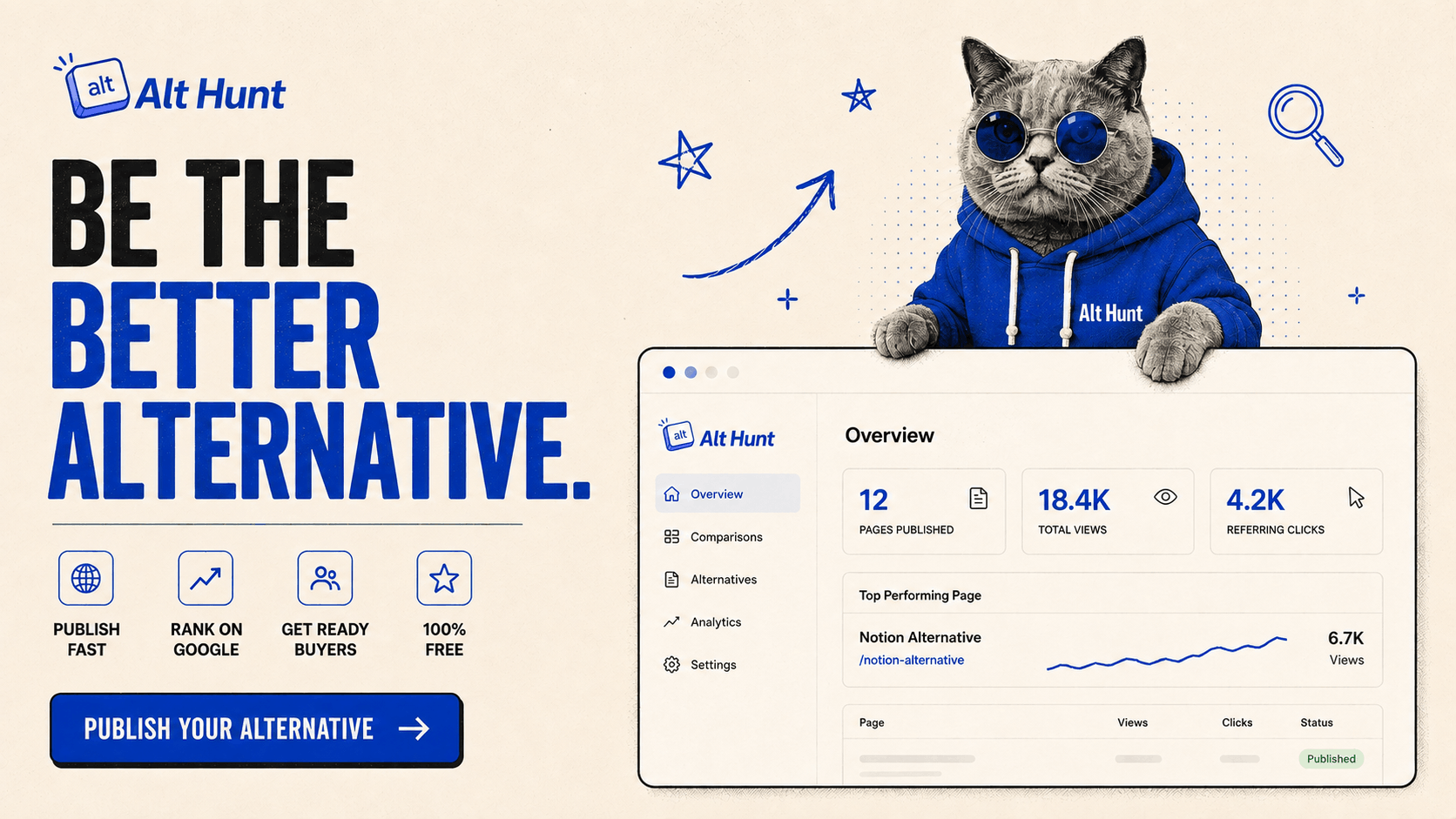
Most launch platforms added SEO language to their marketing. Alt Hunt was designed around this one mechanism from the start, and the design decisions follow from it.
The page outlives the launch. Your comparison keeps a permanent URL at `althunt.io/compare/your-slug`. When the week closes, the page does not move, expire, or get archived. It carries on accumulating search history.
Weekly rounds instead of a bottomless feed. Each week runs Monday to Sunday. Submit by the end of Wednesday to join the week already running; after that your page is scheduled for the following Monday so it gets a full seven days rather than a partial one. A finite weekly board means a new product is competing against that week's entrants, not against everything ever posted.
Free to publish, no subscription. The free tier is $0 forever and includes one comparison page per product, with AI-assisted drafting to get the first version written. There is no card required to launch. The optional Pro upgrade is a one-time $49, not a recurring charge, and covers up to ten pages plus translations into five European languages.
No code. The page is built in a browser. No hosting, no deployment, no SEO plugin, no developer.
Built for AI answers, not just blue links. Increasingly, buyers ask ChatGPT or Perplexity "what is a good alternative to X" and never see a results page. Alt Hunt pages are structured so those engines can quote them directly, which is a different discipline from traditional SEO and is becoming the more important one.
Accuracy is enforced. Any competitor named on a page can submit a correction, and directory-wide rules prohibit disparagement. This is not just fairness. A page that survives scrutiny from the company it compares against is a page search engines can trust.
How to do this in an afternoon
Pick the right competitor. Not the biggest name in your category. The one your actual customers are switching from. If you have spoken to ten users, you already know which name keeps coming up.
Check the search exists. Search ` alternatives` yourself. If there are results, roundups, and Reddit threads, the demand is real.
Be specific about who should switch. "Better than X" persuades nobody. "Better than X if you are a team under ten people who never used the enterprise permissions" persuades exactly the person it describes.
Write the objection section honestly. Name the cases where they should stay. This is the section that makes the rest credible.
Publish and launch it. Submit by Wednesday to join the running week.
Then leave it alone. The most common mistake is treating this like a launch and checking it daily for a week. Comparison pages take weeks to months to settle into position. Revisit in ninety days, update the pricing if it moved, and let it work.
What to expect, honestly
Two things worth setting expectations on, because overpromising here helps nobody.
This is slower than a launch day. A comparison page will not spike. It builds gradually and unevenly. If you need traffic this week, this is not the lever.
Volume is lower and quality is far higher. A search for ` alternatives` will never match Product Hunt's launch-day pageviews. But the person running that search has budget, understands the category, and is actively looking to leave a product. Compare the two on conversion rate rather than raw traffic and the picture inverts.
The strategy in one line
Launch on Product Hunt for the spike. Publish an alternative page for the slope. Do both, and one launch produces attention and an asset that is still working next year.
The founders who compound are not the ones who launch more often. They are the ones whose launches leave something behind.
---
Ready to publish yours? Create a free alternative page on Alt Hunt. No card, no subscription, no code, and the page is yours permanently.
Frequently asked questions
Is Alt Hunt free? Yes. The free tier is $0 forever and includes one comparison page per product with AI-assisted drafting. No credit card is needed to publish or launch.
Does Alt Hunt have a subscription? No. There is no recurring billing. The optional Pro upgrade is a one-time $49 payment covering up to ten pages and translations into five European languages.
Do I need to know how to code? No. Pages are written in a browser editor with AI-assisted drafts. No hosting, deployment, or plugins.
Should I stop launching on Product Hunt? No. Use it for what it is genuinely best at: awareness, credibility, and concentrated feedback on launch day. Add an alternative page for the traffic that arrives every month afterwards.
How long until a comparison page ranks? Expect weeks to months, not days. Comparison pages compete on relevance and completeness rather than freshness, so they settle in gradually and then hold.
What if my competitor objects to the comparison? Any named competitor can submit a correction through the page itself, and directory rules prohibit disparagement. Accurate, fair comparison is both permitted and expected; misrepresentation is not.
When does my page go live? Weeks run Monday to Sunday. Submit by the end of Wednesday to join the week in progress. Submit later and your page is scheduled for the following Monday so it gets a full seven days on the board.
About the Author

Building Inspo AI | AI-Powered Design Research & Builder Platform | Design Engineer.